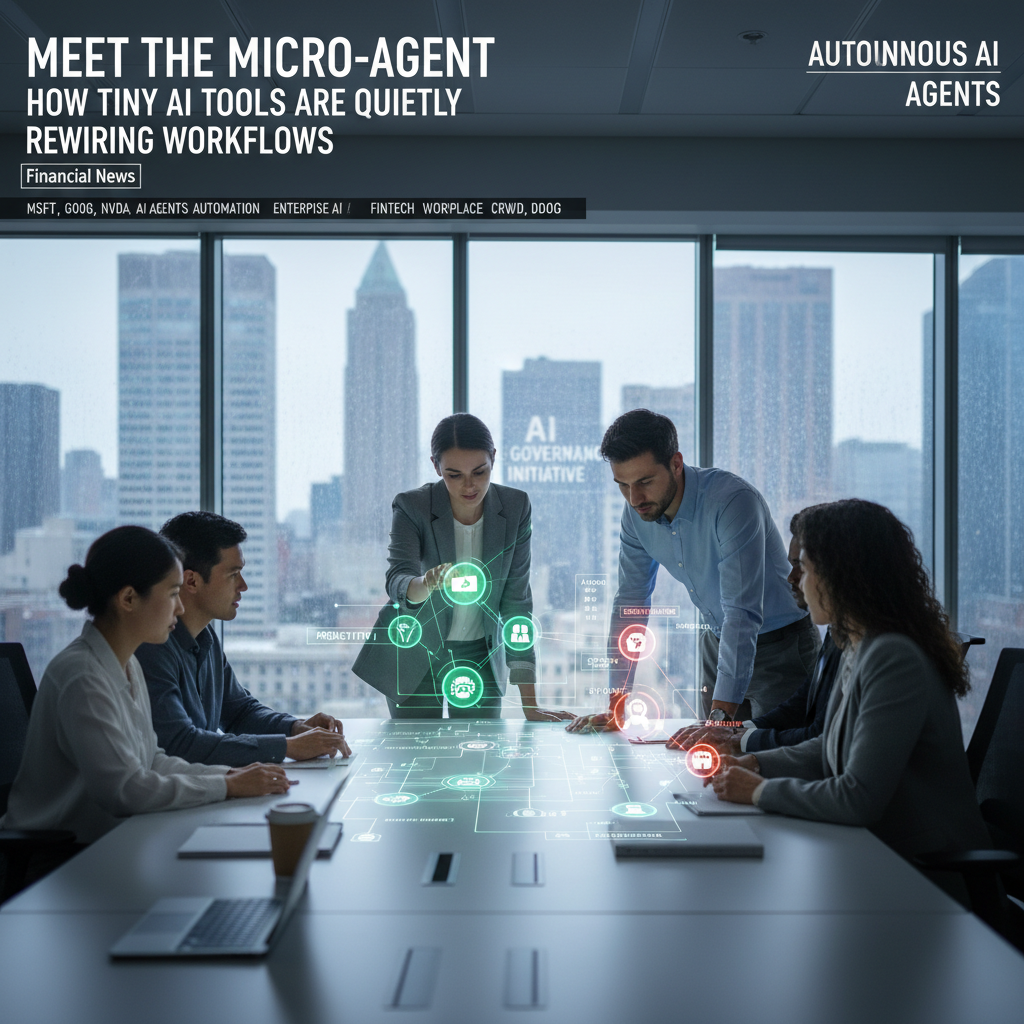
The idea is simple: instead of one massive generative model trying to answer everything, companies are stitching together many tiny, focused AI agents — each one built for a single job: triage email, summarize an earnings call, scrape a filing, or untangle calendar conflicts.
It echoes past automation cycles. Remember macros and VBA, or the RPA spike in the 2010s? Big promises, brittle builds, governance headaches. Micro-agents are not the same — the models and connectors today are far more capable — but that very capability introduces new fragility.
Why this moment?
- Mature LLM APIs and much cheaper inference make small, private agents affordable.
- A richer set of connectors — APIs, webhooks, low-code platforms — lets teams chain actions without rebuilding integrations from scratch.
- Open agent frameworks and orchestration toolkits let developers encode intent, constraints, and fallbacks quickly.
For the US market, and finance in particular, adoption is moving fast. Investment desks want quicker idea flow, compliance teams need near-real-time signals, and service desks want consistent answers. So pilots are popping up on buy-side desks, wealth platforms, and fintechs.
Concrete use cases already running
- Email and calendar helpers that triage requests, draft replies, and suggest meeting times while obeying policy rules.
- Due-diligence micro-agents that compress SEC filings, flag shifts in management tone, and surface red flags for analysts.
- Reconciliation bots that pre-check invoices and call out anomalies before a human steps in.
Real benefits — and real risks
The upside is obvious: routine work speeds up, manual errors fall, and specialized skills can be encoded at scale (think of a compliance reviewer implemented as code). But this is not just productivity lipstick. Micro-agents change who does what: people move from doing tasks to supervising agents, which amplifies both wins and mistakes.
Watch these failure modes closely
- Operational risk: agents hallucinate or misread domain-specific tokens — a ticker, a contract clause — and that error cascades.
- Security and data leakage: agents need access to sensitive stores and external APIs. Misconfigured scopes are attack surfaces.
- Regulatory exposure: auditors will demand logs, model lineage, and evidence of human oversight. Regulators in finance have already begun probing automated decisioning.
A short, pragmatic playbook
- Treat micro-agents like any other production software: version, test, roll back, and monitor. Observability matters as much as model choice.
- Apply least-privilege to connectors and rotate credentials automatically.
- Keep humans in the loop for edge cases and for any decision with legal or compliance implications.
- Record model and prompt provenance: which model, which prompt, and which data sources produced a given output.
Who wins, who pays
Vendors offering secure connectors, governance consoles, and observability tooling will do well. That makes incumbent enterprise partners appealing to CIOs. There will also be a murky middle: startups with clever vertical agents either get snapped up or burn cash trying to meet enterprise-grade security.
Employees experience this unevenly. Junior analysts lose routine tasks first; senior roles that require judgment, negotiation, or oversight gain leverage. How companies handle redeployment matters. Firms that retrain and shift people into higher-value work will keep morale. Those that only cut costs will see churn.
A quick historical aside: automation tends to run ahead of governance. Spreadsheets caused obscure financial mishaps; RPA produced fragile processes. Micro-agents promise efficiency but also create systemic blind spots if ignored.
For operators and investors, the near-term bet is less about a single agent platform and more about ecosystems: orchestration layers, security middleware, and observability tooling. Those are the building blocks enterprises will install once they move past pilots.
One last point: micro-agents are not a headline-grabbing singularity. They are plumbing — quiet, pervasive, and capable of changing how work actually gets done. The teams that pair domain expertise with disciplined engineering and governance will reap the benefits. Everyone else will be rearranging org charts.