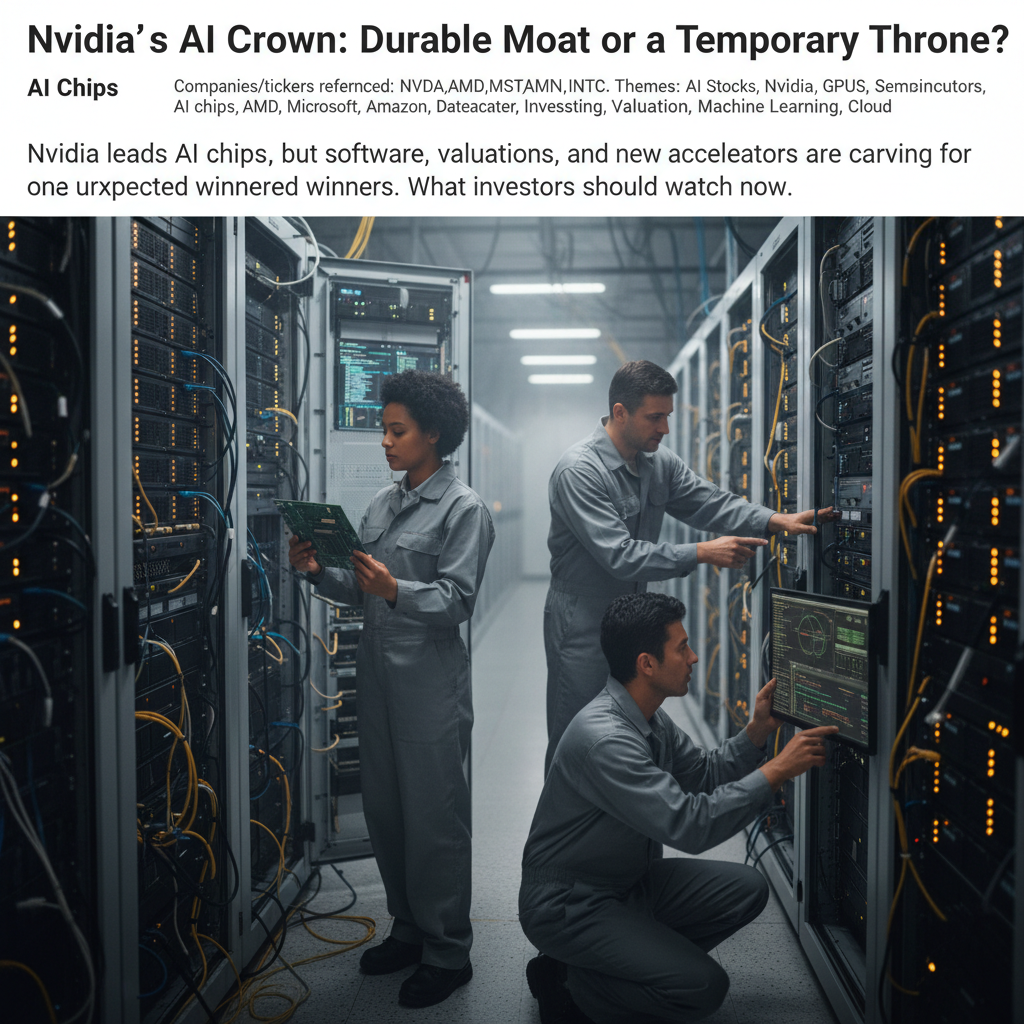
Nvidia is no longer just a chipmaker — for many investors, NVDA now reads as shorthand for the AI boom. That shorthand is convenient. It also hides strains that matter if you’re buying at headline multiples.
Why the market crowned Nvidia
- GPUs are proven workhorses for large-model training. That made Nvidia the default choice for hyperscalers and cloud vendors.
- CUDA created real software stickiness. Once teams build models and tooling on that stack, switching is costly.
Those two facts explain the market cap and the rush of capital. But a moat built from silicon plus a proprietary SDK is not guaranteed forever.
The forces pushing back
- Purpose-built accelerators are closing the gap. Google TPU, AWS Trainium and Inferentia, Cerebras, Graphcore and Intel/Habana chips hit parts of the AI pipeline with better performance per dollar for specific workloads.
- Portability standards like ONNX and higher-level MLOps layers make CUDA less exclusive. Hardware choices are increasingly about cost curves, integration, and partnerships.
- Price pressure and margin normalization. As more silicon lands in datacenters, competition will shift from scarcity of features to ruthless performance economics.
Think of it as the CPU-to-GPU transition stretched into many smaller battles: some tasks will stay on general-purpose GPUs, others will move to bespoke accelerators. The likely winners? Companies that either own the software layer or can command supply-chain economics — though there will be exceptions.
What history says
Big shifts in compute rarely end with one sole winner. Mainframes gave way to minicomputers, then to x86 servers, and now to a heterogeneous datacenter. Each phase created consolidators and niche players that either stayed profitable or became acquisition targets.
Signals investors should watch
- Software ecosystem health, not only chip specs. Deep developer tools and optimizations buy you pricing power.
- Cloud deployments and design wins. When a hyperscaler adopts custom silicon at scale, it reshapes the addressable market for general GPUs.
- Foundry access. Advanced nodes are quarried by TSMC and Samsung; capacity and yield directly affect gross margins.
- Margin and guidance trends. As competitors carve out price-sensitive segments, margin trajectories will tell you who’s actually insulated.
Names worth keeping an eye on
- NVDA: Still ahead on software and scale, but priced for near-perfect execution. Its fortunes track model-training demand, so expect volatility.
- AMD: Competing on price-performance in GPUs and pairing those with EPYC server CPUs to offer integrated datacenter stacks.
- MSFT: An indirect play via its OpenAI relationship and Azure’s push into custom silicon.
- AMZN: AWS is building custom chips focused on inference efficiency — that’s a major battleground for cost-sensitive workloads.
Each company represents a different bet: platform dominance, price competition, cloud integration, or bespoke hardware strategy.
A practical investor stance
Think optionality. Own the dominant platform, but also hold positions that target the more price-sensitive parts of the market. Datacenters themselves hedge with a few general-purpose GPUs plus a basket of accelerators. That approach maps to how the economics are likely to play out.
Nvidia’s crown still matters. Crowns are heavy, though. Watch software portability, cloud design wins, and foundry dynamics more than the headlines. Those variables will separate fleeting market leadership from durable value.
Pedro Marini