S&P 5005,842.10 0.42%
NASDAQ19,210.55 0.88%
NVDA1,184.22 2.41%
MSFT478.90 0.88%
GOOGL210.11 1.12%
META612.50 0.34%
AAPL239.80 0.21%
AMZN248.66 1.40%
AVGO1,902.40 3.12%
TSLA298.10 1.05%
BTC98,420 1.88%
ETH4,210 2.24%
10Y4.18% 0.02%
DXY104.12 0.18%
S&P 5005,842.10 0.42%
NASDAQ19,210.55 0.88%
NVDA1,184.22 2.41%
MSFT478.90 0.88%
GOOGL210.11 1.12%
META612.50 0.34%
AAPL239.80 0.21%
AMZN248.66 1.40%
AVGO1,902.40 3.12%
TSLA298.10 1.05%
BTC98,420 1.88%
ETH4,210 2.24%
10Y4.18% 0.02%
DXY104.12 0.18%
Back to homepage
On-Device AI

Offline Genius: Why On-Device AI Is the Next Big Shift in Tech

From faster replies to real privacy wins — how local LLMs and new NPUs are remaking phones, apps, and business models
P
Pedro Marini
June 10, 2026 · 3 min read
Offline Genius: Why On-Device AI Is the Next Big Shift in Tech

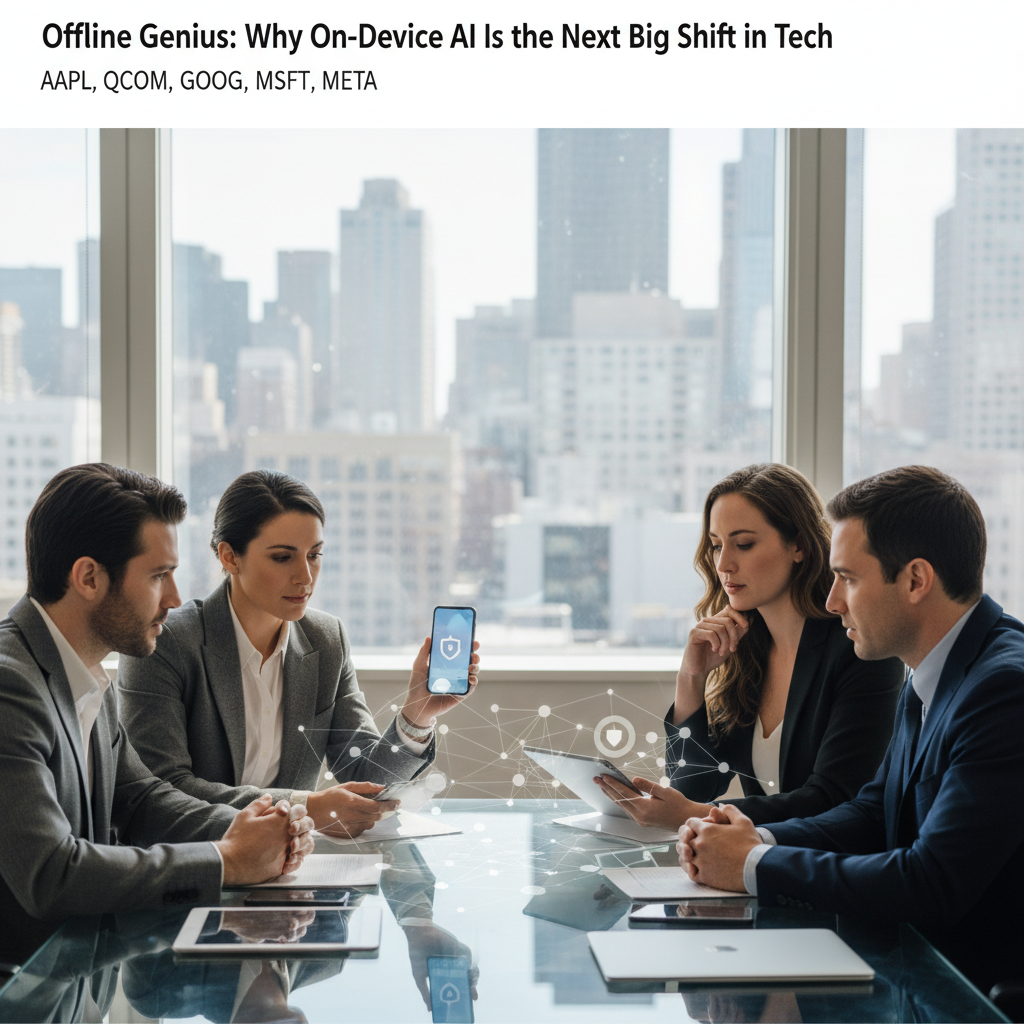
Illustration by IMF Alpha editorial · Reviewed by Pedro Marini

Listen to this article
AI narration · ~3 min
Tickers mentioned
AAPL+1.20%QCOM-0.50%GOOG+0.80%MSFT+0.30%META-1.10%

On-device AI isn't a niche experiment anymore — it's quietly becoming the default way we get everyday intelligence. After a decade where the cloud handled most of the heavy lifting for search, chat and analytics, teams and chip designers are shifting many workloads back onto phones and laptops. The payoff: snappier responses, fewer privacy headaches, and a fresh scramble over who actually controls the user experience.

A short history with long consequences. In the 2010s we moved work to the cloud because servers were cheaper and models were enormous. By the early 2020s model size blew up and latency stopped being just an annoyance — it started to hit the business. Now two things are converging: dedicated NPUs in consumer devices, and smarter model engineering — quantization, pruning and distilled LLMs — that make capable generative models small enough to run locally.

Why it matters right now

  • Privacy-as-a-feature. Run a model on your device and private messages, health notes and drafts don’t have to leave the handset. This is not mere compliance theater; many users will pay for that level of control.
  • Speed you can feel. Local inference slices out round trips. For quick, interactive tasks — summarizing an email, drafting a short reply, generating a caption — the difference is obvious.
  • Offline usefulness. Bad airplane Wi-Fi doesn’t break a local assistant. That matters for field workers, travelers, anyone who needs tools that behave when the network doesn't.

That said, this is not a mass exodus from the cloud. The cloud still does the heavy work: training new models, hosting the largest LLMs, and keeping things in sync across devices. Expect a hybrid pattern: local inference for day-to-day interactions, cloud for scale and freshness.

What changed on the hardware and software side

  • Consumer phones and laptops are shipping with NPUs tuned for matrix math. That’s the difference between painfully emulating inference and running it efficiently.
  • Toolchains have improved. Smaller, quantized models and runtime frameworks mean developers can ship local models without draining batteries or blowing memory budgets.

Concrete things you’ll notice this year

  • Summaries and redactors that keep sensitive text on-device but still approach enterprise-quality accuracy.
  • Instant photo edits and style transfers done entirely locally — no upload required.
  • Voice assistants that parse commands offline and only send minimal metadata upstream when needed.

Winners, losers and the business question

  • Companies that control the whole stack — silicon, OS, apps — gain a real strategic edge. They can own the default assistant and shape how it gets monetized.
  • Ad-driven platforms have reason to push back. Local models reduce the signals used for targeted ads, and that creates friction between app developers and platform owners.
  • Startups that can ship compact, useful models quickly will be hot targets. They integrate into device ecosystems faster than firms built around massive cloud stacks.

Risks and practical limits

  • Battery and thermals still bite. Expect trade-offs: smaller context windows, occasional cloud fallbacks, or hybrid inference where only the last mile runs locally.
  • Freshness and hallucinations are harder to solve on-device. A persistent tiny model is cheap to run, but keeping its facts up to date without constant cloud updates is tricky.
  • Fragmentation is real. Not every phone will run the same model; developers will be optimizing for a moving target.

What to watch if you’re building or investing

  • Hardware cycles. The inflection comes when mainstream, low-cost phones get capable NPUs. That’s when adoption really accelerates.
  • Developer tooling and runtimes. Frameworks that make compression and deployment straightforward will create the strongest developer flywheels.
  • Monetization plays. Privacy-first features, paid offline assistants, and enterprise bundles look interesting from an investment angle.

A human note: this reminds me of the shift from mainframes to personal computers. Centralized power seemed inevitable until smaller machines reclaimed utility by offering immediacy and control. On-device AI is a similar swing — but with the cloud still in the picture.

Expect a messy transition. For users it will appear as a set of incremental improvements — faster replies in messaging, better photo edits, assistants that keep working when service drops. For companies it’s a fork in the road: double down on cloud scale or invest to own the device-level experience. Either way, AI is about to get personal again — literally.

Advertisement
Continue reading

Related coverage

The IMF Brief · Daily Newsletter

The AI economy, decoded before the open.

Five minutes. One email. The signal cutting through the noise at the intersection of artificial intelligence and Wall Street. Free, forever.

Join 184,000+ readers · No spam · Unsubscribe anytime