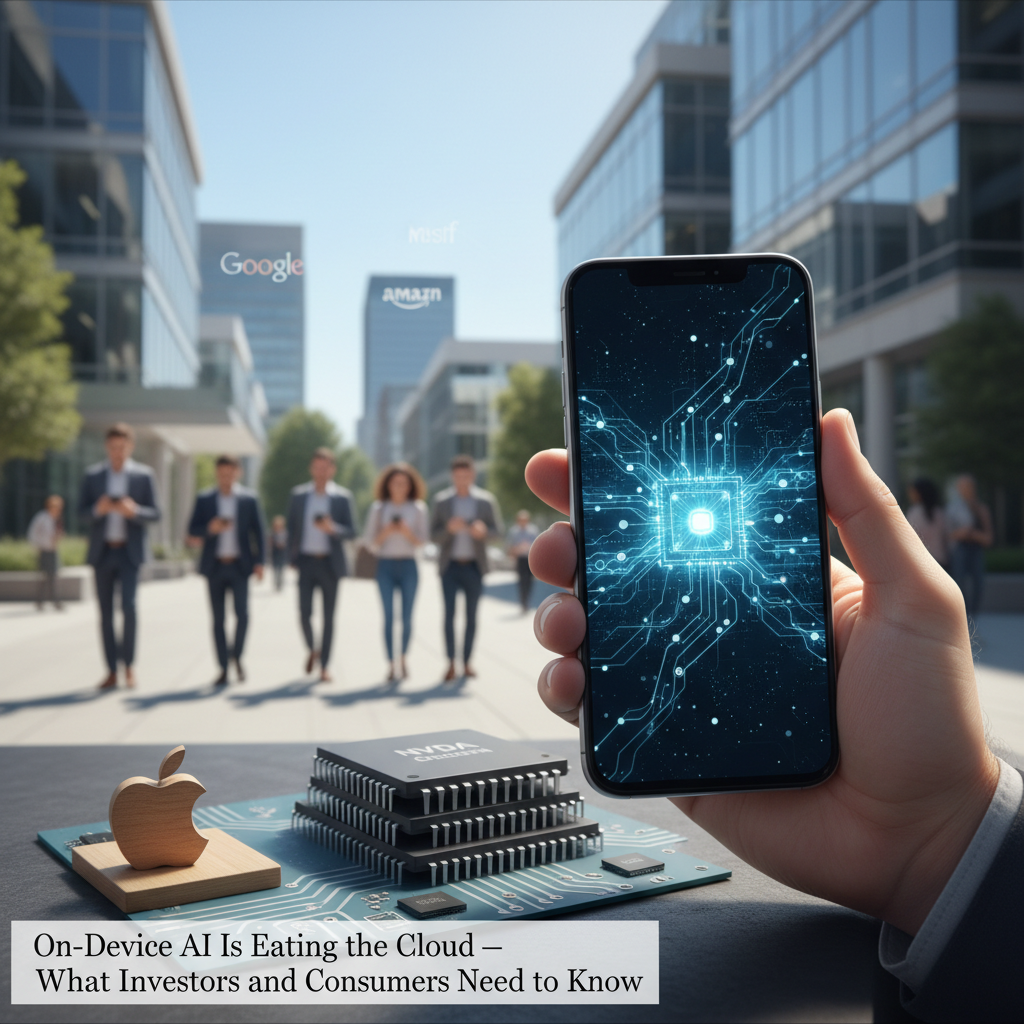
The soft handoff from cloud to silicon is underway — and it matters more than most earnings calls do.
Lately the industry has quietly focused on running smarter models on phones, tablets, and laptops. It’s not glamorous, but it changes the user experience, nudges privacy and regulation in a different direction, and slowly shifts value away from sprawling data centers toward device makers and chip designers.
Why this feels like a structural shift
- Latency and UX. Instant suggestions and snappier voice assistants stop feeling like demos when inference happens on-device. A few seconds saved is surprisingly meaningful.
- Privacy and regulation. Local models dodge a lot of thorny cross-border data-transfer headaches regulators are starting to care about. That gives device companies an operational edge in sensitive markets.
- Unit economics. If you’re burning GPU hours in the cloud, even a modest move to on-device inference trims costs. For OEMs and chip vendors, it opens new revenue paths.
A quick history lesson, with an example
This is not new in principle. Think about computational photography — phones used to upload raw images to servers and now do most of the heavy lifting locally. On-device AI is the same impulse applied to model inference: compact, distilled models that do a lot when paired with the right silicon. What’s interesting is how much better those smaller models get when the hardware and software are designed together.
Winners, losers, and the messy middle
- Likely winners: chip designers and device makers that can marry silicon, system software, and developer tools. Companies that control both hardware and the OS integration will have an advantage.
- Cloud incumbents: still indispensable for training and for very large models. Expect them to push hybrid offerings and incentives to keep developers on their platforms.
- The software layer: startups focused on model compression, quantization, and secure on-device orchestration look like a sensible bet over the long haul.
- The messy middle: enterprises with legacy stacks and thermal-constrained devices. They’ll move more slowly and patch together hybrid solutions.
Investor signals worth watching
- Patent filings and SDK rollouts mentioning on-device inference formats and runtimes. Those are telling.
- Partnerships that bind model providers to handset makers or chipset firms. Real tie-ups beat glossy demos.
- Cloud GPU utilization trends. Even a small dip in inference workloads could hit cloud margins harder than people expect.
Not a cure-all — some real limits
On-device AI does not replace large foundation models for training, nor does it solve every inference problem. Battery life, thermal budgets, and model freshness are genuine constraints. For big, multimodal tasks you’ll still need datacenter muscle. And economics vary: consumer apps will likely push devices first; enterprise adoption is slower and messier.
What this means for users and businesses
- Users should expect richer offline assistants and more privacy-forward apps.
- Businesses can see incremental cost savings if they successfully shift heavy inference to the edge, but that requires engineering work and supply-chain alignment.
- For investors, it’s a slow rotation: device- and silicon-focused winners emerge over years, while cloud providers remain cash generative for training and high-end inference.
A short, practical checklist
- Watch chip and OS announcements that call out ML runtimes and model formats.
- Track concrete partnerships between model labs and handset or chipset makers — those deals matter more than benchmark numbers.
- Keep an eye on cloud provider margins and GPU utilization, but don’t assume immediate upheaval.
This is a multi-year rebalancing, not a sudden rupture. The bigger question isn’t only whether models run locally; it’s who owns the end-to-end stack — hardware, system software, and the developer ecosystem that actually puts private, useful intelligence into people’s pockets.