Why this matters now
Smartphone chips plus compact language models have quietly passed an inflection point: tasks that once needed racks of cloud GPUs can now run on-device, with usable speed and reasonable accuracy. That shifts the economics of AI, alters the balance between cloud providers and handset makers, and changes who actually holds your personal data.
How we got here — a short history with a point
Three forces converged in the past five years.
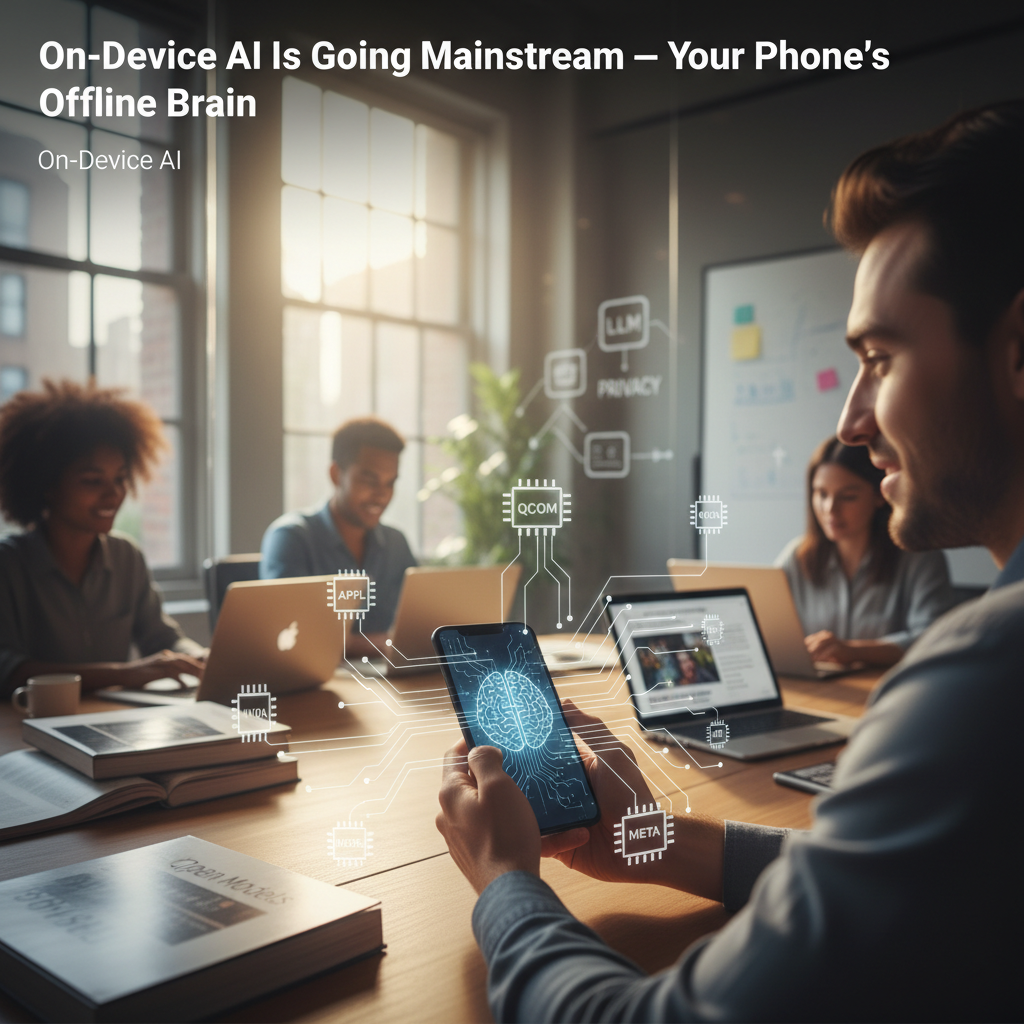
- Hardware: mobile neural engines and Apple/ARM-class performance narrowed the gap on inference workloads.
- Software: leaner model architectures and pruning techniques made LLMs small enough to fit in a phone.
- Licensing: more permissive weights and open models gave startups the legal room to ship local experiences.
It’s a bit like the MP3 moment for music — once devices could store and render high-quality audio, the industry reconfigured itself. On-device AI is that same kind of pivot for intelligence, albeit messier and more gradual.
What real apps look like today
- Offline summarization of messages and documents so sensitive content never leaves your device.
- Local translation and captioning with sub-second latency for calls and videos.
- Personal assistants that index your photos, notes, and calendar without syncing everything to a server.
These aren’t lab demos. Consumers are encountering them in betas and some shipping OS features. What’s changed is scale: chipmakers, OS vendors, and independent model teams are all rolling out tools that make on-device intelligence practical.
Winners, losers, and the gray area
- Winners: device makers and chip vendors who can sell privacy and battery-friendly AI; startups that get local-first UX right.
- Losers: some cloud-only incumbents that depend on per-call inference margins; businesses built around centralizing raw user data.
- Gray area: ad-supported apps and services that need aggregated telemetry — they’ll pursue hybrid setups and new incentive designs.
Expect messy competition. Some players will double down on cloud compute; others will claim privacy wins while still nudging data into the cloud when convenient.
Limits and trade-offs
On-device models trade raw capability for practical utility. A few predictable constraints:
- Smaller models hallucinate more and offer less nuanced reasoning than the largest cloud LLMs.
- Fragmentation across chipsets and OS versions complicates development and testing.
- Patching, updates, and safety controls are harder when models live on millions of devices.
These are solvable, but they slow adoption and push the heaviest workloads back to the cloud.
What this means for privacy and regulation
Running models locally strengthens privacy narratives, but it isn’t a cure-all. Metadata, app behaviors, and optional cloud syncing create loopholes. Regulators will need to focus less on the binary question of whether data leaves the device and more on how companies obtain consent, surface trade-offs, and govern telemetry.
Investor and product implications
- Expect more capital to flow toward chipmakers and silicon IP firms, not just into cloud GPU vendors.
- App teams that master incremental on-device features — fast, private, and low-power — will outcompete cloud-first rivals that pile on features at the cost of latency and battery life.
That’s where product differentiation will show up, pragmatically and commercially.
The upshot: on-device AI won’t replace the cloud overnight, but it will change where value gets captured. For users it promises speed and greater privacy; for companies it opens new monetization paths and new engineering headaches. The smart bets are hybrid architectures that use the device for personal, low-latency tasks and the cloud for heavy lifting.
Quick takeaways
- On-device AI makes everyday assistants faster and, in many cases, more private.
- Hardware advances and open models are the twin enablers.
- Real trade-offs remain in model quality, safety, and developer fragmentation.
If you care about privacy, battery life, or how apps will make money next, this is the shift to watch.