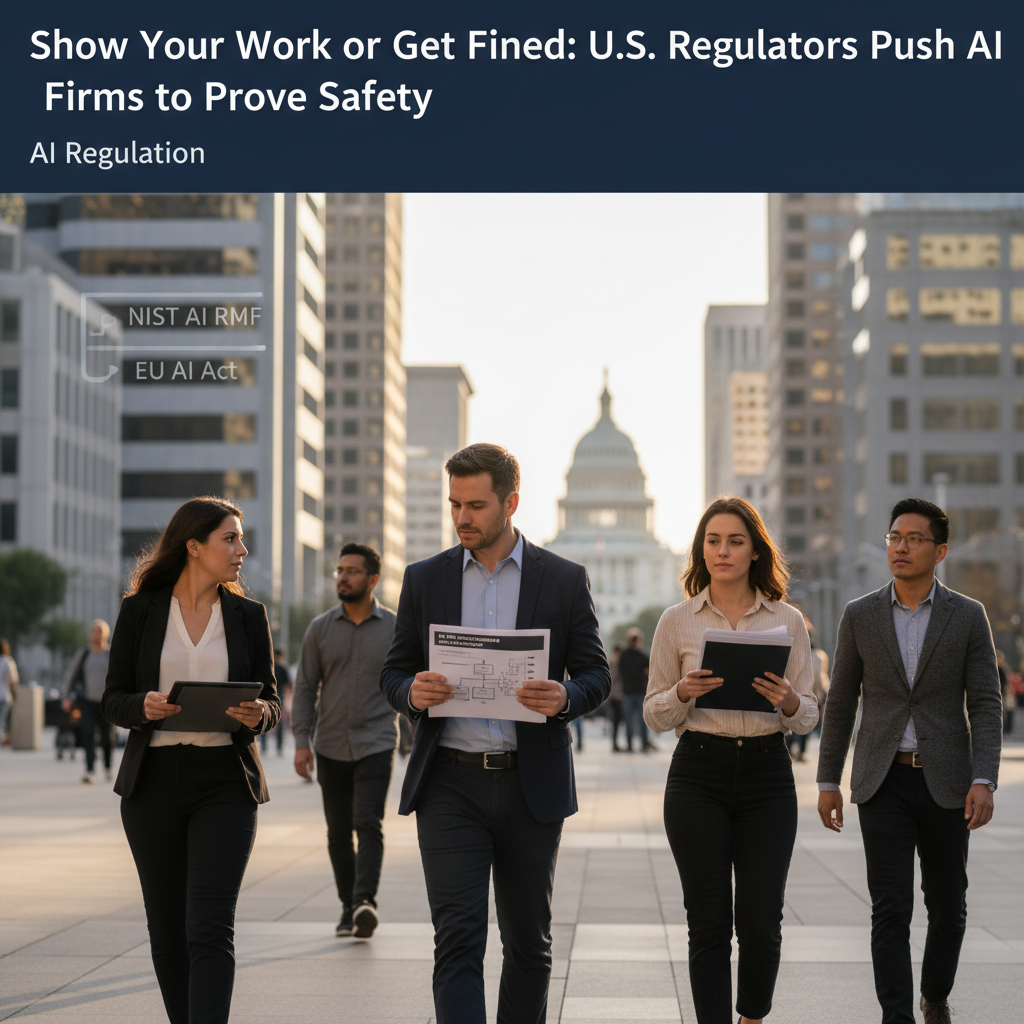
Regulators are moving from guidance to enforcement
For months the tone of AI policy in the U.S. sounded like polite traffic control — suggestions, voluntary frameworks, lab notes from academics. That is shifting. Federal agencies, prodded by state-level experiments and overseas rules, are moving toward mandatory tests, documentation, and penalties when models cause real harm.
This is not about strangling innovation; it's about wiring accountability into systems. Think of the post-2008 financial rules that forced banks to rewrite risk models almost overnight. I don't mean to overstretch the analogy, but AI is approaching a similar inflection: engineering choices will increasingly be driven as much by compliance workflows as by marginal gains in model accuracy.
Why now
- High-profile harms have made the costs obvious — manipulated media, discriminatory hiring algorithms, and other visible failures that turned into political pressure.
- International pressure matters. The EU AI Act and updated NIST guidance are creating a de facto baseline that U.S. regulators find hard to ignore.
- Regulators have teeth. Agencies like the FTC, NIST, and state attorneys general are signaling a shift from advisory notes to enforcement actions.
What regulators are starting to demand
- Impact assessments showing how models affect consumers and protected groups.
- Data provenance and governance proving training data was sourced and handled responsibly.
- Clear documentation on performance, limitations, and mitigation strategies.
How big tech will respond
They are not going to fold. Expect larger firms to bake these requirements into product lifecycles.
- AI safety groups will gain budget and clout — a rise similar to what security and privacy teams experienced over the last decade.
- Startups will feel the squeeze. Compliance costs plus exposure to legal action could raise the bar to compete, or push consolidation; some early-stage teams may pivot to compliance-first offerings.
Market effects
What’s interesting here is how advantage shifts. Companies with deep engineering and compliance resources stand to benefit. Watch Microsoft (MSFT), Alphabet (GOOGL), Meta (META), Nvidia (NVDA), and Amazon (AMZN). Firms that can demonstrate provenance and run credible audits quickly will pick up trust — and business.
Counterpoints and trade-offs
There are real trade-offs. Forcing disclosure about training data provenance could help regulators but also erode competitive advantage. Civil-rights groups say disclosure alone won't cut it — they want independent audits and real enforcement. Industry warns that heavy-handed rules might simply move investment to jurisdictions with lighter-touch regimes. None of these objections is trivial.
A pragmatic path forward
- Tier obligations by risk. High-stakes domains — health, hiring, credit — should face mandatory audits and external review.
- Standardize reporting so regulators can compare models without demanding every low-level detail.
- Encourage third-party audits and certifications to create market signals for safety.
What this means now
Regulatory readiness should be treated as part of product design, not an afterthought. For investors and product teams: assume compliance is a cost of doing business and plan accordingly. For lawmakers: the real work is fine-grained rulemaking that protects people without needlessly driving innovation overseas.
Regulation will be messy and incremental. Still, a few years from now we may well look back and see this as when governance finally began catching up to the code.