The premise
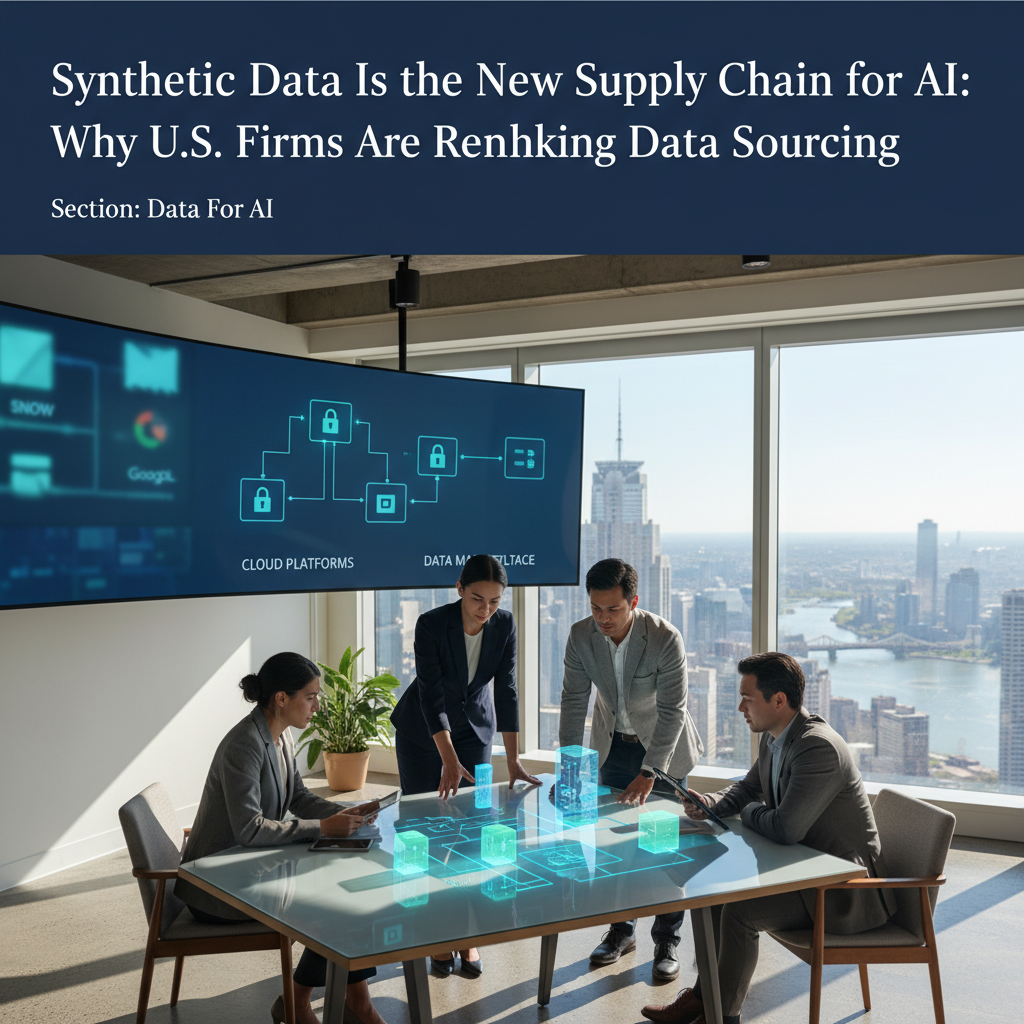
Synthetic and privacy-first data are moving out of the lab and into the core stack as companies race to feed generative models without running afoul of regulators or exposing customers. This is not hype hunting a use case; it’s structural work—rebuilding the data supply chain so models can be fed reliably and legally.
Why now
- Model appetite has ballooned. Modern LLMs and multimodal systems demand far more labeled examples and rare edge cases than the old rule-based world.
- Regulation is tightening. State and federal authorities are making casual data sharing riskier and more expensive.
- Cloud providers and marketplaces are adding governance-aware tooling, which lowers the friction for buying and using datasets.
What companies are building
- Clean rooms that let multiple parties run joint computations without sharing raw records.
- Synthetic generators that reproduce statistical behavior of real data while stripping identifiable details.
- Marketplaces that carry metadata, lineage, and usage restrictions with each asset so buyers know what they’re actually getting.
Who benefits and who pays
Big cloud platforms and specialist vendors win when enterprises buy well-governed data plumbing. Expect Snowflake-style marketplaces and clouds that embed privacy features to capture recurring dollars. Startups that can prove vertical accuracy and domain realism—think finance, healthcare, automotive—will be able to command premium pricing.
A quick reality check
Synthetic data is useful, but it is not a cure-all. Rare edge cases matter the most for fraud detection, safety, and compliance, and synthetic sets can miss them. A few pilots that swapped out real data entirely found surprising blind spots when models hit production traffic. That’s why many teams are settling on a hybrid approach: synthetic to augment, not wholly replace, curated records.
Regulatory and reputational risks
- Regulators look at harm, not technical labels. A dataset that’s labeled synthetic but still encodes biased patterns will draw scrutiny.
- Provenance matters. Firms that can show consent metadata, lineage, and enforceable usage controls will sleep better during audits.
Market signal and money
Investors are pricing this shift. Platform companies that surface marketplaces and governance tools tend to get higher multiples because buyers see repeatable consumption. Expect M&A: incumbents buying specialists to add vertical fidelity and compliance features.
What CIOs and product leads should do now
- Start with high-value, low-risk pilots where synthetic data can quickly widen training sets.
- Demand provenance, schema contracts, and test suites that probe edge-case behavior.
- Budget for hybrid pipelines that mix real, synthetic, and curated third-party assets.
Editorial take
This feels like the early days of cloud storage and CDNs, when bespoke work gave way to shared infrastructure. Clean rooms and synthetic data are the plumbing that will make AI a dependable production practice. The real danger is complacency: treat these tools as a checkbox and you’ll bake in hidden biases and legal exposure. Success will show up not as flashy demos, but as quiet, auditable pipelines that survive regulatory and market stress.
Example snapshot
- A mid-sized insurer uses synthetic claims data to stress-test fraud models without exposing customer files.
- An autonomous vehicle startup buys curated corner cases instead of driving millions of miles to capture the same scenarios.
Where this goes next
Expect a wave of integration deals, clearer regulation, and pragmatic engineering patterns. Teams that master measurable fidelity, governance, and quality will turn synthetic data from a buzzword into a real competitive advantage.