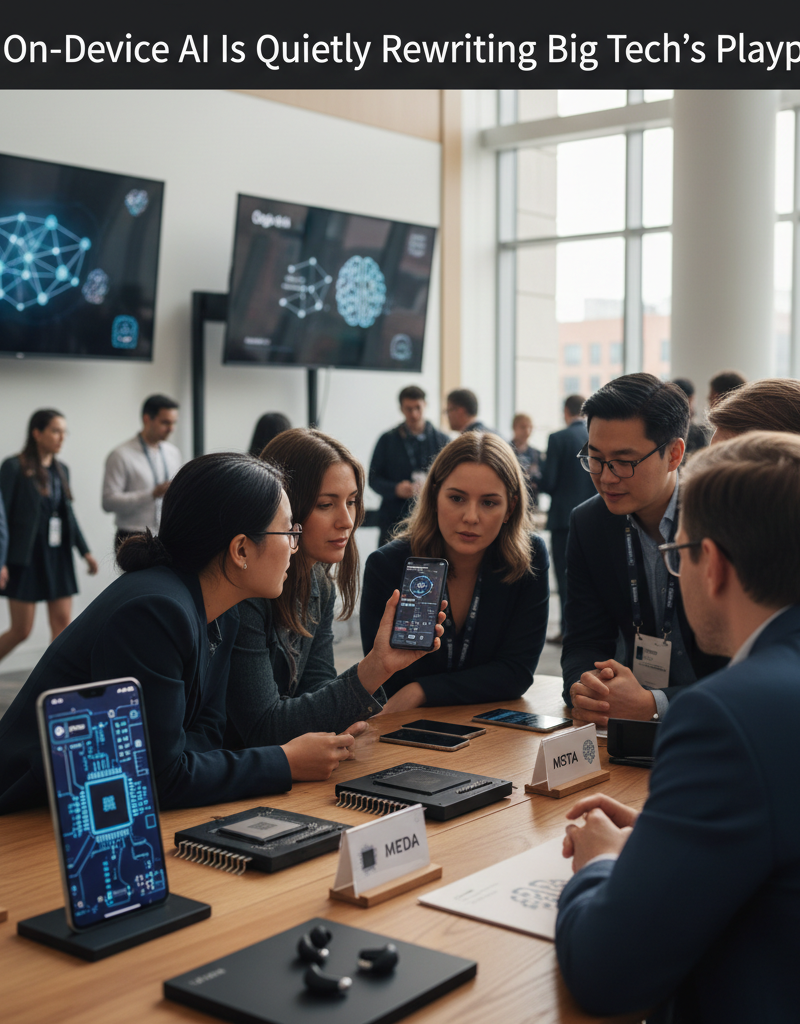
A quiet technical shift just got loud for users. Over the past year a few advances — more efficient model architectures, 3–4-bit quantization tricks, and much stronger mobile NPUs — have made it realistic to run meaningful large language models on the phones people already carry.
This is not a minor feature tweak. It feels like the moment native apps stopped treating AI as a distant cloud service and started shipping with actual brains on the device.
How this happened
- Researchers and startups pushed quantization past toy demos. With aggressive 4-bit and mixed-precision reductions, 7B and 13B models now run with acceptable latency on-device.
- Mobile neural engines from the usual suspects — Apple, Qualcomm and others — have lifted matrix-math throughput and memory bandwidth enough to make inference practical for many everyday tasks.
- Open weights and permissive licenses lowered the barrier to entry, so small teams can build useful assistants without a constant cloud GPU bill.
What’s interesting here is how these pieces fit together. Any one of them alone would be incremental; taken together they change what’s feasible on a phone.
Why users feel the difference
- Privacy. Drafts, banking helpers, health notes — these can be processed offline, keeping data off servers.
- Speed. Many tasks now return in sub-100ms; there’s no waiting on networks or cold-start cloud containers.
- Resilience. Functionality survives flaky connections and locked-down corporate networks.
What to watch in business terms
- Expect consumer cloud-inference revenue growth to slow. That doesn’t mean clouds vanish — they’ll refocus on training, orchestration and hybrid stacks.
- Hardware makers stand to gain. Margins will shift toward SoC partners who deliver higher on-device throughput and smarter memory use.
- App stores and platform owners gain more control. On-device models raise fresh questions about safety, content filtering and discoverability, which increases platform gatekeeping power.
A small aside: these platform dynamics often move faster than people expect. Policy and review mechanisms will become a battleground.
Concrete examples already appearing
- A note-taking app that runs summaries on-device, so medical or legal notes never leave the phone — an obvious compliance win for small clinics.
- A fintech startup giving private, real-time budgeting advice without transmitting transaction details.
- Indie language apps that produce high-quality translations mid-flight, no tether required.
Limits and caveats
- Not everything moves local. Large multi-modal models, heavy fine-tuning, and generative workloads with huge memory contexts still favor cloud GPUs.
- Battery and thermal limits are real. Running an LLM continuously will drain and throttle a phone; it’s not a plug-and-play replacement for all-day use.
- Security risks change shape rather than disappear. On-device models can be reverse engineered, and supply-chain or NPU-level attacks could become new vectors.
What investors and product teams should do
- Investors: rethink cloud-inference growth assumptions and look for winners among chip designers, mobile ML tooling, and startups offering hybrid orchestration.
- Product teams: build edge-optimized pipelines, quantify battery and latency trade-offs, and design for mixed architectures that gracefully fall back to cloud when needed.
On-device AI is less a single endpoint than a new axis for product thinking. It hands users more control, reshuffles distribution economics, and forces a rethink of where intelligence actually lives. The sensible bet is not that cloud AI dies; it’s that the experience war moves closer to the silicon in our pockets — where latency, privacy and context finally meet.
Quick take
Think of this as the smartphone moment for AI: the tech is mature enough that the most interesting user-facing innovations will cluster around offline, private, context-rich assistants, not only ever-larger models running on distant servers.