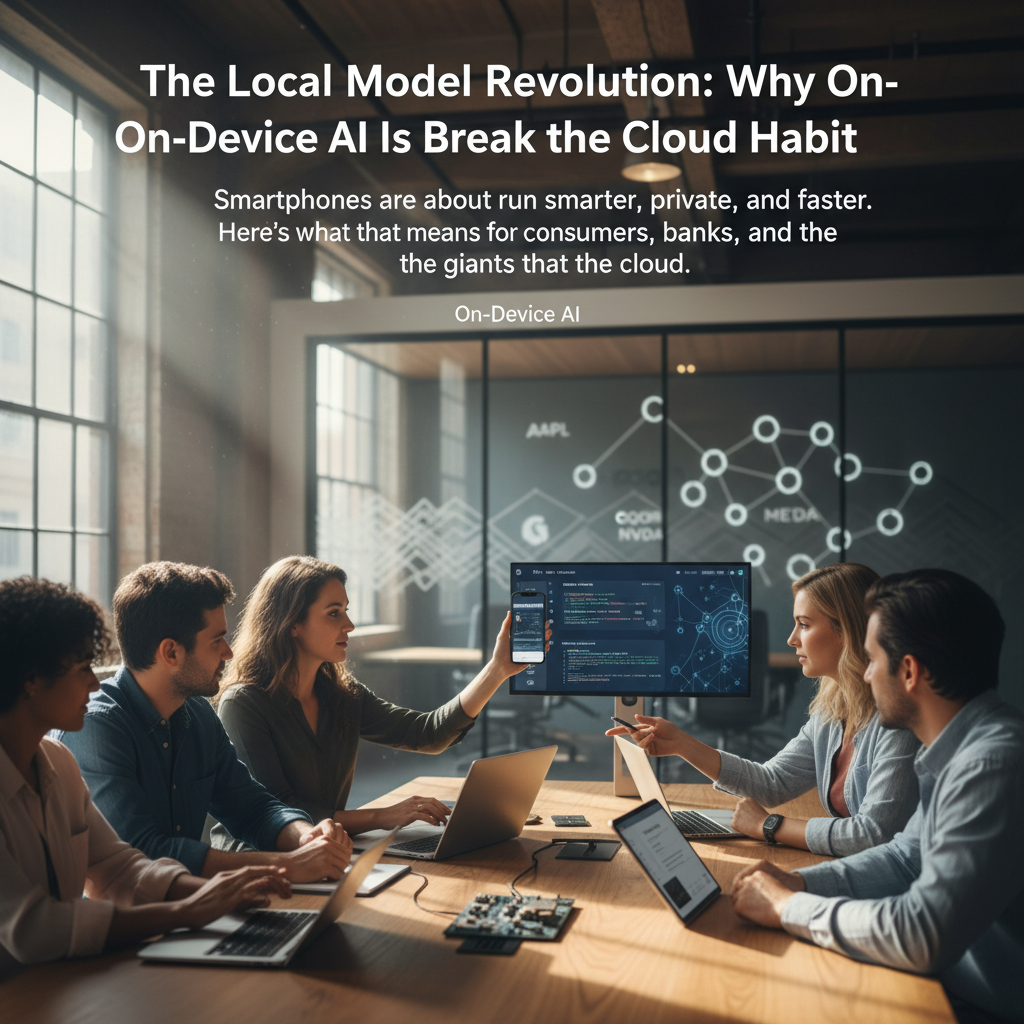
The smartphone as an independent AI workstation is no longer science fiction
Two years ago this would have sounded like a prediction for some distant future. Now, the combination of compact generative models, optimized runtimes and much stronger NPUs has reached a practical break point: genuinely useful AI that runs on phones and tablets without constant server trips. I mean useful in the sense that latency, privacy and cost start to look very different when inference happens locally.
This is not just a speed trick. It reshuffles the tradeoffs companies have relied on — latency, privacy, cost and control — and that reshuffling will be messy, uneven and create winners and losers you might not expect.
Why it matters now
- Hardware finally catches up with software: mobile neural engines and low-power accelerators can now execute several-billion-parameter inferences that once needed a data center.
- Open-source runtimes and quantization toolchains have turned porting models to phones from an experiment into routine engineering work.
- Users care more than before about where their data lives; running inference on-device removes a major friction point for privacy-sensitive cases.
Practical user changes
- Faster interactions. Real-time transcription, instant summarization and camera-based search stop feeling like cloud magic and start feeling immediate because requests no longer hop to the cloud.
- Offline reliability. Features that used to require connectivity now work on planes, in subways and in the field — useful for journalists, first responders and traveling executives.
- Privacy-first experiences. Apps can personalize without shipping raw text or audio into centralized logs, which shifts legal and reputational risk away from platform owners.
Who stands to gain — and who risks losing
- Winners: chipmakers and device makers with capable NPUs, engineers who adapt to local inference, and categories like mobile banking where latency and privacy are real differentiators.
- Risks: cloud vendors will feel margin pressure on high-volume inference. Incumbents that depend on server-side data capture for analytics may see slower feedback and weaker product signals.
A fintech lens
On-device models change the economics of mobile finance in specific, practical ways.
- Edge fraud detection can block suspicious behavior before it hits centralized systems, shaving minutes and reducing some regulatory headaches.
- Personal financial assistants running locally can analyze spending patterns and suggest actions without exposing transaction details to third parties.
- That said, compliance teams will need new audit strategies. Proving deterministic behavior and tracing model provenance for code that runs across millions of devices is harder than logging a single cloud inference.
Limits and counterpoints
- Capability versus footprint. Smaller local models trade some raw ability for size. Heavy-duty multi-turn reasoning and always-up-to-the-minute knowledge will often still require the cloud.
- Battery and thermal limits remain practical ceilings for sustained, heavy workloads.
- Distribution and updates. Keeping thousands of device variants patched and aligned is operationally tougher than updating a central service.
In practice, though, the story is messier: some uses move fully local, some split work between device and server, and some stay server-first for good reasons.
What to watch next
- Frameworks that treat secure model updates as a first-class feature will accelerate adoption.
- App store rules and privacy regulations will strongly influence which experiences migrate to local inference and which stay server-side.
- Partnerships between OEMs and fintech companies will create niche battles; expect mobile banks to promote local AI as a selling point.
A practical view
This is not a clean replacement of cloud models. It is an architectural shift that pushes certain intelligence into users’ hands and redistributes value across the stack. For founders and investors, that means looking beyond raw model accuracy to device integration, privacy guarantees and update tooling. For product teams, now is the time to ask which features genuinely benefit from local inference and which still need the cloud.
The next few years will feel a lot like the early smartphone era: sudden feature bursts, surprising use cases and a handful of players consolidating core plumbing. The notable difference is that many of those features will run in your pocket, not on some distant server farm.