The big idea
Companies that grew rich on massive cloud scale are facing a quieter threat: intelligence migrating back onto devices. This isn’t hype. It’s a straightforward economics story — and an engineering one. When you run billions of daily inferences and the cloud bill is measured in dollars per million tokens, moving some workloads to phones, gateways, or on-prem accelerators suddenly looks like sensible budgeting.
Why it matters now
- Costs. Several e-commerce and fintech early adopters report meaningful reductions in inference spend after shifting routine tasks to edge processors. I’m talking about recommendation tweaks, compliance checks, voice transcription — not retraining massive models.
- Latency and reliability. For user-facing features, sub-50 ms responses matter. On-device models avoid network retries and regional outages.
- Privacy and regulation. Keeping sensitive inferences local avoids some cross-border data headaches and reduces audit exposure.
What’s interesting here is how practical constraints drive the change. It’s less about a tectonic shift in AI capability and more about running the numbers.
Who’s winning the architecture debate
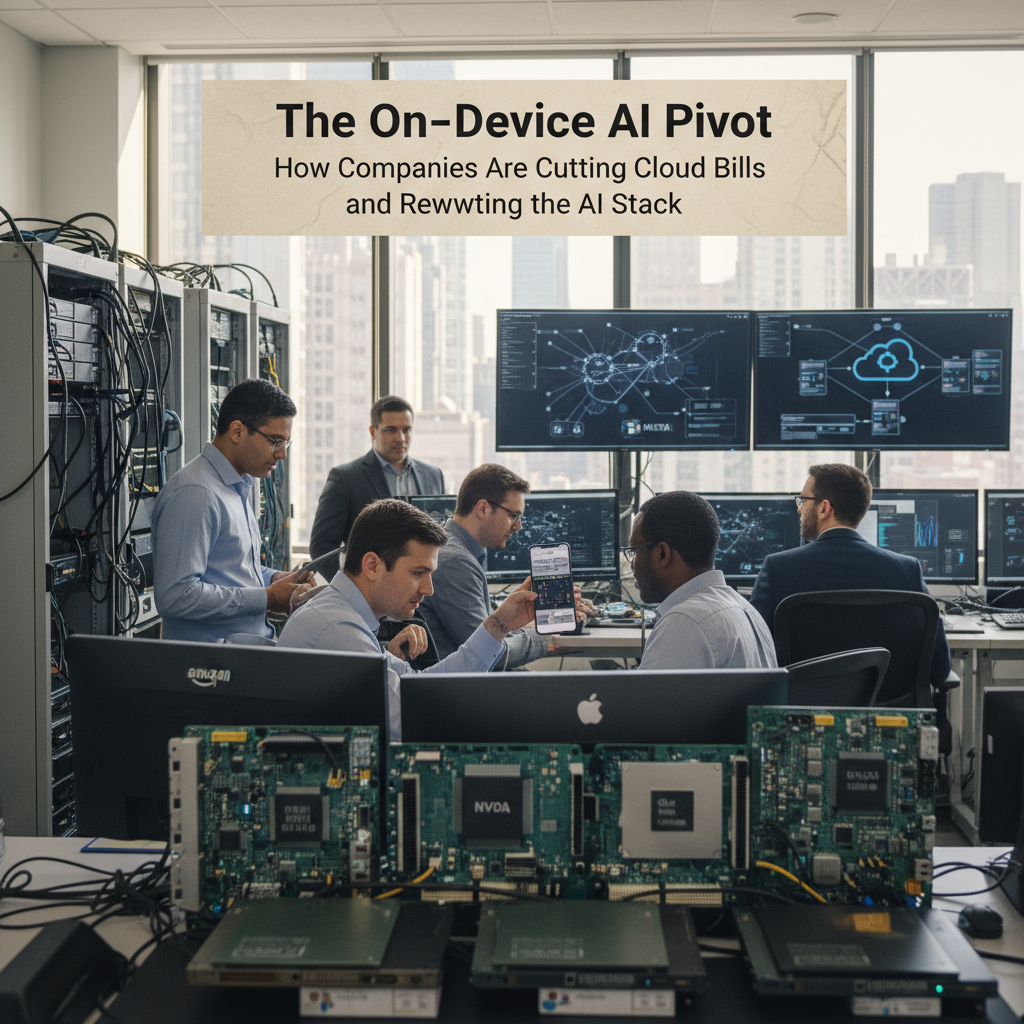
Hardware and software collide in messy, sometimes contradictory ways. Apple’s Neural Engine, Qualcomm’s Hexagon DSPs, and Google’s TPU/Edge work make plausible, useful generative features on-device. Meanwhile Nvidia, AWS, and Microsoft still own the heavy lifting for training and large-scale inference.
Think of the stack splitting: training stays centralized in the cloud; routine service moves out to the edge. Do everything in the cloud and you pay premium margins for predictability. Go all-in on-device and you inherit complexity around updates and a loss of fidelity for very large-context tasks. Most firms will sit somewhere in between.
Tactics that make on-device work
- Model compression: quantization, pruning, and distillation cut model size with acceptable quality trade-offs.
- Hybrid pipelines: local models handle the 80% of routine interactions; the cloud covers long-context or higher-risk requests as a fallback.
- Federated updates and secure enclaves: a middle path that preserves privacy without hauling raw data back to central servers.
Counterpoints and risks
It’s not free. Training still requires vast GPU farms; advanced multimodal work demands resources phones and gateways cannot match. Fragmentation is real — dozens of SoCs, multiple OS versions, enterprise security rules — and that means more engineering, not less. Also, degraded model fidelity on-device can hurt user experience in subtle ways that only show up in production.
A quick history lesson
We’ve been here in spirit before. The industry oscillated between centralized mainframes and client devices; the cloud era recentralized compute for about a decade. On-device AI feels like a synthesis: centralized training, distributed inference. It may look familiar, but the economics and privacy drivers this time are different.
What CIOs and investors should watch
- Whether enterprises adopt model-optimization toolchains — that’s an early indicator of a sustained on-device strategy.
- Partnerships between chipmakers and software vendors; they reveal where OEMs intend to differentiate.
- Cloud providers’ pricing for inference — if they introduce low-cost tiers or targeted discounts, migrations will slow.
Final thought
This won’t end the cloud. It will reassign roles. Near-term winners will be the companies that stitch both worlds together: lightweight edge models that cut routine spend and a cloud backbone that handles the heavy lifting. Expect M&A to favor model-compression startups and on-device orchestration tooling more than another massive training farm.