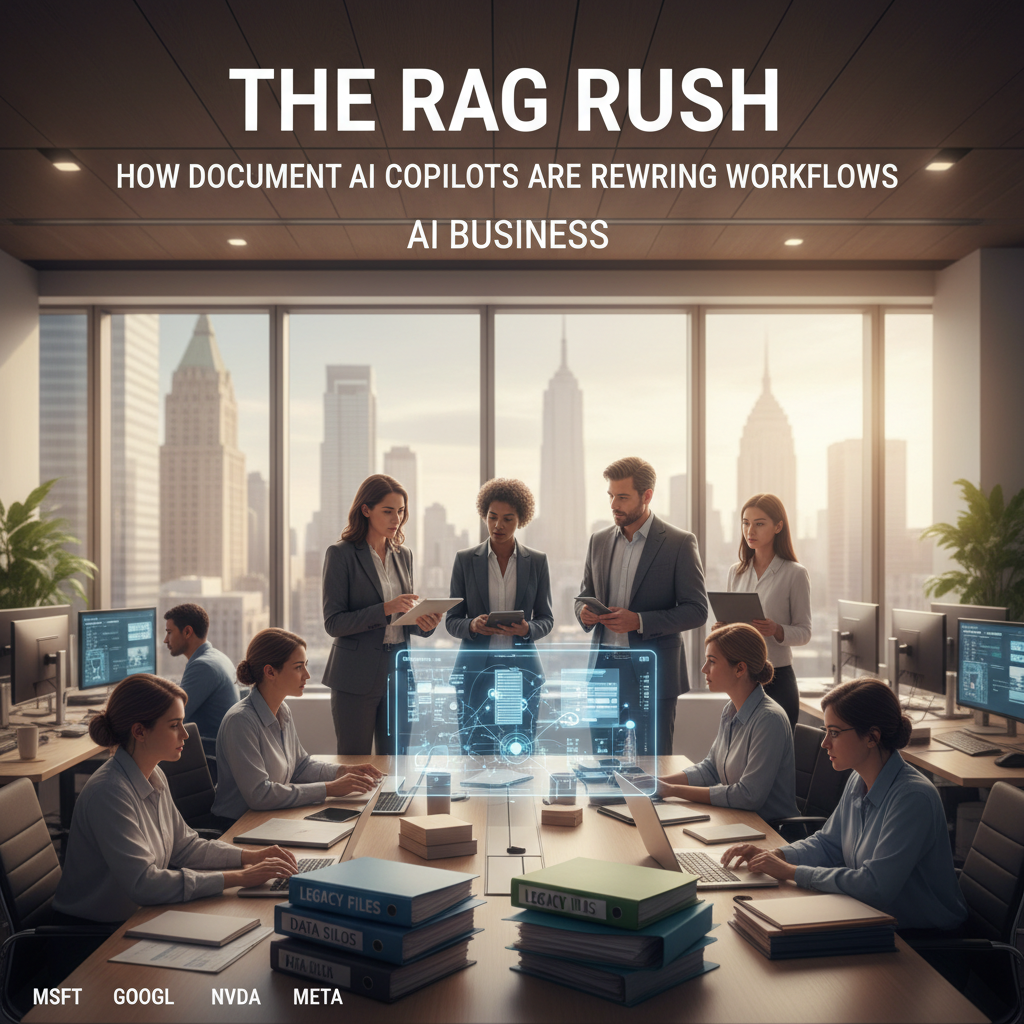
Something subtle is changing inside corporate inboxes and file shares. Over the past year, startups and cloud vendors have started wiring transformer models into vector databases and company knowledge stores. The result — call it a document AI copilot — fetches relevant passages, synthesizes answers, and behaves a bit like a colleague who actually read the manual.
Why it matters now
- Retrieval-augmented generation (RAG) lets models consult a curated memory instead of guessing from generic training data. That matters because answers become usable for real workflows much faster.
- This is practical, not just academic. Legal teams surface relevant clauses; support agents cut resolution time; sales folks pull pitch snippets straight from product docs.
A bit of history
Semantic and enterprise search have existed for years. What changed is the combination: higher-quality embeddings, instruction-tuned models, and production-grade vector stores working together. Think less keyword matching and more of a comprehension layer that speaks back in plain English.
Who’s earning the margins — and how
- GPU makers and cloud platforms win when inference scales beyond prototypes. Expect compute bills to climb as pilots turn into production.
- Vector databases are the quiet middlemen. They make retrieval fast, manage indexing strategies, and add the security controls that regulated customers demand.
- Model and API providers still shape the user experience. A small UX change can collapse a months-long deployment into a single day. That power shouldn’t be underestimated.
Risks people tend to gloss over
- Hallucinations are rarer but not gone. When retrieval misses or sources are wrong, you can get a confident but incorrect contract summary — with real-world costs.
- Data leakage and compliance remain real concerns. Sending sensitive internal data to an external model, or storing embeddings in a poorly secured index, triggers regulatory alarm bells.
- Hidden costs bite. Vector storage, continuous reindexing, and token-based inference fees often exceed early estimates.
Practical moves for teams and investors
- CIOs: prioritize provenance. Make systems return source snippets and build audit trails before broad rollout.
- Legal and compliance: run human-in-the-loop validation during a defined probation period and track errors quantitatively.
- Investors: watch the stack. Cloud providers and GPU vendors capture steady recurring spend; niche software can command premium multiples if it proves sticky and defensible.
Concrete examples
- Support teams that used to crawl FAQs now get ranked, context-rich answers. Early deployments report average handle-time drops of roughly 20–40 percent — anecdotal, but consistent across pilots.
- Contract teams move from clause libraries to multi-document searches that synthesize deviations from standard language, highlighting what actually matters.
Limits and open questions
Not every task benefits. Highly creative work still favors human synthesis. Some kinds of knowledge resist tidy indexing. There’s also a growing market for hybrid approaches: keep retrieval and previews on-premises, and send only sanitized prompts to hosted models. Makes sense to me, and others are building exactly this.
Where this lands
Document AI copilots are not a magic switch. They are, however, the most immediately practical use of generative models inside enterprises right now. The commercial winners will solve provenance, predictable costs, and compliance. Expect competition between cloud giants pushing integrated stacks and nimble vendors focused on secure, low-latency retrieval.
What to watch in the next 12 months
- tighter regulation and compliance tooling around vector stores
- more investment in on-prem embeddings and hybrid inference models
- consolidation among niche vector DB and tooling startups
If you run corporate knowledge, treat adoption like a staged rollout: measure, validate, and budget for surprise infrastructure bills. The upside is real — but so are the eats-and-odds that come with adding a new layer to enterprise software.