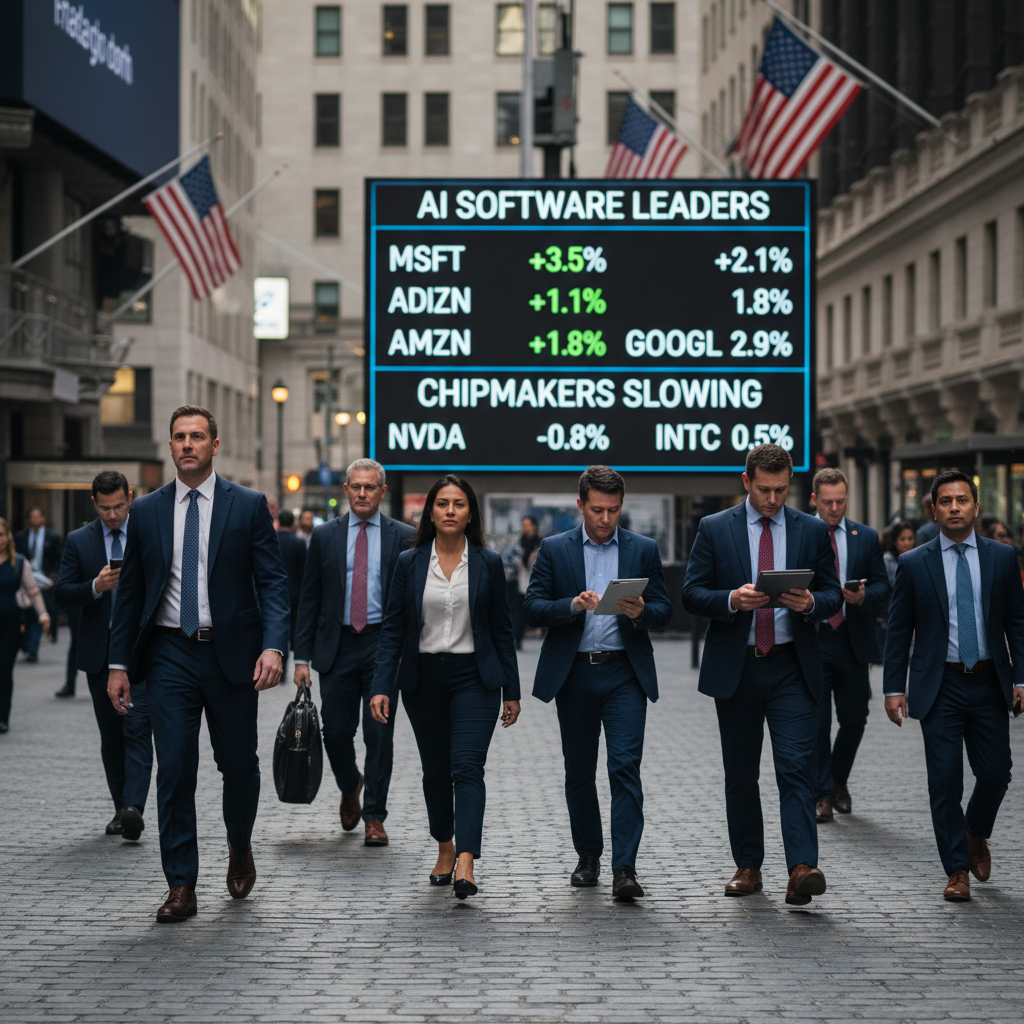
Quick thesis
The AI trade that began in silicon — GPUs, memory, hyperscale data centers — is clearly spreading out. After a blistering run in chip names, capital is migrating into higher-margin, recurring-revenue software and platform plays that promise stickier cash flows as enterprises weave generative AI into everyday workflows.
Why this shift is happening now
- Margins and predictability. Software turns AI features into subscriptions, not one-off hardware refreshes. That appeals to investors exhausted by capex cycles.
- Deployment, not just procurement. Buying GPUs is step one. The big, ongoing budgets live in product integration, compliance, monitoring, and UI work — the parts that actually make AI useful inside a company.
- Risk-adjusted returns. Chips hinge on performance jumps and supply chains; software accumulates value through data, models, and distribution over time.
Winners, losers, and the fuzzy middle
- Probable winners: platform and SaaS leaders that can bake AI into high-ARPU products. Think productivity and creative suites, vertical enterprise apps, and cloud vendors with tight go-to-market motion.
- Still-important winners: chipmakers and cloud infrastructure firms remain indispensable — but their returns look more cyclical than before.
- The gray area: AI infrastructure companies that sit between hardware and software. If they prove durable enterprise revenue, their multiples can re-rate quickly. If not, it’s a tougher road.
Names to watch
- NVDA — still the gearbox of the AI boom; central to both training and inference.
- MSFT and GOOGL — platform reach, cloud distribution, and developer ecosystems that tend to lock in enterprise spend.
- ADBE — product-led AI for creative workflows, and clear monetization levers.
- AMZN (AWS) — big inference footprint plus ambitions in custom silicon.
- AMD and INTC — plays on price/performance and, in Intel’s case, margin recovery.
Not an exhaustive list, but enough to illustrate the move from hardware scarcity premiums toward recurring software economics.
A dose of skepticism
This shift does not mean chips are obsolete. GPUs remain the backbone of large-model training. The key question is whether software vendors can deliver differentiated AI that customers will actually pay for, repeatedly and at scale.
Also watch regulation and adoption risk. Enterprise buying cycles are long; privacy and antitrust pressures could slow rollouts. And many software stocks already price aggressive future AI growth — valuation risk is real.
Historical frame
Remember the late-2000s cloud transition: infrastructure winners eventually ceded valuation leadership to application-layer companies once monetization patterns clarified. AI feels like a similar, multi-decade reallocation — only faster, because models and distribution can scale quickly. Still, history warns against assuming the shift is complete.
Trade framework (concise)
- Core holding: a mix of GPU exposure plus two platform software names.
- Tactical tilt: overweight software that shows clear ARR lift from AI, underweight pure-play hardware vendors without a diversification path.
- Risk controls: size positions sensibly, consider options to hedge headline risk, and follow adoption metrics (ARR growth, upsell, churn) rather than press-release model claims.
The upshot
Markets are moving from buying raw compute to buying outcomes. For investors that means emphasizing companies that convert AI into recurring value and predictable margins — not just those selling the machines to run it. That reorders leadership in the AI era, but it doesn't erase the chip winners.