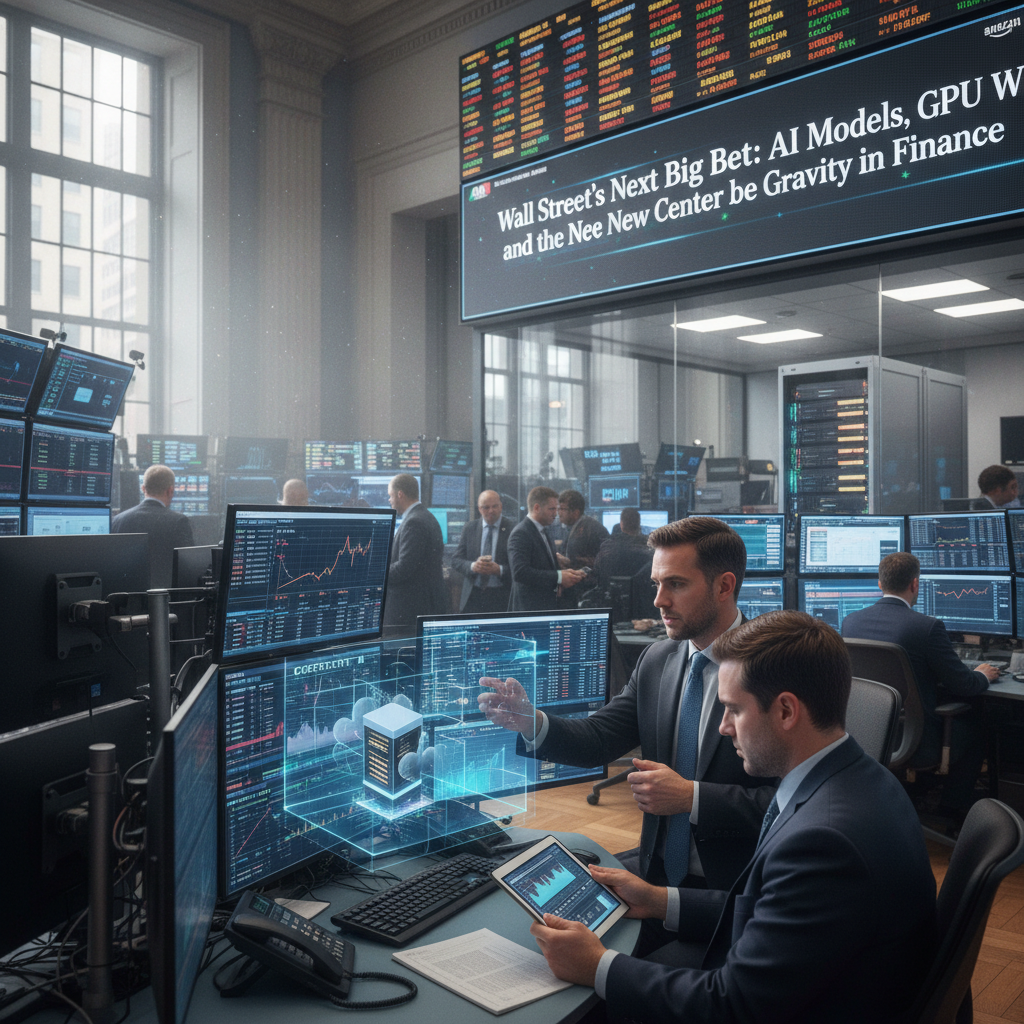
Wall Street isn’t just buying software — it’s buying compute.
Conversations on trading floors and in portfolio meetings have shifted. A year ago the talk stopped at models; now it often starts with H100s, cloud credits and data pipelines. That upgrade to research tools is actually remapping who can compete: firms with the cheapest, fastest compute and the best labeled data get a real edge.
Why this matters now
- New large models let startups and buy‑side teams automate research notes, spin up scenario analyses, and backtest macro ideas far faster than before.
- Those models are resource‑intensive. Training and fine‑tuning at scale favors whoever can secure GPUs, win large cloud discounts, or run their own racks.
Think less “software arms race” and more “power plant” competition: control the kilowatts and you control margin.
Who’s winning (and why)
- Nvidia’s chips have become the go‑to for model training. That turns what should be neutral infrastructure into a chokepoint for financial innovation.
- Cloud providers — Microsoft, AWS, Google — are bundling AI services and deep discounts for big customers, which pushes advantage to firms willing to sign multi‑year commitments.
- Large asset managers and banks are turning research stacks into private model platforms, often training on proprietary order flow and internal analyst notes.
Some concrete shifts I’m seeing
- Quants are no longer lone signal-hunters. Teams now mix ML engineers, MLOps, and traders who understand both markets and models.
- Boutique managers that used to compete on niche insight are either partnering with cloud vendors or buying pooled GPU time to keep up.
- Strategies once driven purely by signals are increasingly using synthetic scenarios and natural‑language risk explanations to satisfy compliance and portfolio managers.
This isn’t an unalloyed win for the biggest firms
There are countervailing forces. Open models and cheaper inference stacks, plus a growing secondary market for GPU time, will erode absolute advantage. Startups can still outpace incumbents with faster iteration and clever data deals. And bad models — the ones priced or validated poorly — will overfit and underperform. Speed doesn’t guarantee returns.
Regulatory and market risks
- Concentration: heavy dependence on one chipmaker or a few cloud providers creates systemic vulnerability if supply or pricing shifts.
- Model risk and explainability: expect regulators and risk teams to demand clearer guardrails as models start to influence client allocations.
- Data leakage and market integrity: training on proprietary order flow or mixed third‑party datasets raises obvious compliance and fairness questions.
Where this could go — three rough scenarios
- Consolidation: big managers lock in cheap compute, widen their moat, and squeeze smaller rivals.
- Wider access: cloud marketplaces and open models drive down costs and let nimble boutiques thrive.
- An uneasy mix: incumbents retain scale advantages but face continuous disruption from specialists who master particular niches.
What to watch next
- GPU supply and pricing — shortages show up quickly in the strategies people can run.
- Large cloud deals and long‑term commitments from major asset managers.
- Regulatory moves on AI governance in finance — guidance or enforcement could flip incentives overnight.
The point: AI in finance is as much an infrastructure story as it is a modeling story. Over the next decade, the winners will combine domain expertise with real control over compute, data and deployment. It’s a different kind of moat than the one quants built in the 2000s, but defend it well and it’s just as durable.
— Pedro Marini