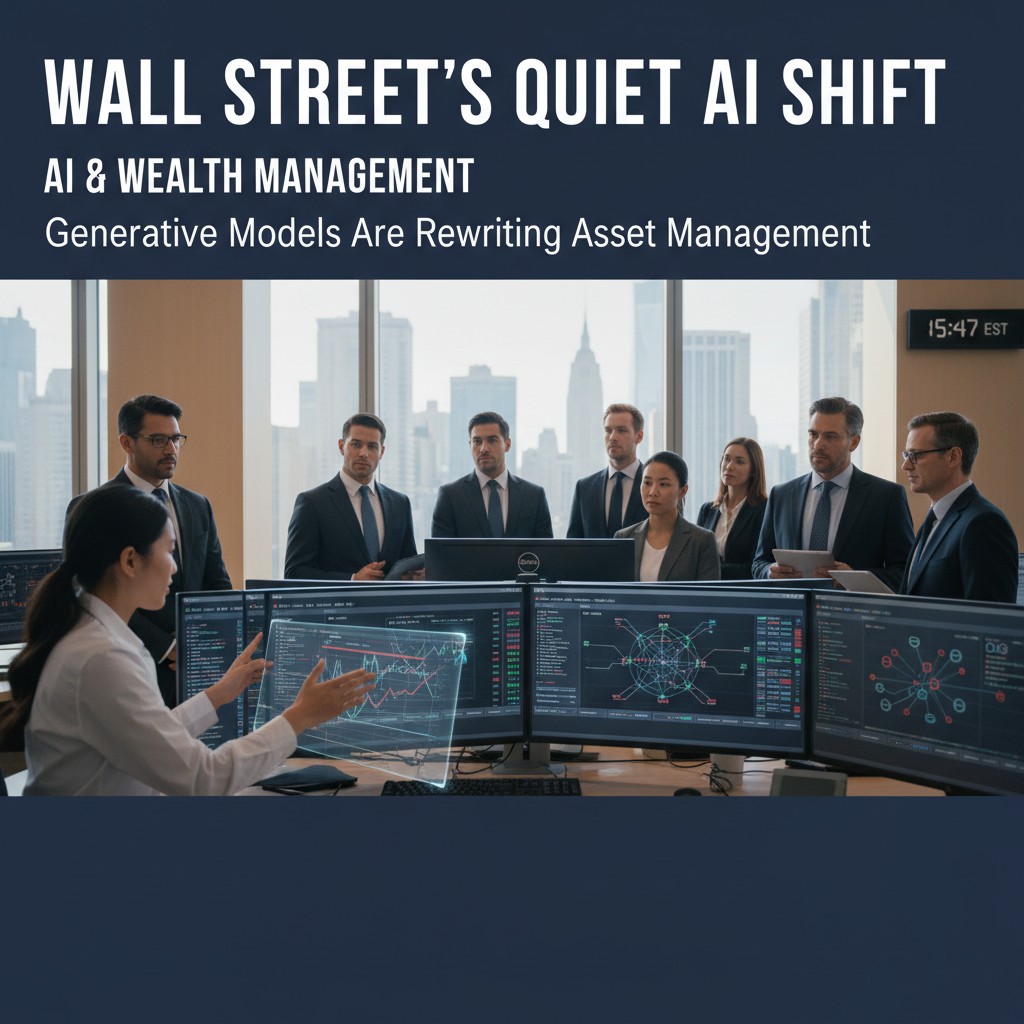
Headline: AI has stopped being a niche tool on trading desks and is moving into the plumbing of wealth management. What might at first look like another efficiency push is already changing portfolio construction, adviser–client interaction, and how firms compete on price.
A few things are happening at once. Big asset managers are bolting large language and generative layers onto decades-old risk engines. Startups are using LLMs to deliver hyper-personalized advice once reserved for wealthy clients. Quant shops are mixing classic factor models with sentiment and thematic signals pulled from earnings calls, news and SEC filings.
Why this matters now
- Language becomes numbers. Generative systems make qualitative signals usable at scale, compressing research cycles and shifting some decision power from pure portfolio managers to systems engineers and data teams.
- Cost math flips. Automating onboarding, rebalancing and tax-loss harvesting can erase much of the marginal cost of servicing an account, which will push down margins on commoditized strategies.
- More people get access. Retail platforms are packaging AI-driven strategies into ETFs and model portfolios you can buy with a click.
Think of the quant wave in the 1990s and early 2000s: factor investing and HFT changed returns and the jobs that produce them. The current change feels similar, but there’s a twist. Pre-trained models and cheap compute are widely available now, so the technology that once required huge proprietary budgets is becoming much easier to adopt.
Concrete examples help expose trade-offs. BlackRock has long relied on Aladdin for risk analytics; adding generative layers accelerates scenario work but also adds opacity you cannot always unpack. Vanguard and major custodians are trialing chat-driven adviser tools to scale advice to mass-market clients. Boutique wealthtechs, meanwhile, promise bespoke tax optimization using LLMs — something legacy platforms rarely offered without hands-on human work.
What investors and advisers should watch
- Fee pressure. Expect more price competition among robo-advisors and low-cost ETFs as AI trims servicing costs.
- Model risk and auditability. Generative systems are prone to plausible-sounding errors. Firms that cannot explain their decisions will lose clients and attract regulator attention.
- Data lineage and bias. Training data matters. Models tuned to market chatter or social media can fail badly when regimes shift.
- Talent shifts. Teams increasingly need ML engineers, data scientists and ethicists alongside PMs and compliance officers.
The risks are not theoretical. Regulators like the SEC are already asking questions about model governance and vendor concentration. A mis-specified model could amplify flows into crowded trades and trigger liquidity squeezes at exactly the wrong moment.
A useful caveat: not every firm needs to build a giant model from scratch. Many will buy modular AI services that drop into core workflows. That lowers upfront cost and expertise requirements — but it also concentrates risk among a few vendors, which brings systemic vulnerability.
Net effect: this is structural, not just tactical. First-order: cheaper, more personalized products for investors. Second-order: risk concentration where a handful of platforms provide the AI layers. For practitioners, the calculus shifts. Alpha generation still matters, but managing model governance becomes a core competency.
What to do next
- Investors: prioritize transparency and operational resilience when choosing AI-enabled products.
- Advisers: invest in explainability tools and build guardrails around model-driven recommendations.
- Technologists: test models across regimes and document data sources rigorously.
Wall Street is quietly rewriting the asset management playbook. The winners won’t be the firms with the loudest chatbot; they’ll be the ones that pair deep domain expertise with disciplined ML governance.