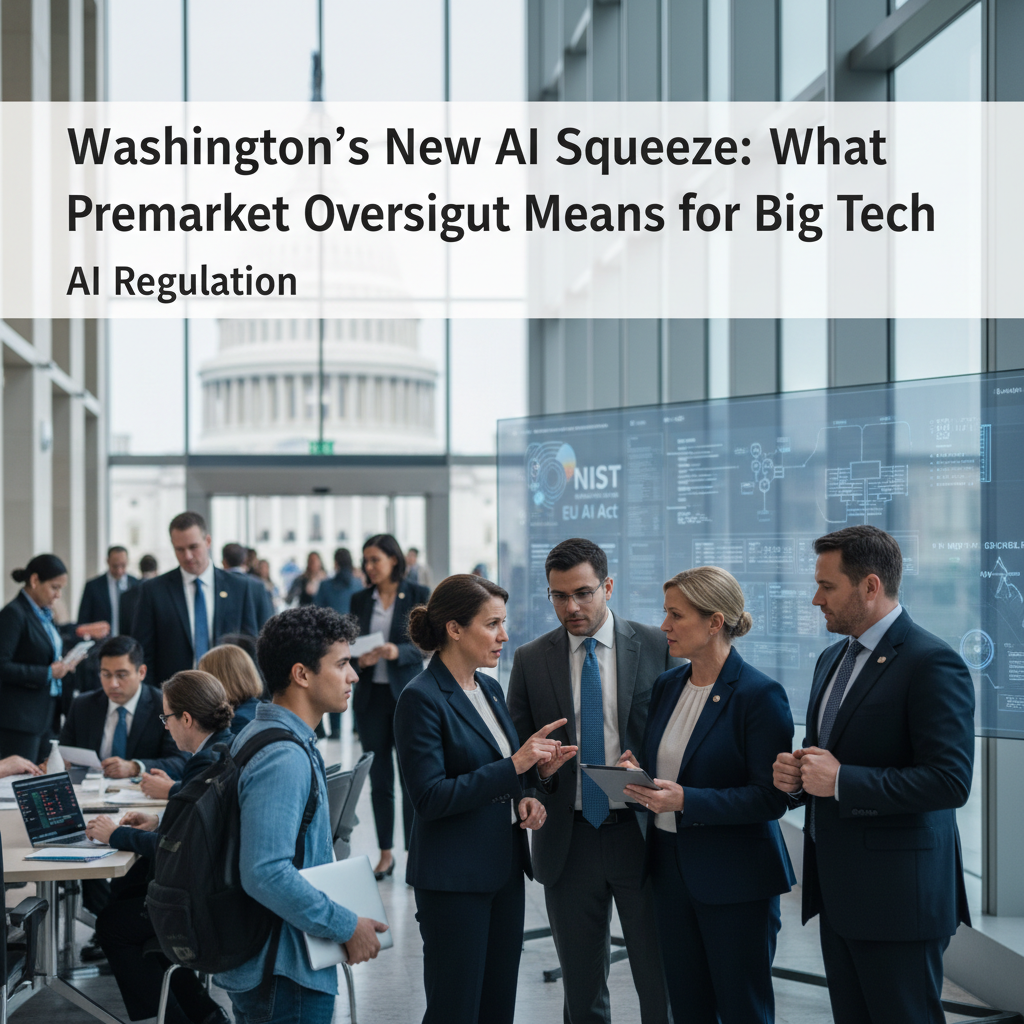
A policy pivot that matters
Washington is quietly shifting from abstract talk about safe and ethical AI to concrete, operational rules. Think premarket safety tests for high-risk models, provenance and watermarking requirements, and clearer liability paths when things go wrong. This is not a theoretical exercise anymore. The debate is moving out of think tanks and white papers and into rulemaking and bill language — and that matters to engineers, compliance teams, and investors.
Why now
- A string of high-profile model failures and deepfake abuses has made the issue politically salient.
- Europe’s AI Act provided a template for hard rules; U.S. lawmakers feel pressure to avoid a patchwork of state laws and to keep innovation onshore.
- Agencies such as NIST and the FTC have been assembling technical and enforcement tools that can be turned into mandatory obligations.
What regulators are eyeballing
- Premarket testing for high-risk uses, modeled more on product safety regimes than on disclosure-only approaches.
- Strong provenance and documentation so downstream integrators and consumers can trace datasets, fine-tunes, and deployment contexts.
- Watermarks or other provenance signals for generative outputs to slow fraud and mis/disinformation.
- Liability shifts that push some responsibility upstream to model providers when predictable harms materialize.
What's interesting here is the emphasis on operational rules, not just principles. That changes how companies need to build and ship models.
Who wins and who loses
- Big incumbents get a short-term edge. Compliance regimes raise fixed costs, which favors firms with deep legal, security, and engineering benches.
- Startups face an inflection point: costly predeployment audits could become a real barrier. On the flip side, a market for compliance-as-a-service is likely to emerge and that creates opportunities.
- Consumers and regulated sectors — finance, healthcare, critical infrastructure — should see safer products, though feature rollouts may slow.
Not every startup is doomed; firms that adapt governance early can still compete. But the friction will sort the field faster than before.
Market signal: short-term pressure, long-term moat
Expect near-term volatility as investors price in compliance costs and enforcement risk. Over the medium term, organizations that build trustworthy, auditable model pipelines will have a regulatory moat. To give a directional sense of sensitivity to regulatory pressure:
- MSFT: -1.2
- NVDA: -2.5
- GOOGL: -1.0
- META: -3.0
These are directional estimates of short-term share pressure tied to regulatory risk — not trade recommendations. Treat the numbers as illustrative rather than precise.
Practical implications for companies
- Start documentation early. Model cards, data lineage, and red-teaming will stop being optional gloss.
- Invest in provable detection and watermarking tools; the technical bar for deployable generative systems is rising.
- Prepare for audits. Expect third-party testing and keep reproducible model artifacts on hand.
A practical note: small teams should prioritize reproducibility and clear provenance first — those are the cheapest, highest-leverage defenses against future scrutiny.
A few counterpoints
- Overbroad premarket rules could slow beneficial deployments in healthcare and energy, areas where well-regulated models can save lives and reduce emissions. A blunt instrument would risk killing niche innovation.
- Enforcement will probably focus on high-impact harms; regulators may accept gradualism in low-risk contexts.
In short, the regime will be uneven at first.
Historical echo
There is precedent: cars, drugs, and finance moved from voluntary codes to mandatory premarket regimes once harms became systemic. AI differs in one key way — velocity. Models and deployments iterate far faster than cars or drugs ever did, so rules need to be precise and operationally implementable if they are to work.
The upshot
The U.S. regulatory cycle for AI is maturing from abstract principles to enforceable steps. That transition will be messy and contested — and somewhat predictable. Compliant firms will gain market access and trust; laggards will face fines and reputational costs. For founders and investors, the real question is not whether rules will arrive, but how swiftly and narrowly they will be written.
Signals to track next
- Draft rule releases from federal agencies and any bipartisan committee markups.
- New compliance-service startups raising capital to help smaller firms meet premarket obligations.
- Early enforcement actions that reveal regulator appetite and interpretation.
Watch which organizations adjust their engineering and governance rhythms first. That timing will matter — it often determines the winners in the next market cycle.