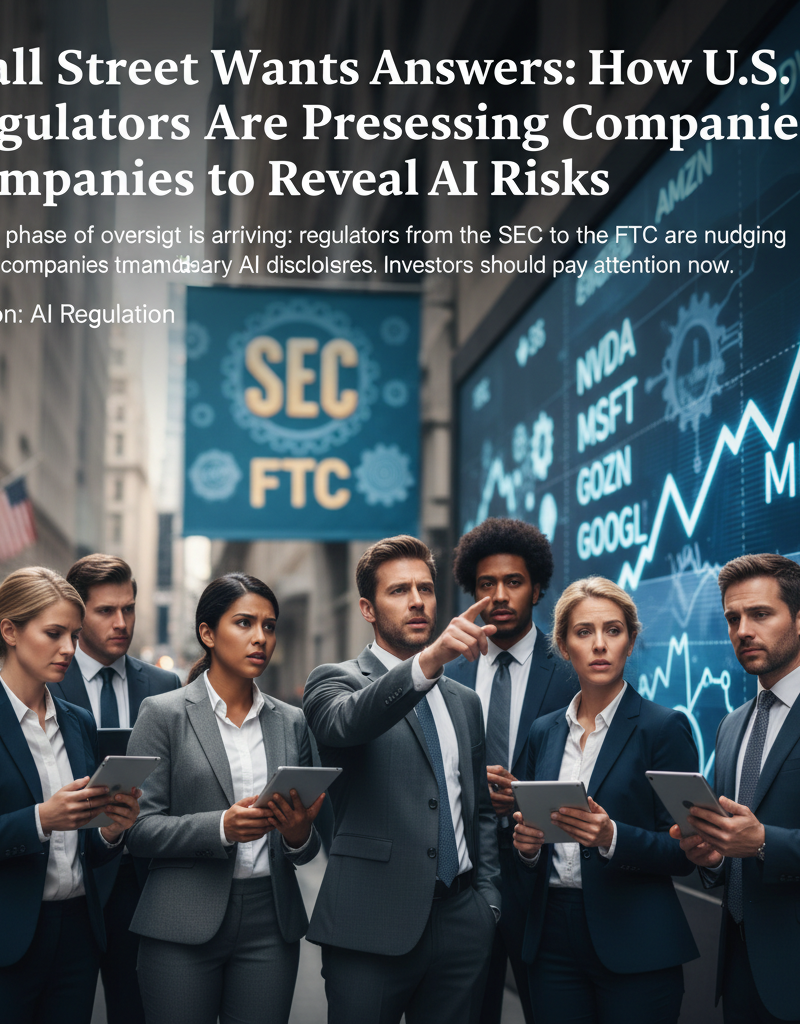
What’s happening now
There’s been a quiet policy pivot: regulators in Washington are zeroing in on provenance and watermarking for generative AI. They’ve been borrowing language from existing FTC rules about deception and from NIST-style risk frameworks, aiming for ways to trace outputs back to the models and datasets that produced them. The logic is simple enough — if content can be reliably labeled or traced, the problems from disinformation, fraud, and consumer deception become easier to spot and to police — but getting a robust system in place is another story.
Why this matters — now
This is not an academic exercise. The EU AI Act already requires conformity assessments for higher‑risk systems, while industry groups such as C2PA are building practical provenance tools. Regulators in the U.S. are watching those examples closely, trying to adapt them without smothering innovation. For companies, compliance will mean engineering work (new telemetry and signing), more extensive audit trails, and revised contracts with vendors and data suppliers. Expect both technical and legal workstreams to run in parallel.
Who wins and who pays
- Winners: big cloud providers and security vendors that can package certified provenance stacks, enterprises with strong data governance, and chipmakers selling inference hardware. Think Amazon, Microsoft, Google, and continued demand for Nvidia-class GPUs.
- Payers: startups that have to retrofit models and pipelines, platforms hosting third‑party content, and adtech players who monetize generated material on thin margins.
Not symmetrical, and that matters — incumbents have scale and trust that newcomers will find expensive to replicate.
A real-world analogy
Think Sarbanes‑Oxley, applied to AI. Once information must be auditable, companies build systems and buy services to prove compliance. That spawned consulting practices, auditing firms, and software vendors in the 2000s. We’ll probably see a similar pattern here, only faster — the tooling exists in a more mature form, and political pressure is high. Still, it won’t be a carbon copy; the technical contours differ.
Counterpoints and frictions
- Technical limits. Watermarks can be removed and provenance metadata stripped. Bad actors adapt.
- Trade-offs. Heavy mandates could slow product rollouts or push development to jurisdictions with looser rules.
- National security carve-outs. Governments may exempt classified systems or critical infrastructure, which will create patchy regulation across sectors.
In practice, then, the rules will be porous and contested.
Immediate implications for CFOs, general counsels and investors
- Start an AI provenance audit now. Map where models are trained, what data feeds them, and which channels distribute outputs.
- Budget for compliance engineering and independent attestations — smaller firms should expect higher go‑to‑market costs.
- Investors: watch for startups building provenance tooling — metadata signing, immutable logs, model lineage platforms. These look like plausible acquisition targets, though not every vendor will win.
Where this is headed
U.S. policymakers are unlikely to ignore the momentum coming from the EU and industry standards. Practical provenance and watermarking are emerging as the route regulators prefer because they offer something you can enforce without pretending the tech is foolproof. That gives an edge to companies that move early — and to investors who back the plumbing that makes provenance reliable — even as the rules and attacks keep changing.