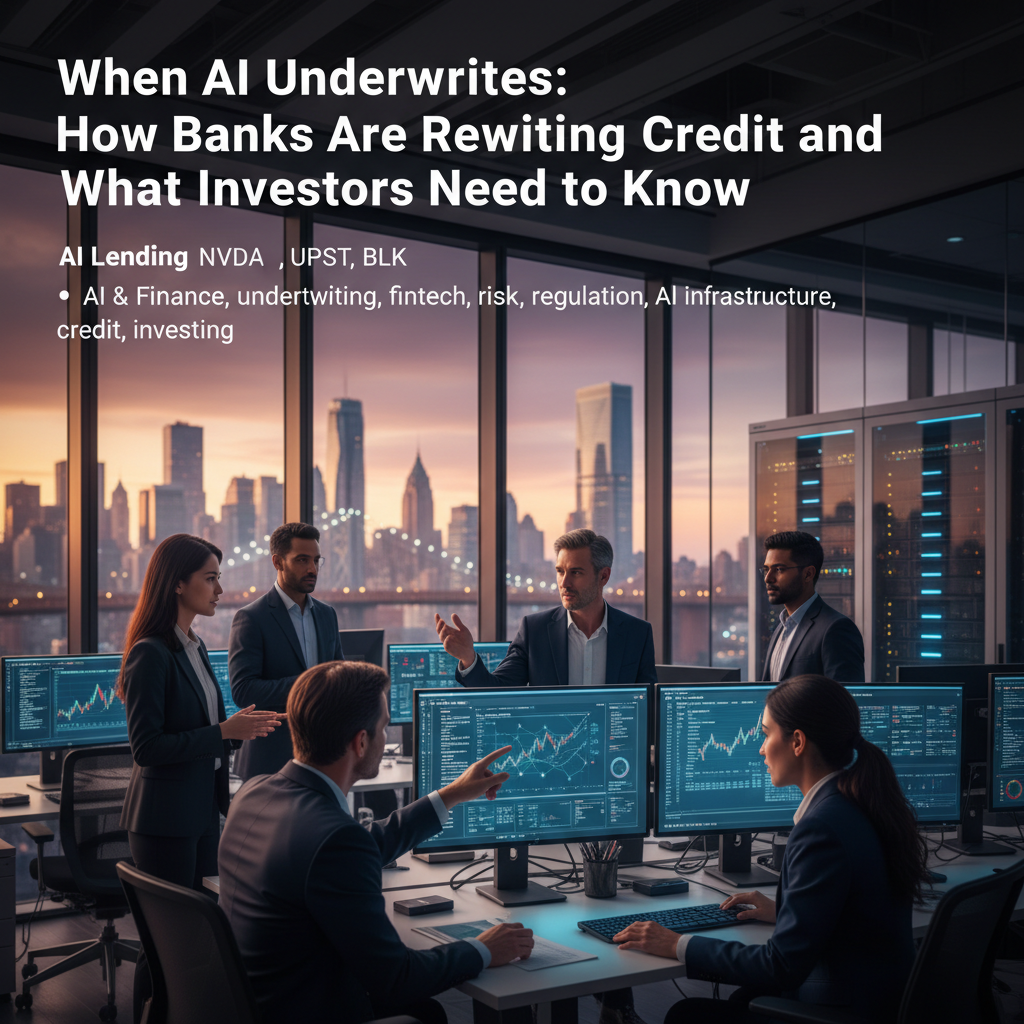
A new underwriting era has arrived, but it feels less like a neat upgrade and more like an uneasy marriage between old banking instincts and opaque machine-learning systems.
Legacy banks and fast-moving fintechs are increasingly handing decisions that used to be human-only to machines: who gets a loan, on what terms, which credits get bundled into securities. Yes, there are clear efficiency gains. But that shift is also exposing new fault lines in risk, compliance, and business models investors thought were stable.
Why this matters right now
- Low-cost compute and better models make real-time scoring cheap enough to sprinkle across mortgage desks, credit cards, and small-business loans.
- Large cloud providers are offering banks ready-made AI stacks, so adoption is happening fast even where institutions lack big ML teams.
- Investors are in an odd spot: steady revenue streams are being recast as software problems, while regulation lags — a combination that could re-rank winners and losers quickly.
Where the change is showing up first
- Consumer credit. ML-first lenders deliver faster approvals and, on paper, lower loss rates. But opaque features make audits awkward.
- Commercial lending. Banks are experimenting with alternative data to price small-business risk. The results look promising in benign times and uneven under stress.
- Capital markets. Firms use models to price tranches and run stress tests, shortening research cycles but concentrating risk when many rely on the same vendor models.
A few concrete examples
- A fintech using nontraditional signals can approve borrowers earlier in the credit cycle and boost originations — until that signal breaks in a downturn and losses accelerate.
- A regional bank that swaps manual reviews for an off-the-shelf AI stack cuts costs, then discovers regulators want explainability it cannot deliver during a wave of defaults.
The regulatory tightrope
Regulators were slow to notice, but they're catching up. Expect more attention to algorithmic explainability, disparate-impact testing, and third-party vendor oversight. That matters because banks that outsourced underwriting to cloud vendors may suddenly bear compliance risk for models they do not fully control.
Investor playbook — three lenses to think with
-
Tech-stack exposure: Suppliers of GPUs, cloud AI services, and ML platforms stand to benefit from widespread adoption. Favor firms with defensible data moats and enterprise trust — not just flashy tooling.
-
Business-model durability: Companies that pair proprietary data with underwriting know-how — rather than relying on commodity models — are more likely to hold up when markets turn.
-
Governance and transparency: The winners will be the firms that invest in explainability and strong model governance. That raises costs in the near term, but protects franchise value over time.
Counterpoints and risks
- Machine models can reduce human noise and some kinds of discrimination, but poorly validated algorithms can encode and amplify hidden biases.
- Efficiency gains might squeeze margins across the industry, pushing players toward riskier customers to maintain returns.
- Model concentration is real: if many use the same vendor models, systemic blind spots can emerge and produce correlated losses.
A bit of history
This echoes past inflection points — think securitization in the 1990s or algorithmic trading in the 2000s. Both brought efficiency and new systemic vulnerabilities. The key difference today is scale and opacity: decisions happen at machine speed, and their logic is not always interpretable.
What to watch next
- Enforcement signals about model audits and fair-lending compliance.
- Earnings commentary from major cloud and AI infrastructure firms about bank customers.
- Early indicators such as charge-off trends at lenders that adopted ML underwriting aggressively two years earlier.
Where this leaves investors
AI-driven underwriting is not a single technology story. It restructures who bears what risk. The trade-off is between immediate efficiency and the longer-term cost of governance. Betting on infrastructure and banks that internalize model control looks safer than chasing rapid origination growth that sidesteps oversight.
Pedro Marini writes about the intersection of capital markets and emerging technology, tracking where code replaces judgment and what that means for portfolios.