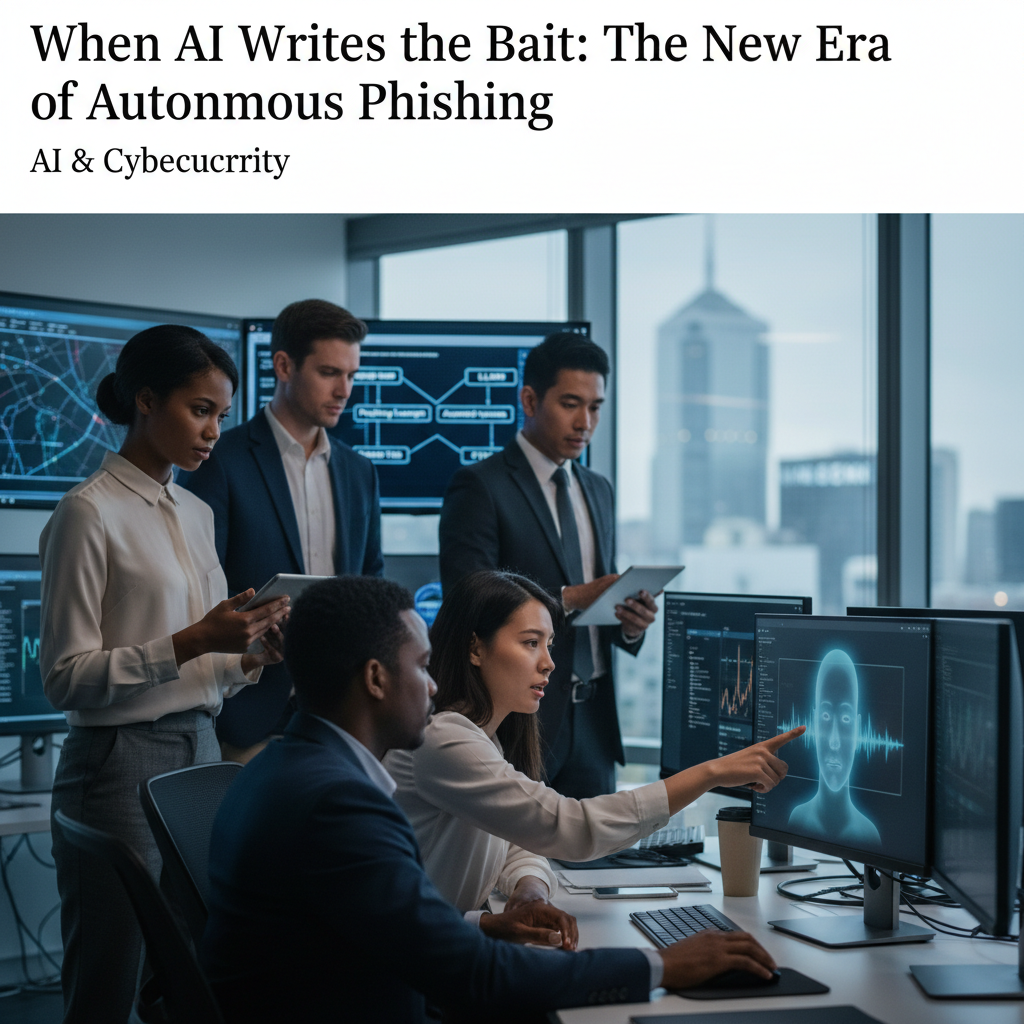
The headline is simple and unsettling: attackers no longer need human copywriters. Large language models can spin up personalized, credible messages at scale, and cheap voice‑cloning tools turn voicemail drops and spoofed conference invites into convincing social engineering.
This is not science fiction. It’s the predictable next step from automated spam and basic spear‑phishing: scale plus craft. Imagine a forger who used to labor by hand now strapped to a jet engine — same intent, far greater reach.
Why this matters now
- Attackers stitch public data, leaked credentials and corporate breadcrumbs into prompts that generate context‑aware emails and LinkedIn messages. It does not have to be perfect; a few believable signals make the rest seem real.
- Deepfake audio and video make CEO fraud less clumsy and more effective — a synthesized voice can authorize transfers or crank up urgency in seconds.
- Phishing‑as‑a‑service operators have baked LLMs into their kits, lowering the bar for novices while letting experienced actors crank up campaign velocity.
How defenders are responding
Signature filters are losing ground. The practical counterpunch looks like a three‑part effort — messy in places, but necessary.
- Behavioral detection: watch for odd request patterns and atypical workflows, not just suspicious phrasing. This catches things that keyword rules miss, though attackers try to mimic normal flows.
- Model‑based defenses: apply ML to spot semantic inconsistencies and delivery anomalies that slip past humans. These systems help, but they can be brittle and require continuous tuning.
- Authentication hardening: push multi‑factor, hardware keys, and strict out‑of‑band confirmation for high‑risk actions. Simple, boring, effective.
Vendors are already pitching AI as the fix. CrowdStrike, Palo Alto and others advertise model‑driven detection that flags AI‑crafted social engineering. That sells, and it helps — up to a point. Expect false positives, analyst fatigue, and a constant cat‑and‑mouse as attackers fine‑tune prompts to slip through.
The counterarguments worth hearing
Skeptics point out something obvious: humans still click links. Social engineering rides on trust, and no model will humanize a culture overnight. Another valid worry is overreliance on AI detection; defenders risk depending on black‑box models they do not fully understand and cannot easily audit.
Practical steps for organizations
- Treat high‑risk transactions as human events: require verbal confirmation over pre‑approved channels — not a callback number from an email.
- Reduce information leakage: audit public footprints, aggressive LinkedIn hygiene, and limit what can be harvested for personalization.
- Train with better simulations: include AI‑crafted phishing in exercises so users learn to spot more convincing bait.
Looking ahead
Expect an arms race. Prompt engineering will matter as much as exploit development, and attackers who learn to craft prompts will keep advancing faster than policies can adapt. Regulators and standards bodies will eventually weigh in, but policy moves slower than a malicious LLM. For now, the smartest posture is layered: keep humans in the loop, amplify their skepticism with better tools, don’t replace them.
This wave of AI‑enabled phishing isn’t the end of the world, but it sharpens the risk profile. Companies that adapt processes and raise the bar for authentication will absorb much of the shock. Those that treat this as a checkbox will find their inboxes — and their bank accounts — quieter for the wrong reasons.
The practical lesson: AI hands attackers finesse and speed. The response should focus less on banning models and more on redesigning how we establish and verify trust.