The shift is quieter than a model update but just as consequential. Over the last 18 months, teams building large language models and domain-specific AI have quietly pivoted away from messy, human-collected corpora toward synthetic alternatives: procedurally generated records, augmented logs, or simulated user interactions that try to approximate real-world distributions.
This is not about flipping a switch and firing human data ops. It’s a practical response to three nagging problems: privacy risk, scarce examples for niche scenarios, and the rising cost of buying and labeling datasets.
Why synthetic data now matters
- Privacy without paralysis. If companies can produce realistic-but-non-identifiable customer records, they cut exposure under laws like the CCPA and under mounting international standards. For large enterprises that cannot afford another breach headline, that’s meaningful.
- Coverage for edge cases. Fraud detectors, autonomous systems, clinical models — they all need rare-event examples. Synthetic generation can create those at scale when real occurrences are too few or ethically impossible to collect.
- Speed and repeatability. You can iterate faster when you can regenerate training sets to test a hypothesis instead of waiting weeks for labeled batches. That changes the cadence of experimentation.
What investors should watch
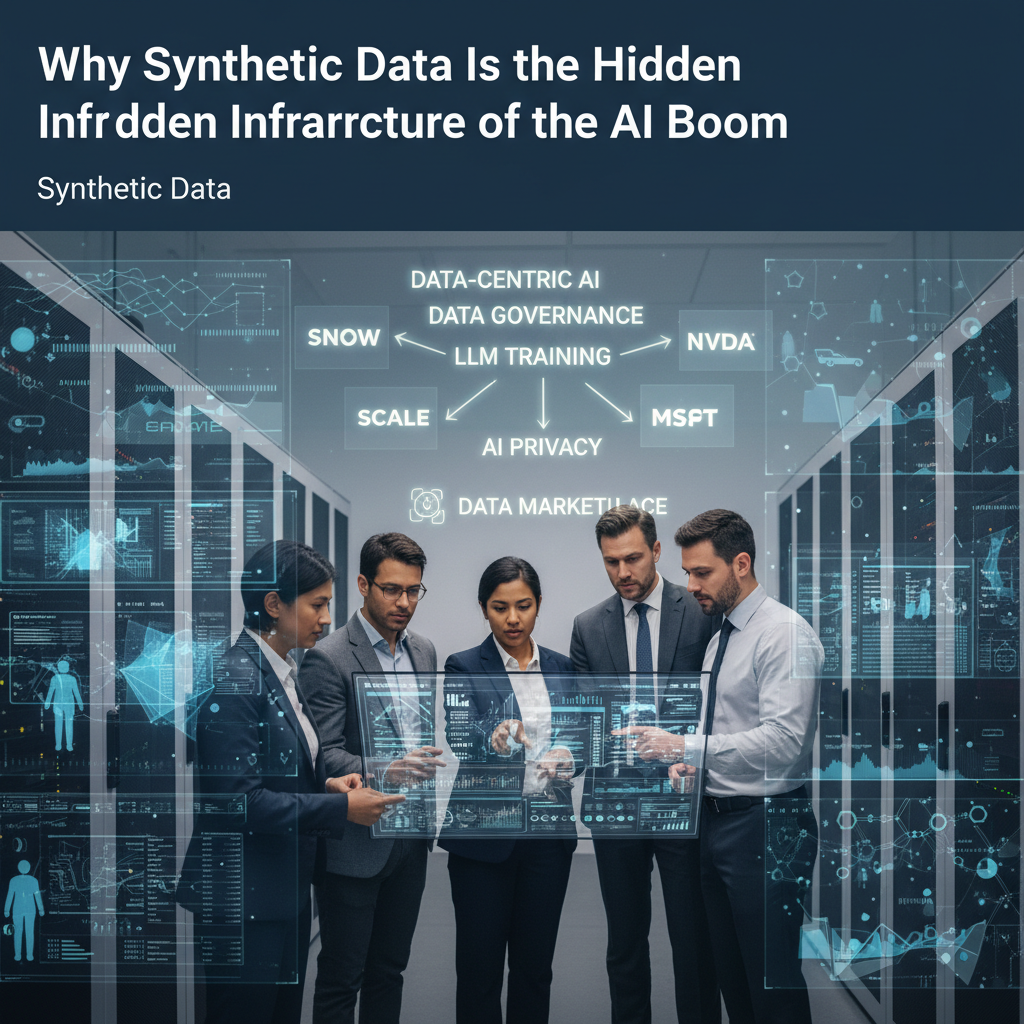
This creates a layered opportunity: better ways to store and distribute data, smarter labeling automation, and tools to validate that the synthetic stuff actually helps models generalize. The winners will be companies that stitch distribution, tooling, and enterprise trust together — not just single-feature startups. Think of Snowflake as a place to host curated datasets, Scale AI for data ops and labeling, NVIDIA for compute and photorealistic rendering, Microsoft for cloud and enterprise services, and Palantir for navigating regulated installations.
Three trade-offs people underplay
- Synthetic fidelity versus brittleness. A simulator that looks great can still teach models the wrong biases. Pretty data is not automatically better at generalizing.
- Regulatory gray zones. Authorities are still deciding whether generated records are treated like personal data. Assuming immunity is risky; rules could be applied retroactively.
- Labor displacement and new skills. Some labeling jobs will contract. At the same time, demand for simulation architects and dataset auditors will rise. It’s a reallocation more than a simple job-loss story.
A short history, because context helps
Data hasn’t always been the bottleneck. Early 2010s: compute was scarce. Late 2010s: models were the choke point. Now we’re moving into a data-constrained phase where gains come from cleaner, richer, and ethically vetted datasets. The data-centric AI movement pushed this idea into the mainstream; synthetic data is its practical offspring.
Real-world examples and what to look for
- A fintech team using synthetic transaction histories to train fraud models for new products without exposing customer PII. Faster launches, fewer compliance headaches. Not magic, but useful.
- An autonomous vehicle group generating corner cases in photorealistic simulators to stress-test perception systems before taking cars onto real roads.
If you want signals today, watch for:
- More partnerships between cloud/data-platforms and simulation or synthetic vendors.
- Job postings for simulation engineers, data synthesists, and dataset auditors.
- Legal briefs and guidance from state attorneys general and EU regulators that explicitly mention generated or derived datasets.
A necessary caveat
Synthetic data is not a cure-all. In domains where human nuance matters — certain forms of creative writing, clinical notes, cultural context — generated examples often miss subtlety. The best teams mix real and synthetic data, and they instrument models so they know which examples came from which source. Provenance matters for debugging and for compliance audits.
How this plays in the U.S.
Synthetic data is fast becoming part of the infrastructure for scaling privacy-aware, rapid AI development. It’s an enabling technology: it amplifies strengths and exposes new weaknesses. Investors should bet on vendors that can build trust, governance, and tight integration into enterprise data stacks — not on the loudest hype.
Quick hits
- Synthetic data lowers some privacy risks but raises regulatory questions.
- It helps cover rare events but requires new validation skills.
- Use synthetic and real data together; track provenance; watch partnerships between cloud platforms and simulation firms.
Pedro Marini is a finance and technology journalist who follows the intersection of data, regulation, and markets. He writes about where engineering trade-offs meet investor decisions.