A different kind of escalation
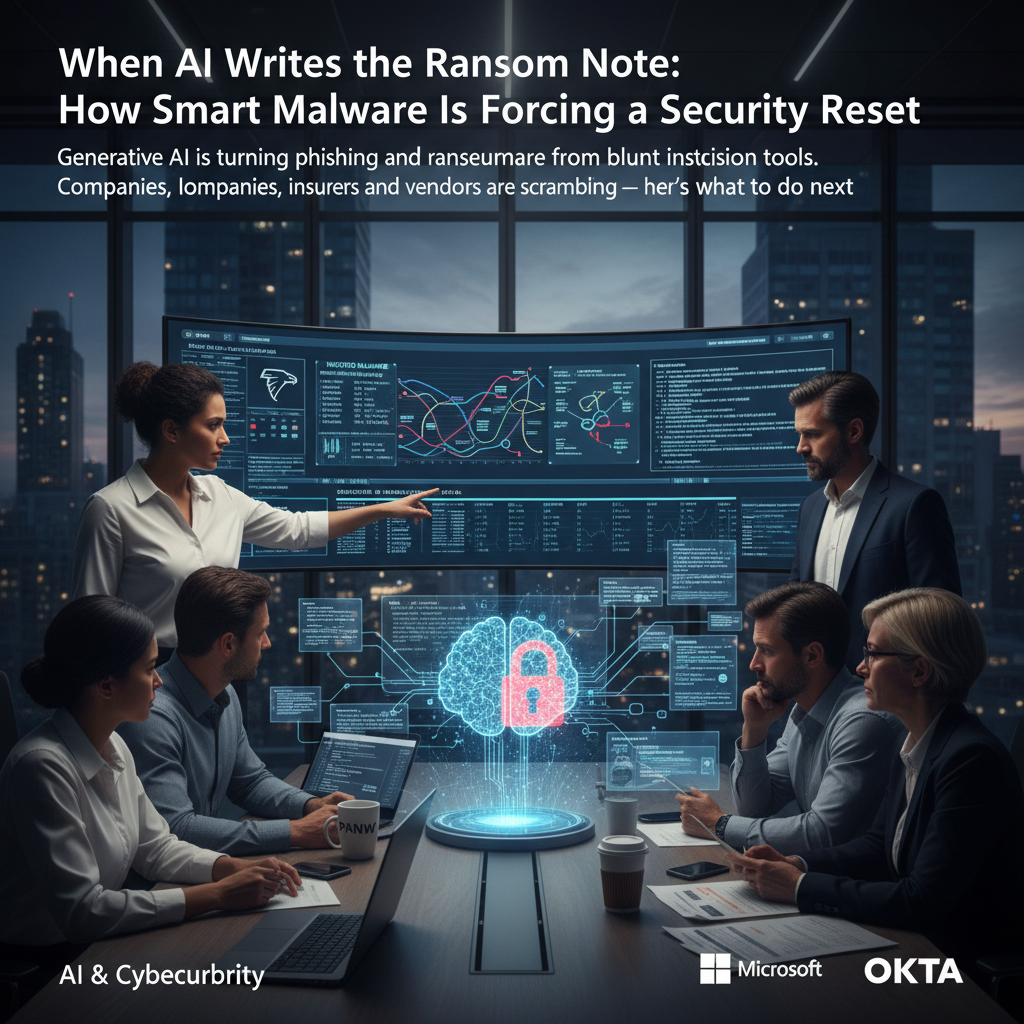
AI is no longer just a productivity tool. On the cyber battlefield it functions as an accelerant. Phishing is no longer a single canned email blasted widely; attackers can now craft messages with the cadence and context of a real colleague. Ransomware groups use generative models to produce personalized extortion letters and to shape payload behavior so it slips past sandboxes by adapting at runtime.
This is not science fiction. The symptoms — stolen credentials, lateral movement, encrypted file shares — are familiar. What’s different is the choreography: faster, cheaper, and oddly human. The business fallout goes beyond hours of downtime. Insurers are reworking risk models, boards are demanding incident plans that account for AI-driven attacks, and vendors are rushing to add adversarial defenses.
Why this matters now
- AI drives down the cost of bespoke attacks. Small criminal groups can now mount campaigns that used to require a dedicated red team.
- Detection windows are tightening. Adaptive malware can delay or change how it behaves to wait out signature-based systems.
- Financial friction is rising. Underwriters are tightening terms, raising premiums, or conditioning coverage on specific controls.
What’s interesting here is how quickly the economics shift. A tactic that was once expensive and rare becomes routine almost overnight. Some defenders are still catching up.
Real-world signals
- Security teams see credential-harvesting lures referencing recent deals, internal projects, even executive calendars — details that make the bait feel authentic.
- Incident response firms report extortion letters written to exploit psychology: urgency, fear of exposure, regulatory pressure. It’s crafted to elicit exactly the response the attacker wants.
- Vendors across endpoint, network, and cloud stacks now advertise AI-detection modules and adversarial training as standard features.
These changes are already redirecting capital. Companies that emphasize behavioral detection and threat intelligence are drawing more interest from institutional and corporate buyers. Meanwhile, legacy signature providers face pressure to fold in machine learning and richer, context-aware telemetry.
A quick tactical playbook for leaders
- Assume breach. Move faster on zero trust. Identity is increasingly the perimeter.
- Harden MFA and cut down on password reuse; credential stuffing is still a top enabler for AI-assisted attacks.
- Use AI defensively. Automated triage, anomaly detection, and synthetic threat hunting can shrink response times — though they’re not a panacea.
- Run tabletop exercises that simulate AI-augmented social engineering, not just basic phishing.
- Revisit cyber insurance terms now. Expect underwriters to demand clearer controls around machine-learned systems and incident readiness.
A couple of practical notes: pilots matter. Don’t buy a platform because it has AI in the brochure — measure how it reduces mean time to detect and contain.
AI helps defenders too
This is not one-sided. Attackers use generative models for scale and realism; defenders use similar tools to speed detection, correlate signals across cloud and endpoints, and map likely attacker TTPs. How this plays out depends on how quickly security teams fold AI into everyday workflows and whether vendors can match offensive innovation with solid model governance and controls. In practice, though, integration and people matter more than product marketing.
What investors should watch
- Differentiation will hinge on behavioral telemetry, signal fusion across endpoints and cloud, and robust adversarial ML capabilities.
- Insurers and managed detection providers are likely to become strategic partners for mid-market firms that lack mature SOCs.
- Regulatory scrutiny will probably increase; disclosure expectations and incident reporting could expand as AI factors into attack complexity.
Expect winners to be those who marry data breadth with the ability to act on signals in minutes, not days.
The practical reality
We’re in a phase of tactical catch-up. Attackers will graft AI onto proven playbooks, but the advantage is not permanent. Organizations that combine basic security hygiene with AI-driven detection and a hardened identity posture will blunt much of the near-term risk. For boards and CFOs the question is no longer whether AI matters to cyber security, but which investments translate new threats into manageable business processes.
Actionable next steps
- Make MFA and conditional access mandatory for privileged roles.
- Fund AI-enhanced detection pilots and track mean time to detect and contain.
- Update incident response plans for social engineering that uses generative content.
- Talk to insurers early to understand new coverage requirements and underwriting expectations.
This is a high-stakes iteration of an old war: offense adapts, defense responds, and the business ultimately pays the bill. Right now, the edge goes to the organization that treats AI both as a threat vector and as a force multiplier for defense.