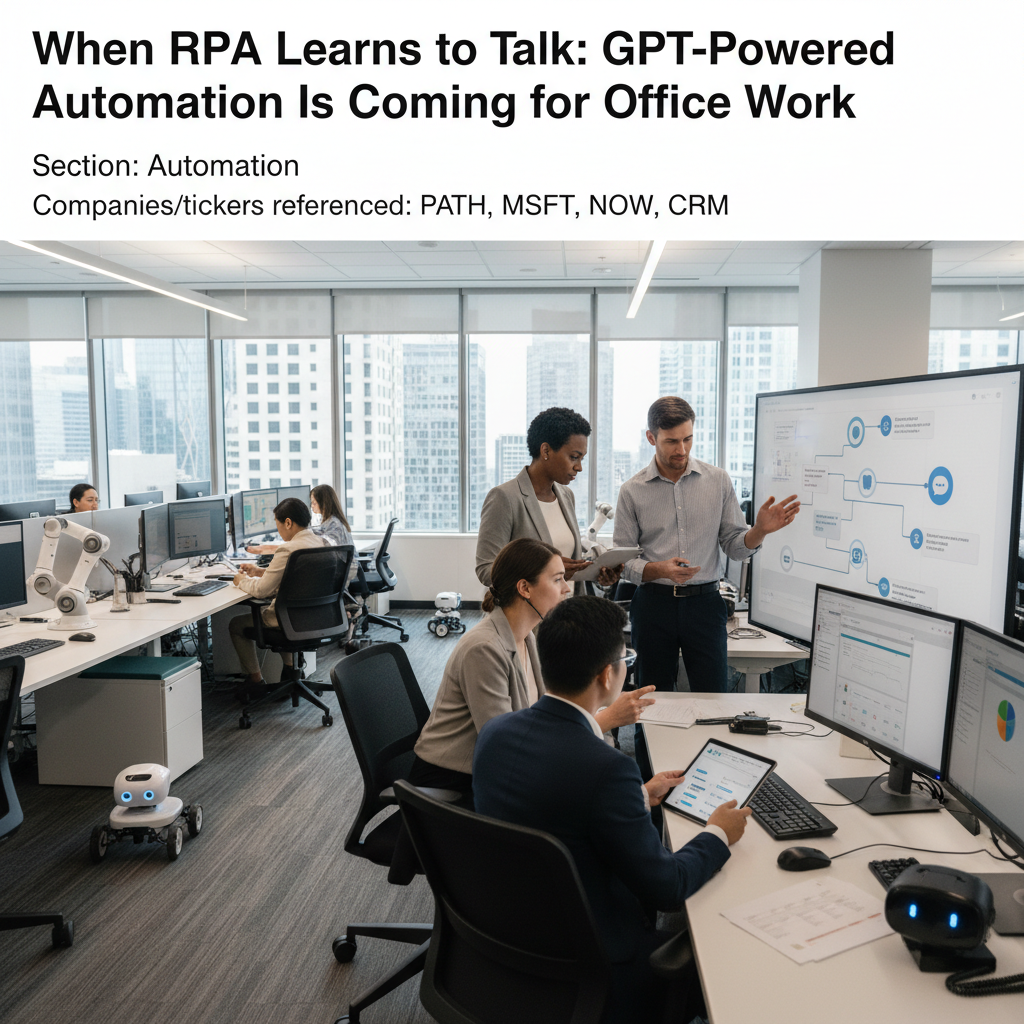
A new chapter in automation just opened. For the last decade RPA handled the repetitive chores. Now add conversational AI and those bots start reading emails, drafting approvals, and negotiating exceptions. This is less about swapping out robots for intelligence than about giving existing automation a voice and a basic layer of judgment.
Why this matters is simple: language is how most white-collar work actually gets coordinated. When tools can parse policy, summarize exceptions, and draft customer replies, routine office work stops being a checklist and starts to look like a stream of decisions.
Where this will hit first
- Finance close and reconciliation: generative models can match line items, propose journal entries, and surface anomalies for human sign-off. Cycle times compress and accounting shifts from data entry to exception management.
- Customer service triage: expect AI-first bots to take the ambiguous middle 60 percent of tickets that previously required a human to read, leaving agents to focus on the knotty cases.
- Loan underwriting and claims: models that read documents and recommend rulings will speed throughput, but they also move much of the risk into model design rather than into individual operator judgment.
What's interesting here is the asymmetry: small errors in model behavior can cascade quickly across volume. That matters more than it first seems.
Why companies will move faster
- Productivity wins show up quicker than headcount changes. Shorter SLAs, fewer escalations, clear cost signals — managers notice those metrics fast.
- No-code interfaces and plug-and-play connectors let teams prototype GPT-enhanced automations without six-month IT projects.
- Vendors big and small are folding language models into their stacks, so trying something out feels less like a research project and more like a routine feature test.
Not the whole story: constraints and counterweights
- Hallucinations and compliance: language models can invent plausible-sounding justifications. In regulated workflows that shifts the bottleneck from throughput to verification.
- Hidden technical debt: brittle prompt chains, fuzzy data lineage, and slow model drift create maintenance work that is often underappreciated.
- Skills mismatch: the work becomes hybrid — you need process expertise plus the ability to supervise model outputs. That is not solved by a single training session.
In practice, though, the story is messier than a clean tech adoption curve. Some teams will underestimate oversight; others will overcentralize control.
Practical playbook for managers and practitioners
- Map decision points, not tasks. Look for where humans exercise judgment — that’s where GPT assistants should plug in.
- Put guardrails in from the start: human-in-the-loop gates, auditable logs, and test datasets that mirror real failures.
- Build AI supervision skills where the process lives. Prompting, validation, and exception analysis belong with process owners, not just IT.
A small pilot with good logging will reveal far more than a big rollout without checks.
A broader perspective
This wave echoes the spreadsheet era: initial fear of job loss, then a shift toward analysis and oversight. The difference now is speed. Adoption, and the mistakes that come with it, will happen faster.
If you run operations, start small and instrument everything. If you are building a career, learn to translate model outputs into governance actions. The tools will talk — figure out who’s listening and why it matters.