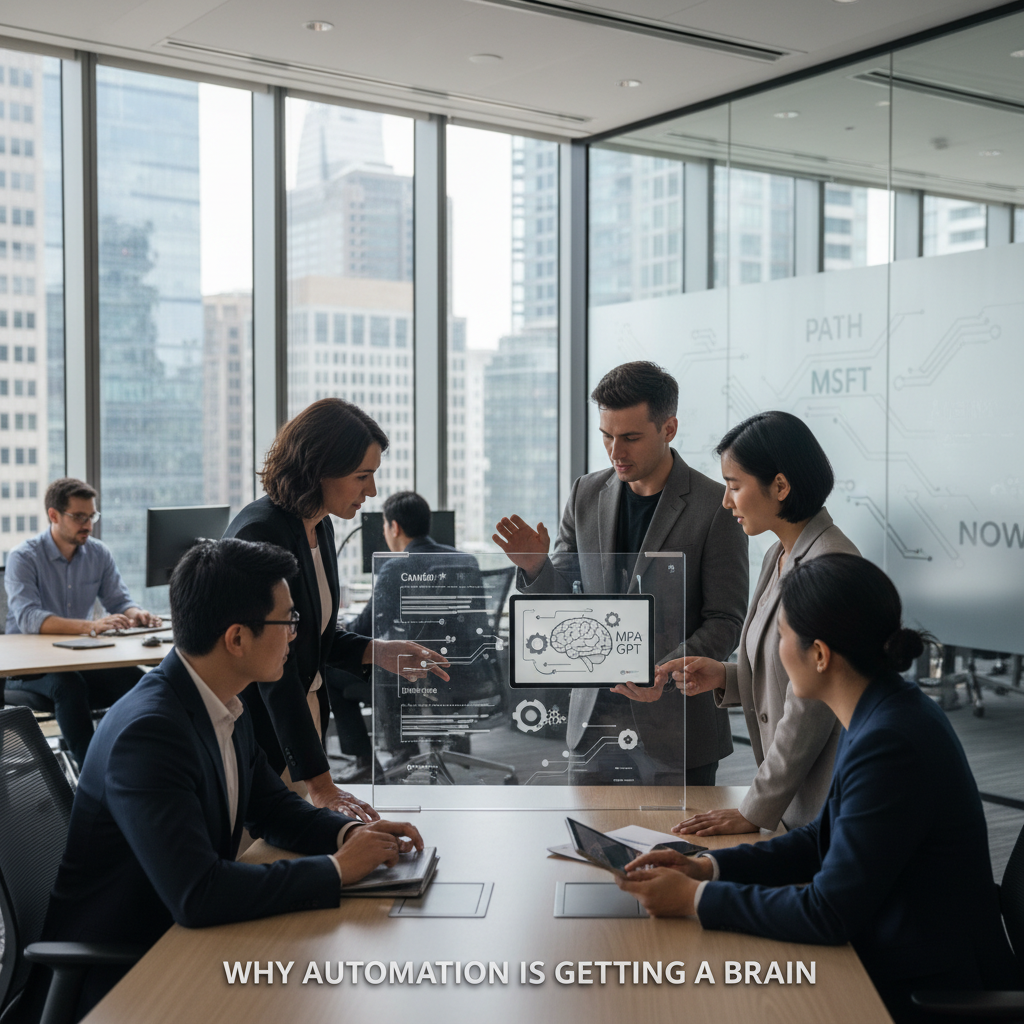
The pivot everyone expected but few prepared for
RPA began with a clean promise: teach a bot to click like a person and shave hours off repetitive work. It worked because many enterprise processes were rule-heavy and predictable. Now generative AI layers in language, judgement and messy context. The result reads less like an incremental tool and more like a new species of automation.
Why this matters now
- Generative models can turn unstructured inputs — emails, contracts, support tickets — into structured actions.
- Vendors, from old RPA shops to cloud giants, are embedding large language models into orchestration platforms. That means fewer script-heavy flows and more natural-language triggers.
- The payoff is pragmatic, not science fiction: pilots show faster exception handling and less manual casework. That matters in day-to-day operations.
Winners and losers
Some vendors will win more than others. Platforms that marry process discovery, low-code orchestration and model governance create real deployment advantages: less friction, more control. Microsoft’s Power Automate and Copilot-style assistants fit neatly into that story. UiPath and ServiceNow are becoming hybrids too, though they still wrestle with the usual enterprise work — customer inertia, messy integrations, long procurement cycles. Expect a slow, lumpy transition.
Not all roles tagged as at-risk will vanish. More likely, back-office routine work compresses while jobs that oversee, tune and audit AI-driven flows gain value. In short: fewer transaction workers, more people who can reason about models and processes.
Three practical implications for CIOs and CFOs
- Treat governance as operational, not philosophical. Hallucinations and drift are business risks. Put human-in-the-loop checks around high-value workflows from day one.
- Rethink skills, not just headcount. Demand will shift toward prompt engineers, automation architects and process miners who can turn messy operations into resilient pipelines.
- Measure differently. Add accuracy, exception rates and downstream business impact to the KPI set — transactional throughput alone won’t tell the full story.
A quick history lesson, with a twist
RPA was the 2010s answer to systems that refused to expose APIs. Hyperautomation pushed the conversation into process mining and orchestration. Generative AI now acts as the missing interpreter: it sees intent where legacy systems saw noise. That’s why some executives call this evolutionary — fair — but evolutionary shifts can still reshuffle billions in value.
The counterpoint: hype and hidden costs
Generative layers bring unpredictability. Training, monitoring, legal vetting and continuous auditing add real cost. Early adopters may capture headline productivity gains, only to find maintenance and explainability erode margins. Small firms can iterate faster; large enterprises must solve for compliance at scale. That tension will shape who moves first and who benefits most.
Here’s my call
This does not mark the end of RPA. Think of it as a rewrite. Companies that treat generative models as a neat feature rather than the new control plane will fall behind. The window to gain an advantage is brief: build governance, retrain key talent, and instrument outcomes now — or watch competitors turn messy automation wins into durable market share.
Next steps for readers
- Pick two high-volume manual tasks, run a narrowly scoped generative pilot, and keep strict human oversight.
- Map the talent gaps you need to fill: prompt design, process mining, model ops.
- Make vendors show failure modes, audit logs and real-world caveats — not just glossy demos.
This is where automation stops being purely mechanical and becomes interpretive. That change alters who profits, who pivots, and who ends up babysitting brittle scripts.