The quick read
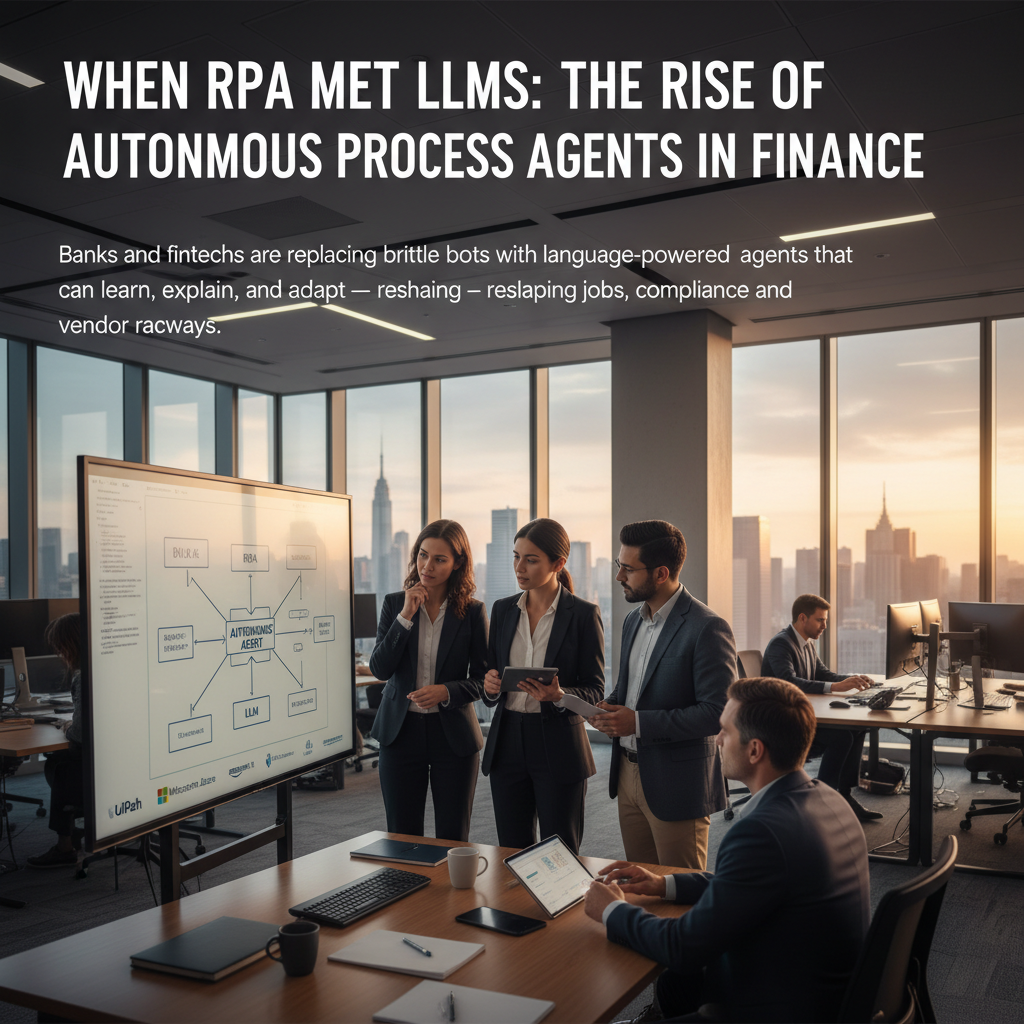
Old-school robotic process automation — the rule-based scripts that click, copy and paste — has stopped being the headline. What’s moving into production now across U.S. banks and fintechs is a new class of language-powered, autonomous process agents. They stitch together LLM reasoning, retrieval-augmented workflows and process orchestration so the system can handle the kinds of exceptions that used to halt automation cold.
Why this matters now
- Where RPA treated processes as fixed recipes, agents treat them more like ongoing conversations with state and context. The upshot: fewer brittle workarounds and faster time to deploy.
- The quick wins show up in the mid-office: KYC reviews, mortgage document assembly, reconciliation and basic surveillance. High-volume, semistructured work that used to consume human hours is where these agents pay off first.
A short history, for perspective
RPA came of age in the 2010s as a pragmatic shortcut: stick a bot on the UI and automate repetitive human clicks. It bought fast wins but also a pile of technical debt — bot farms, fragile scripts and limited explainability. LLMs change the calculus. Instead of brittle pattern-matching, agents can interpret documents, ask contextual follow-ups and route into sub-workflows. It’s a bit like moving from a tape recorder to a junior analyst who reads, summarizes and recommends (and yes, sometimes asks for clarification).
Concrete examples (not hypothetical pilots)
- Large retail banks are routing mortgage intake through agents that extract data from PDFs, flag anomalies and assemble loan packs ready for underwriters.
- Broker-dealers are pairing agents with rule engines in trade surveillance, which speeds triage and cuts false positives.
Winners and vendors to watch
Vendors that add orchestration and governance around LLMs start with an advantage. Expect incumbent RPA players to pivot or be swallowed, while cloud providers increasingly bundle automation with data and identity controls.
The downside: risk, regulation and talent
- Auditability and explainability remain unresolved. LLM reasoning can be opaque; firms need reproducible logs and deterministic fallbacks.
- Data leakage and prompt-injection are real threats whenever agents touch customer records.
- Jobs don’t disappear cleanly. Transactional roles compress, but demand grows for process architects, AI auditors and domain-trained prompt engineers.
What CFOs and heads of operations should actually do — a short playbook
- Map value: focus on high-volume, semistructured processes where exception handling explains a large share of cost.
- Build hybrid controls: run agents behind deterministic gates and require human sign-off for regulatory-sensitive outcomes.
- Vet vendors hard: insist on explainability, model provenance and end-to-end logging — not just retrieval tricks or low-level hallucination metrics.
- Invest in people: retrain processors into oversight roles and hire compliance technologists who understand both the regs and the models.
A contrarian note
Not every finance shop needs to race. Smaller firms with simple compliance footprints may stick with rule-based automation longer because it’s predictable and easier to certify. The real inflection is at scale, where complex exception handling makes agents disproportionately valuable.
If you take one thing away: this isn’t a one-off product upgrade. It’s a platform redesign. The winners will pair agents with governance, measurement and a deliberate people strategy. Expect consolidation among RPA vendors, faster productization from cloud providers, and a rising premium on explainability in regulated finance.
Pedro Marini