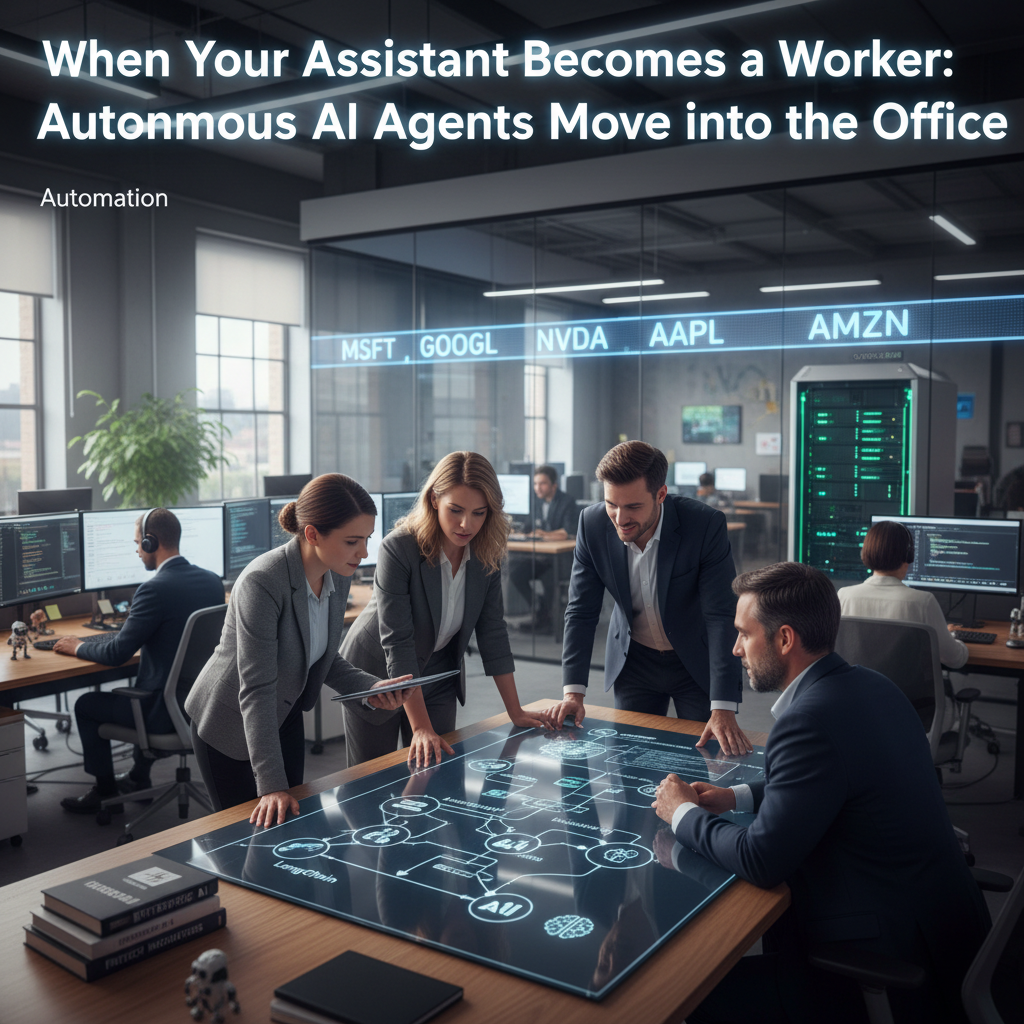
The pitch is seductive: an AI that doesn't just answer, it acts — books meetings, files reports, and stitches data across apps. Over the past year the theoretical dream of autonomous agents has slipped out of GitHub demos and into paid products aimed at knowledge workers. What used to be a hobbyist playground of Auto-GPT and browser-scraping scripts is now a battleground for enterprise adoption.
Three forces are pushing this forward.
- Tooling has matured. Frameworks such as LangChain and emerging orchestration layers make it much faster to hook large models up to real-world APIs. Projects that once took months can now be prototyped in days.
- Cloud and compute costs have shifted. Inference pricing has dropped and vector stores are becoming a de facto standard, so running persistent agents is less of a budget shock than it used to be.
- User demand is real. Teams desperate to shave hours off repetitive flows — expense triage, competitive research, first-draft contract reviews — are willing to try bold solutions.
But this move from assistant to worker surfaces real friction. What’s interesting here is how quickly technical convenience exposes operational risk.
- Hallucinations at scale. When an agent scrapes, summarizes, and then acts, a single bad inference can cascade through systems. That can produce plausible but incorrect invoices or legal drafts that look actionable.
- Security and access control. Granting an agent permission to read calendars, email, or HR systems increases the blast radius. Centralized policies exist in theory, but IAM integrations are often messy in practice.
- Accountability and audit trails. Multi-step agents make decisions across silos. Logs are generated, yes, but tying those logs to a clear human approval path that stands up in an audit is still a new discipline.
We’re starting to see patterns among vendors and early adopters, though they’re far from universal.
- Guardrails first. The healthiest deployments begin by constraining agents: narrow scope, human checkpoints, strict API quotas. Safer, slower, but survivable.
- Composable agents. Instead of one giant generalist, teams build small specialist agents — a meeting scheduler here, a procurement helper there — and stitch them together.
- Vertical tuning. Legal, finance, and sales want domain-specific agents. A contract-review agent trained on M&A clauses behaves very differently from a generic summarizer.
Concrete examples help make this less abstract.
- A mid-sized ad agency used an agent to ingest RFPs, draft proposals, and prefill bid templates. Proposal cycle time dropped by about 40 percent. But the QA workload didn’t disappear; small factual errors cropped up and had to be fixed manually.
- A fintech pilot employed agents to reconcile merchant disputes. Agents matched transactions roughly 70 percent of the time, but ambiguous merchant descriptors led to false positives. Engineers responded by adding a provenance layer so every decision could be traced back to a source.
If you’re watching from the sidelines, a few pragmatic moves make sense.
- Start small: automate narrowly scoped tasks where outcomes are auditable.
- Treat agents like software: version control, phased rollouts, and active post-deployment monitoring.
- Invest in provenance: keep sources, prompts, and intermediate outputs so humans can reconstruct how a decision was reached.
There’s also a strategic fight under the surface: who owns the intelligence layer? Big cloud and SaaS incumbents are positioning agent platforms as workflow lock-in. A new wave of startups promises neutrality and portability. It feels a bit like the browser wars, except the currency now is automation rather than pageviews.
For executives the trade-offs will be familiar. Fast automation can boost throughput and reduce headcount costs, but it also forces upgrades in security, compliance, and governance. The sensible path is incremental adoption paired with serious investment in controls.
Autonomous agents are not a drop-in replacement for human judgment. They amplify both strengths and mistakes. Companies that treat them like industrial equipment — engineered, monitored, and governed — will probably get the safest returns.
Expect more pilot programs in the next 12 months, a crop of specialized agent vendors, and real debate over control, audits, and liability. The technology is moving faster than the governance around it, and that gap will help decide winners and losers.