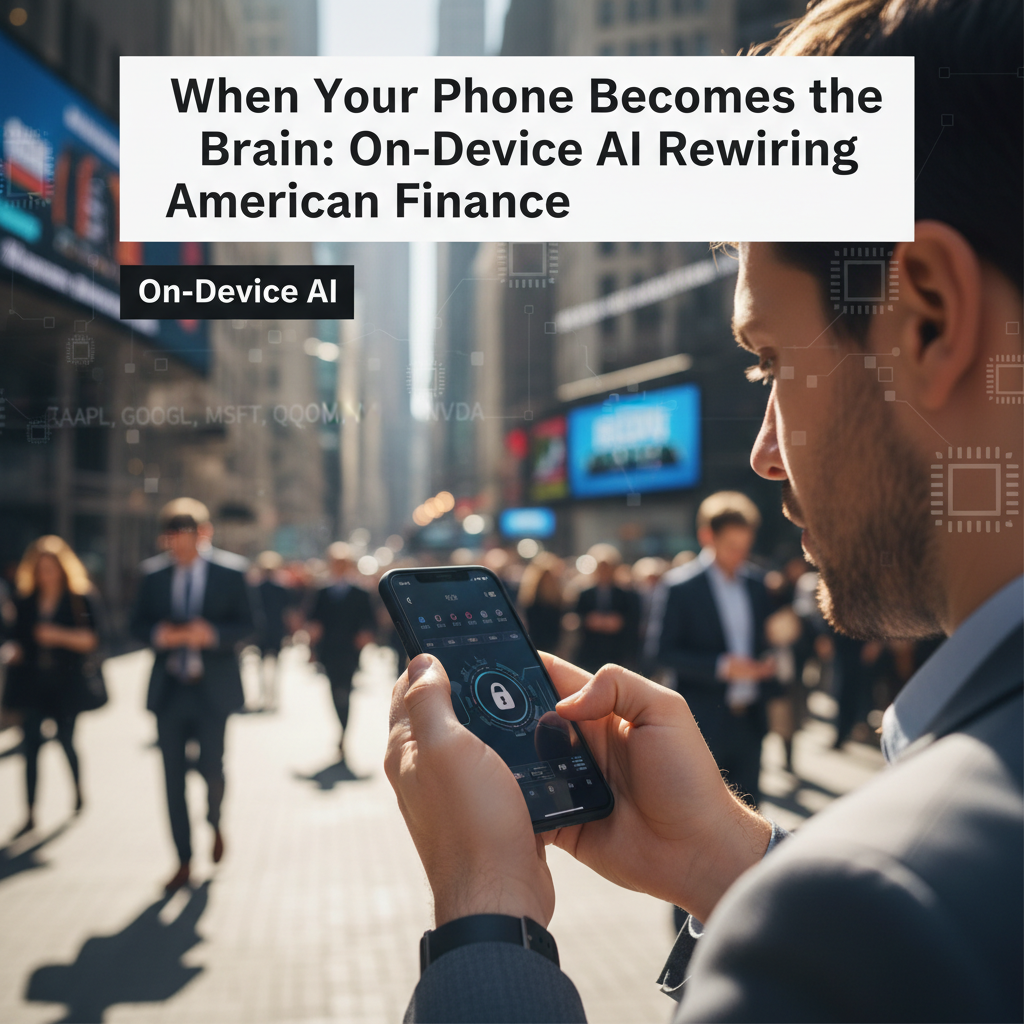
Smartphones are eating the cloud for breakfast
The move from server-side AI to models that actually run on phones is not just a speed tweak. It shifts who owns data, how products are priced, and where regulators look. In finance that shift matters in a practical way: latency, privacy and uptime are not nice-to-haves — they often determine compliance outcomes.
What’s changed
- Mobile neural engines and much smaller LLM architectures have reached the point where credible natural-language assistants can run locally on flagship phones. That used to feel futuristic; now it’s a realistic product decision.
- For American banks and fintechs this can mean instant transaction categorization, offline credit checks, and fraud scoring with almost no lag. Useful in ordinary consumer flows and critical in high-frequency decisions.
Why investors should pay attention
On-device models move costs from recurring cloud GPU bills to device-oriented expenses. Firms can pay once for a compressed model or tuck AI features into premium plans. Suddenly the math changes: acquisition tactics look different — give the model away, monetize real-time data streams or execution paths. It sounds simple, but it rewrites unit economics for mobile-first players and forces a rethink of pricing and retention.
Real implications for consumers and banks
- Faster and more private. Budgets and balances can be analyzed on-device, so less sensitive data leaves the handset and breach risk shrinks.
- Better offline resilience. Rural customers, travelers, or anyone with spotty service can still use sophisticated features.
- New compliance headaches. Institutions that depend on centralized, auditable decision trails will have to redesign logging when significant decisions are made by ephemeral local models.
Trade-offs and risks
Edge models are compact by necessity, which means gaps in nuance and domain depth versus big cloud models. Security concerns shift too: side-channel attacks, poisoned local updates, and divergent behavior across device generations make rollouts messy. Regulators will insist on reproducibility and auditability — and that’s harder to guarantee when the model lives on millions of different handsets.
A short history lesson
This pattern is familiar. Computing moved from mainframes to desktop PCs, then to cloud services. Each wave created winners and losers: client-focused startups rose, incumbents recast themselves as service providers. Expect similar churn now, with chipmakers, OS vendors and banks all jockeying for position.
Where money will flow
- Chipmakers and OS vendors can capture value through licensing and premium silicon — think banking-grade neural engines baked into flagship chips.
- Fintechs will try to monetize bundled device services, tiny recurring fees, and APIs that let local models signal to the cloud for settlement and regulatory reporting. Hybrid models win: local inference for speed and privacy, cloud for accounting and compliance.
If you care about finance — building products, investing, or managing risk — watch how mobile silicon, model compression and banking rules come together. On-device AI promises speed and privacy, but it forces firms to redesign controls and rethink revenue. That tension is where the next generation of fintech winners — and a fresh round of regulatory fights — will emerge.
Pedro Marini brings reporting and analysis from the crossroads of silicon, software and Wall Street.