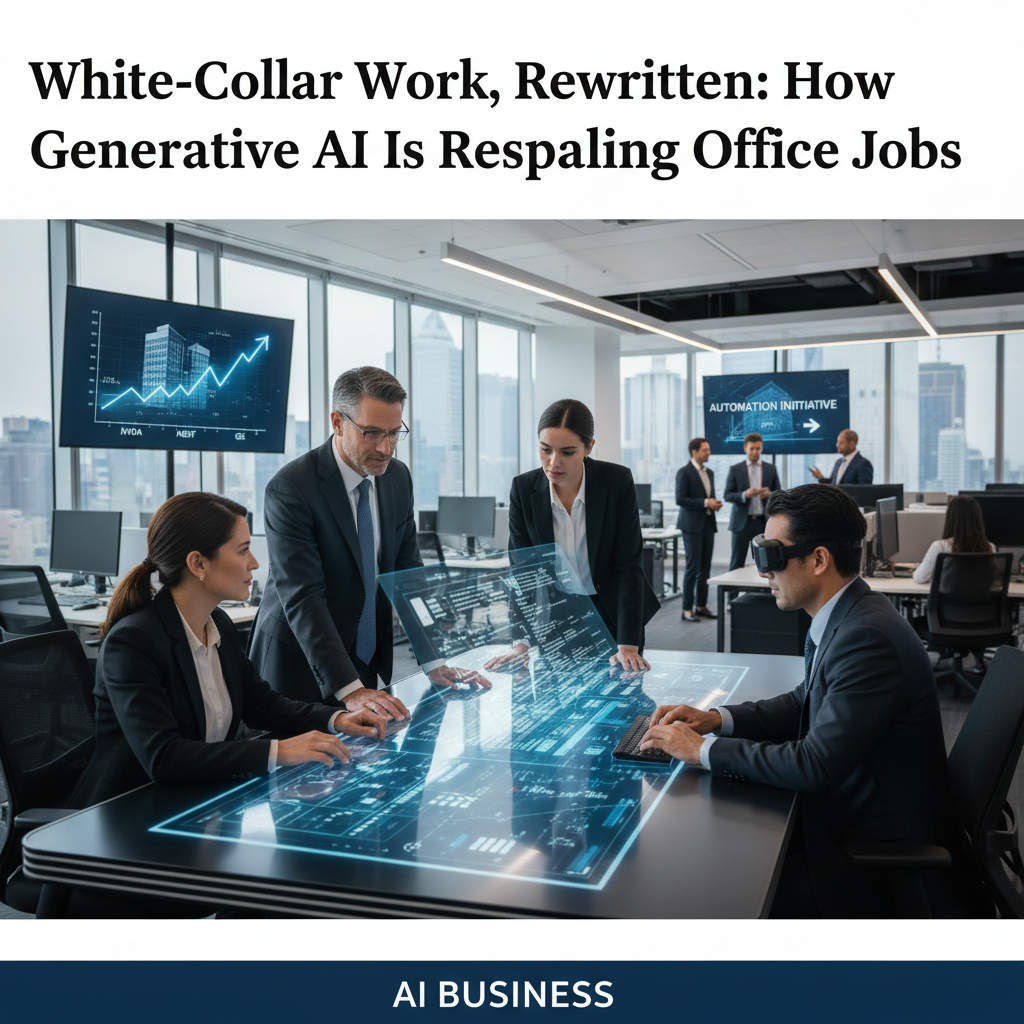
The headlines make it sound binary: AI will either kill jobs or create them. Reality is messier.
In the last year large language models quietly moved from impressive demos into everyday tools at banks, consultancies, law firms, and marketing shops. I’ve watched pilot projects become practical helpers that paraphrase research, draft client emails, summarize contracts, and crank out slide decks — usually faster than the teams that started them.
Speed matters. A well-tuned model can shave routine knowledge tasks down by half or more. For managers watching margins, that shows up as fewer billed hours and, in some cases, fewer roles. The layoffs you read about are not random; they often target positions where tasks have become repeatable and automatable.
That said, automation is not synonymous with wholesale unemployment. Two opposing trends are emerging that are worth separating.
- Augmentation. Senior analysts and creatives are using AI to get to better outputs faster. That raises expectations, and it raises the value of strategic judgment, deep domain knowledge, and client relationships.
- Task restructuring. Many jobs are being refactored rather than erased. A role that used to be 80 percent rote and 20 percent judgment is shifting toward 20 percent prompt work and 80 percent interpretation and decision-making.
Some practical consequences for firms and workers:
- Faster cycles. Consulting pitches, legal due diligence, research briefs — all are produced at a cadence we didn’t have a year ago. Firms now face pressure to either offer more for less or to charge a premium for AI-augmented, higher-touch services.
- Skills premium shifting. Comfort with prompting, data hygiene, model testing, and domain fine-tuning is becoming a real edge. Academic credentials still matter, but the ability to marshal AI outputs is increasingly central.
- New risk work. Models still hallucinate and can leak sensitive information. Firms juggling client confidentiality and regulators are spending on engineers and lawyers to build guardrails.
A little history helps. Office automation has been changing roles for decades — spreadsheets, email, workflow tools — but each wave shifted what people were paid to do. What’s different now is the scope of tasks affected and how quickly those changes can be rolled out.
That speed produces uneven winners. Early adopters with deep pockets and rich data — big banks and major tech incumbents — tend to capture better margins and attract talent. Smaller firms are left with a tougher decision: invest in integration or double down on human-differentiated services where they can still compete.
If you work in knowledge work, practical moves that make sense right now:
- Learn prompt design and model validation; treat models as sophisticated collaborators, not something you trust blindly.
- Build domain-specific datasets and playbooks so outputs are reliable for your niche.
- Emphasize client-facing judgment, negotiation, and ethical oversight — areas where human credibility still pays.
Policy is lagging. Lawmakers are only starting to wrestle with liability, IP, and workforce transitions. Expect a patchwork of corporate governance and regulation before anything coherent appears.
So, neither apocalypse nor panacea. Generative AI is a fast engine of task-level change that rewards adaptability and punishes complacency. The real question for firms is how to combine human expertise with model scale without eroding institutional trust. For workers, it’s less about the specific tasks you do today and more about the distinct judgment you bring to what AI produces.