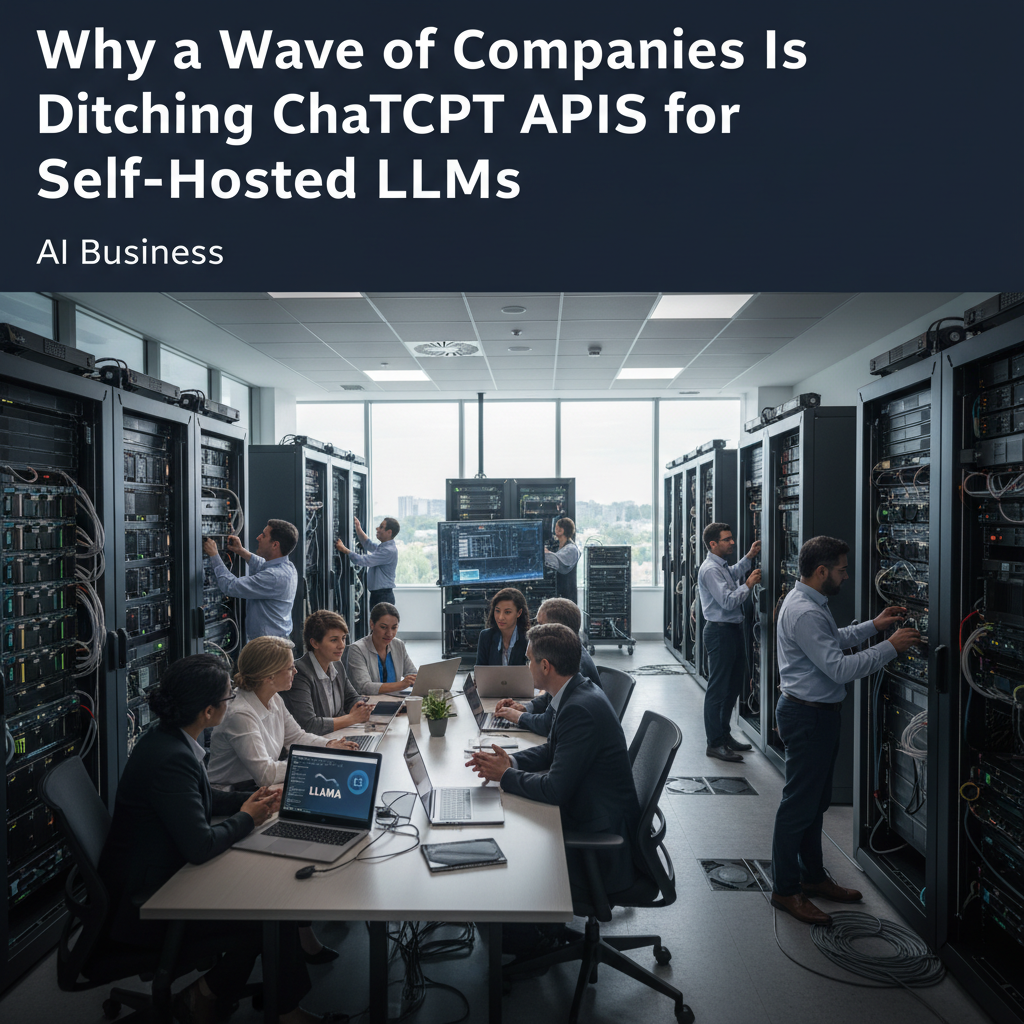
The shift is less about ideology and more about the ledger. Over the past year a clear pattern has emerged: companies that once happily routed language tasks through API vendors are increasingly running their own large language models — either on-prem or on dedicated cloud instances.
Why now? A few blunt realities explain the move.
- Cost. API bills climb in direct proportion to use. If your chat or search system sees millions of queries, those monthly invoices get painful fast. Self‑hosting — especially with newer, efficient open models — can cut inference costs noticeably when traffic is steady.
- Data control and compliance. Regulated sectors like healthcare and finance, or teams worried about leaking IP, prefer setups they can inspect, log, and isolate from vendors’ retention policies.
- Latency and customization. Putting the model closer to users reduces round‑trip time and makes it easier to tune behavior or integrate specialized retrieval systems without every call leaving your environment.
This isn’t a purity test for open source. Companies such as Meta (the Llama family), Mistral, and a raft of startups have made on-prem alternatives practical. At the same time, cloud providers now offer managed racks and inference accelerators that make hybrid deployments realistic — less ops friction, more choices.
What this shifts in the market
- Cloud providers. Expect revenue to become more nuanced. Raw compute grows, yes, but real value migrates to integrated tooling — vector databases, monitoring, governance. Microsoft and AWS are racing to bundle experiences that feel like self‑hosting without the full operational grind.
- Chipmakers. Demand for inference‑tuned silicon is rising. That helps players selling specialized GPUs and accelerators — lower power, higher throughput boxes that slide into private clouds.
- Startups and integrators. There’s a hot market for model‑ops, fine‑tuning-as-a-service, and audit/compliance tooling. Business models shift away from per‑call pricing toward retained services and SLA-backed hosting.
A couple of pushbacks, because nothing is free
- Maintenance burden. Models aren’t plug‑and‑play. You’ll chase updates, patch vulnerabilities, and fight model drift. Many teams underprice that operational tax.
- Legal and safety risk. Hosting it yourself doesn’t dodge regulators. You still need guardrails, red-team testing, provenance logs.
Small vignette: a regional bank I spoke with chose a distilled open model in a private VPC for its customer chat. Not out of vendor distrust so much as auditor demand — they wanted a clear chain of custody for every suggestion the model made.
If you’re deciding today
- Figure out whether your workload is bursty or steady. APIs are easier for spikes; self‑host if you have constant, high‑volume traffic.
- Budget for ops. Plan on a small in‑house team or a partner to handle deployments, security, and retraining.
- Think past the weights. Retrieval layers, vector indexes, and guardrails often end up being the real differentiators.
The broader pattern is familiar: the market is fragmenting from a few centralized APIs into a layered ecosystem where control, cost and compliance matter. It’s not a sudden technology reset so much as the industry deciding who keeps the keys.
My read: expect a long tail. Centralized APIs won’t vanish — they’ll remain great for prototyping and low‑volume apps — but enterprises hungry for control will keep self‑hosting LLMs a strategic play for years.