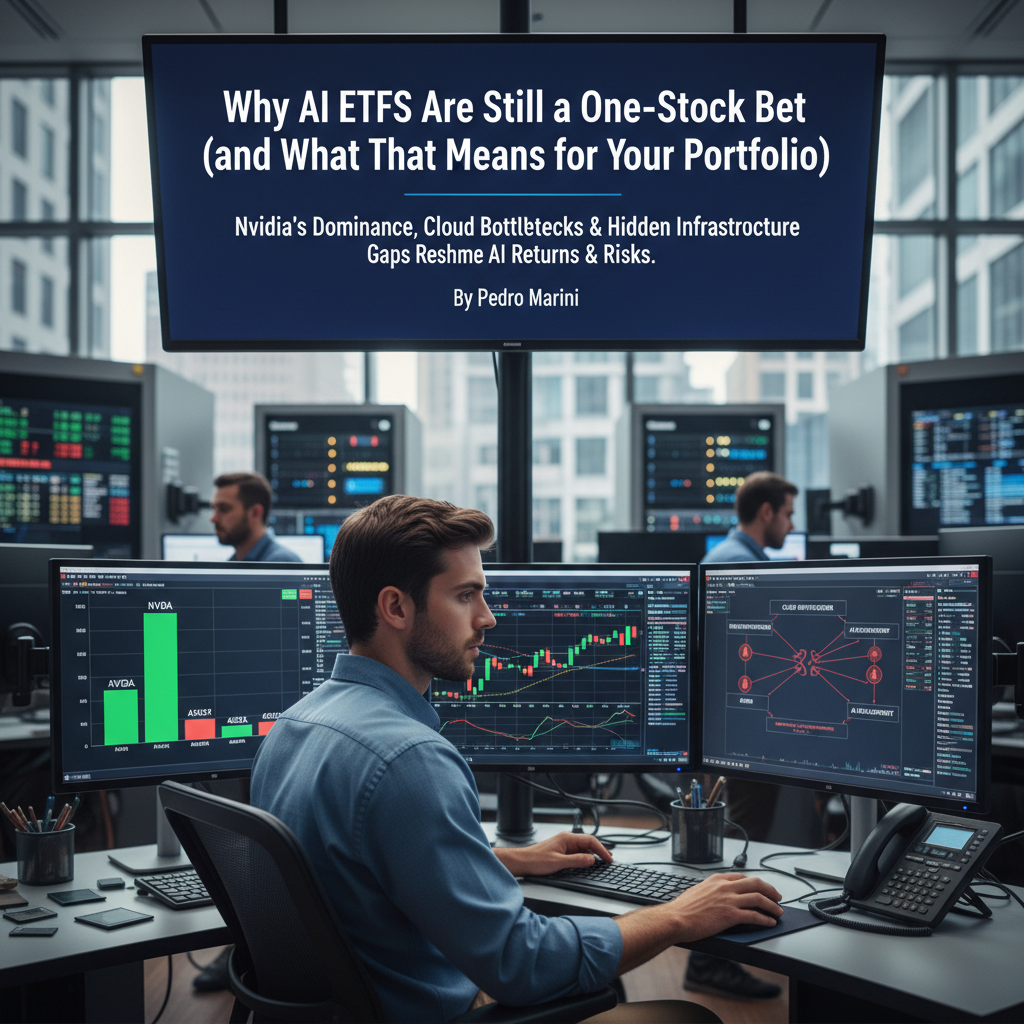
AI investing looks diversified on paper, but feel for the market says otherwise.
Over the past two years, investors poured money into a raft of AI-themed ETFs and mutual funds, chasing a sector everyone expects to rewrite corporate margins. On paper these products promise exposure across chipmakers, cloud vendors, enterprise software and startups building applications. In reality, one name often ends up carrying the whole story.
Why concentration isn’t just algebra
Nvidia became the default hardware backplane for large-scale generative AI training. When a handful of models and platforms standardize on the same silicon, passive funds designed to capture the AI wave naturally inherit that weighting. Prices rise, headlines follow, more money flows into funds that already own the chipmaker — a feedback loop. It’s less an industry and more a festival where one headliner sells out the place.
Cloud and supply constraints change the tempo
AI eats GPUs, networking, power and orchestration software. So cloud providers and the data-center supply chain matter as much as the chip itself. A shortage of racks or a jump in energy costs can slow adoption almost as effectively as a hardware shortfall. That mix — concentration plus infrastructure bottlenecks — reshapes the risk profile for investors.
Three practical implications
- Idiosyncratic risk goes up. A problem at a single dominant firm can pull the entire theme down. History shows how fast winners can become losers when sentiment flips.
- Valuations become fragile. When market prices assume near-perfect execution, there’s very little room for mistakes from the names everyone owns.
- There are overlooked beneficiaries. Network equipment, power-management firms, specialized foundries and orchestration platforms can profit from the AI build-out without carrying the same frothy multiples.
A quick history note
Think back to 1999–2000. Broad narratives coalesced around a handful of brands that seemed unstoppable. When reality diverged, concentrated exposures amplified losses for thematic investors. This time the product is different — compute rather than clicks — but the pattern is familiar enough to warrant caution.
Where to look without making a single-stock bet
If you want AI exposure but don’t want to effectively own one company, try a few approaches that have worked in practice:
- Shift into funds that cap position sizes or use equal-weight methodologies rather than those dominated by a single stock.
- Add cloud-infrastructure plays that get paid as models scale: data-center REITs, networking vendors, and firms that sell power or capacity to hyperscalers.
- Consider enterprise software platforms that operationalize AI. They won’t capture training upside, but their revenue streams tend to be steadier.
- Use options or explicit hedges to protect concentrated stakes instead of reflexively selling into every pullback.
A counterpoint worth admitting
There is a rational case for concentration. Network effects, ecosystem lock-in and a dominant architecture can deliver sustained profits. If you believe the market will crown a few long-term winners, owning the leader is a legitimate, even sensible, bet. The real question is whether today’s price already bakes in that certainty.
A pragmatic checklist before you allocate
- Look at fund-level concentration, not just the sector label.
- Ask how much of the AI roadmap depends on one supplier or one cloud provider.
- Stress-test your holdings against a headline shock for the largest name.
- Lean toward diversification when multiples are high and execution risk is tangible.
So: AI is likely to reshape many businesses. But the easiest way to participate has paradoxically narrowed — many AI funds are, in effect, one-stock bets. That can work out, or it can concentrate narrative risk. For investors who prefer exposure without a single point of failure, the smarter play may be the parts of the ecosystem that get paid whether the chips are hot or not.