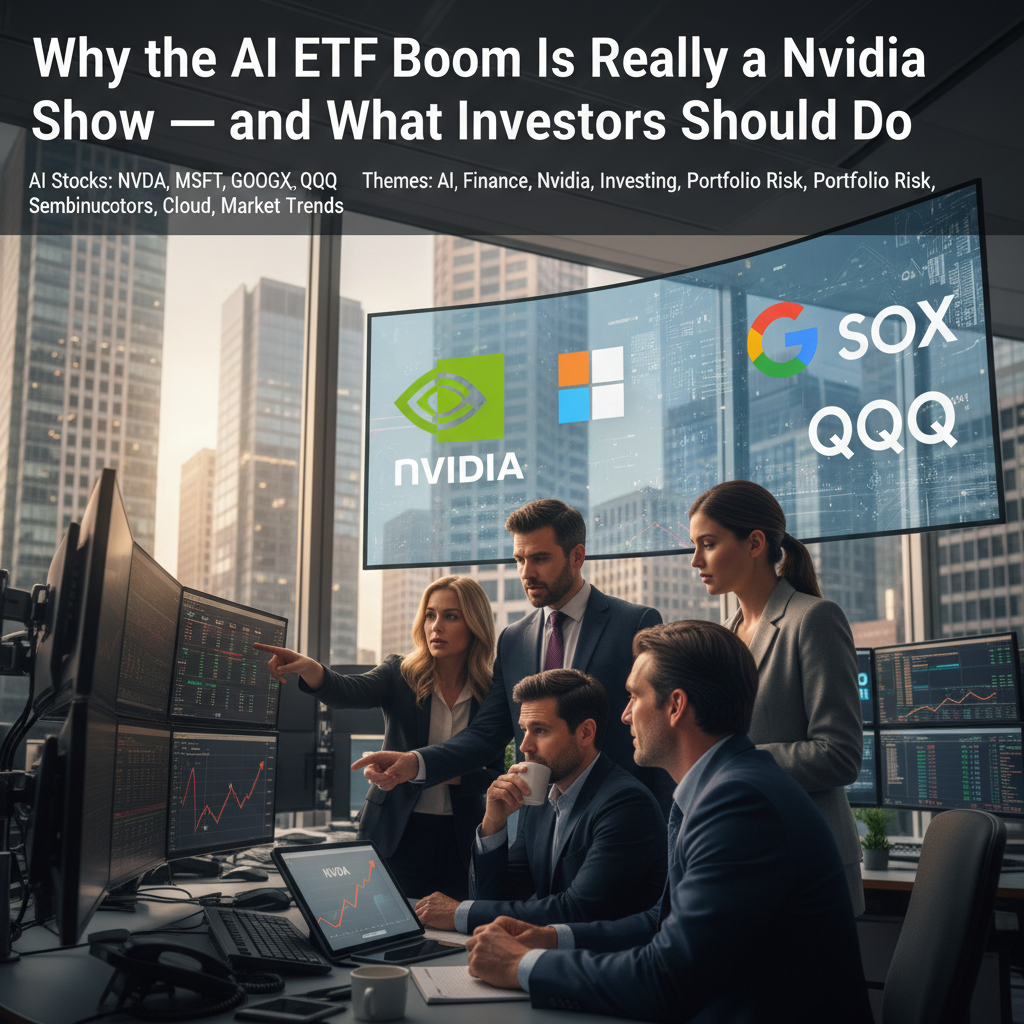
The headline is simple: money is pouring into AI-branded ETFs and funds, yet most of the market action is carried by a very small group of stocks — with Nvidia at the center.
That’s not hair-splitting. When a thematic ETF ends up concentrated in a few names, buying the theme often means you’ve made a bet on one or two companies while still paying ETF fees for diversification you may not actually have.
Why it matters now
- AI stopped being an academic curiosity a while ago; it is now the dominant earnings narrative across semiconductors, cloud infrastructure, and enterprise software. Momentum begets flows, and flows reinforce momentum.
- Marketing for AI ETFs is straightforward: exposure to next-generation winners. That pitch works. But many of these funds’ top holdings look more like concentrated tech bets than broad, diversified baskets.
- The market microstructure effect is real: when a handful of stocks drive index returns, ETF inflows and outflows can amplify moves in those names, raising volatility for everyone exposed.
A few sharper observations
- There’s a historical echo here. This resembles episodes in the early 2000s and late 2010s when single sectors and a few giants carried indexes. Some companies sprinted ahead; many didn’t.
- The business dynamics aren’t identical. Nvidia benefits from a hardware-driven surge in datacenter GPUs — scarcity and capacity matter. Microsoft, Google and others are selling AI-as-a-service, which looks more like recurring software revenue. That distinction changes risk and return profiles.
- Risks are asymmetric. A new export rule or a supply-chain shock can disproportionately hit chip makers in ways it would not a diversified cloud franchise.
What this means for investors
- If you bought an AI ETF expecting broad diversification, look at the top 10 holdings. If a single name is a double-digit weight, you’ve got a high-beta position on that company whether you meant to or not.
- For longer-term portfolios, think in layers:
- Core exposure via broad large-cap ETFs.
- Smaller satellite allocations to AI-themed funds or to individual stocks, sized deliberately.
- Dollar-cost averaging to avoid mistiming a market that feels frothy.
- If you trade actively, watch liquidity and options skew on the biggest names. ETF flows can set up one-way pressure that magnifies squeezes or gamma-sensitive moves.
What asset managers will say — and what skeptics will respond
- Managers will argue thematic ETFs democratize access to a structural trend without the need to pick individual winners.
- Skeptics will point out that a wrapper doesn’t erase concentration or valuation risk. It can make exposure look simpler than it actually is.
The simplest way to get burned is to assume theme equals diversification. AI is real and will reshape profit pools across industries, but today the story often condenses into a handful of giant companies. Know exactly what exposure you own, and size positions accordingly.
Quick checklist for today’s AI investor
- Review the top 10 holdings before you buy.
- Size positions so a single-stock move won’t derail your portfolio.
- Pair thematic exposure with broad-market core holdings.
- Reassess after major earnings reports or regulatory developments.
This is a genuine technological inflection, not just a meme. Treat it like technology investing: there are large opportunities, and there are operational and concentration risks that deserve respect.