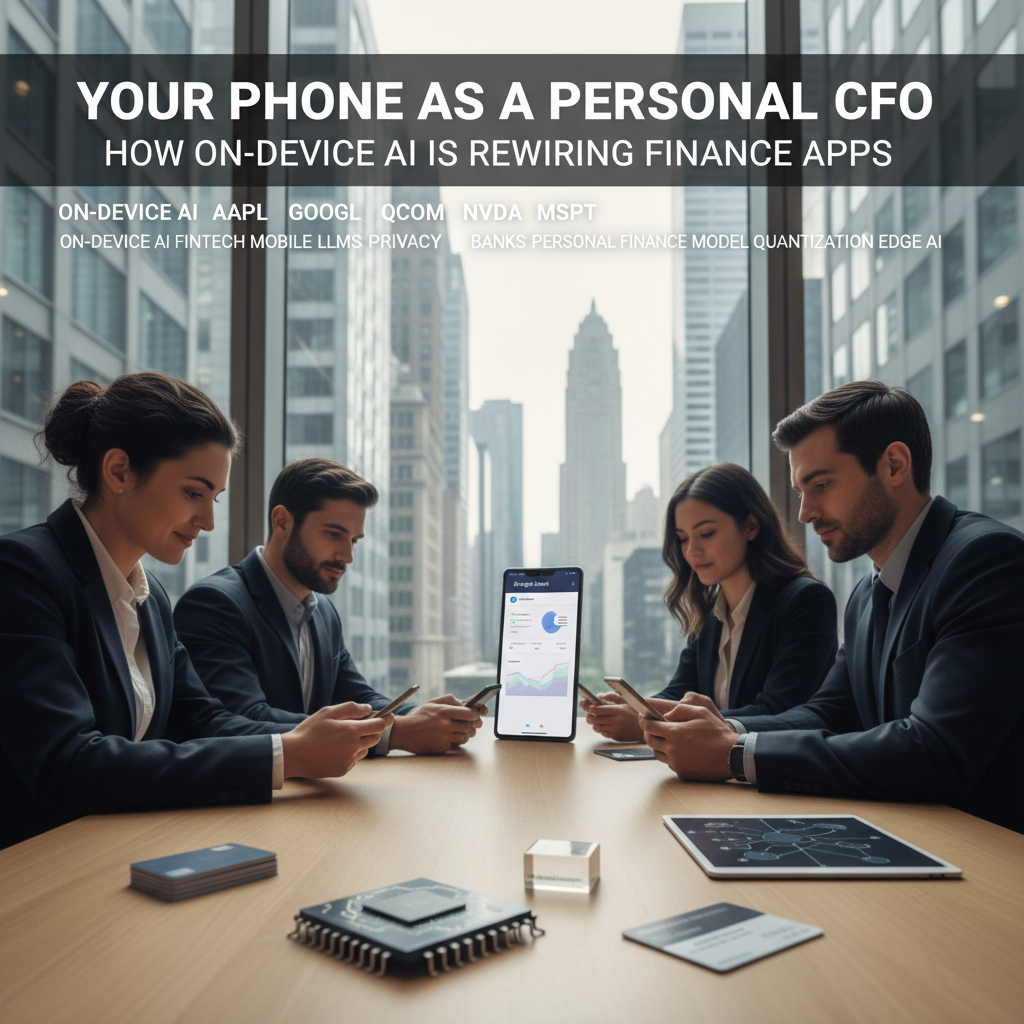
Thesis in one line: modern phones are becoming capable of running finance-grade AI locally, and that shift will change who controls financial advice, where data flows, and how monetization works.
Mobile AI feels like an awkward teenager right now: powerful, a bit messy, and promising more than it comfortably delivers. Over the past 18 months, faster neural engines, smarter quantization and model-distillation tricks, and chips built for matrix math have quietly pushed usable LLMs out of data centers and into pockets. That matters for personal finance in ways we tend to gloss over.
Why this upgrade matters — and how it’s different
- Performance and privacy now pull in the same direction. If a model runs on-device you get lower latency and your sensitive prompts don’t have to cross third-party servers. For lots of users that tradeoff beats a small accuracy advantage in the cloud.
- The balance of trust shifts. Banks and fintechs no longer monopolize advice; device makers and silicon vendors become strategic partners or outright competitors.
- Costs change shape. Developers can dodge recurring cloud compute bills, but they invest more in engineering time to compress, tune, and ship models that behave well on limited hardware.
Concrete examples already appearing
A budgeting app with a compact on-device model can scan receipts and categorize spending instantly — even underground. That immediacy changes user experience and retention in a way weekly batch processing never did.
Offline tax assistants that pre-fill forms from local data reduce friction during peak season, when cloud queues and spikes make waiting painful.
Fraud detection running on the phone can flag odd transactions in real time, before data ever leaves the device. That’s not hypothetical; teams are shipping prototypes.
Technical levers making this feasible
- Quantization and pruning shrink models with tolerable accuracy loss.
- Tiny fine-tuning layers, such as LoRA, let apps personalize behavior locally without uploading raw user data.
- Hybrid architectures keep privacy-sensitive inference on-device while using the cloud for heavier retraining or high-stakes calculations.
Winners and losers — a quick read
Chipmakers and OEMs look good. Companies that build flexible neural engines into their silicon will pull fintech partners toward them. It feels a bit like the app store wars, but the prize is model execution.
Cloud providers still win on scale and compliance-heavy enterprise workloads; their role shifts toward orchestration and governance rather than pure compute.
Traditional banks face both threat and opportunity. They can bake on-device assistants into their apps and tighten customer relationships, or they can cede ground to nimbler fintechs that deliver a faster, cleaner UX.
Risks and practical limits
Local models can still fail in subtle ways. Auditing and explainability get harder when models are compressed and customized per user. That matters for regulated financial advice.
Regulatory rules haven’t kept pace. An on-device assistant can sit in a grey area between harmless suggestion and regulated advice; expect friction there.
Device constraints — battery, heat, storage — will keep the largest models in the cloud for the near term. This is incremental change, not an overnight flip.
What consumers should look for
- Does the app clearly state that processing stays on the device? That’s a real privacy signal.
- How are edge cases and required disclosures handled? A clear fallback to human advisers for high-stakes situations is a good sign.
- Which device makers and chip partners does the company name-check? Those alliances often predict who gets better models first.
What’s interesting here is how this echoes earlier shifts in computing: central servers, then a swing to the edge. This time the stakes are people’s money and identity. For product leaders and investors the sensible bets are to partner with silicon, make privacy guarantees meaningful, and build smooth cloud paths for compliance. For consumers, expect faster, smarter, more private tools — with tradeoffs in battery life and the depth of long-form reasoning.
Net effect: phones stop being mere portals to financial services and become the place where advice actually happens. That change will reprice trust and rearrange who takes a cut of the personal finance ecosystem.