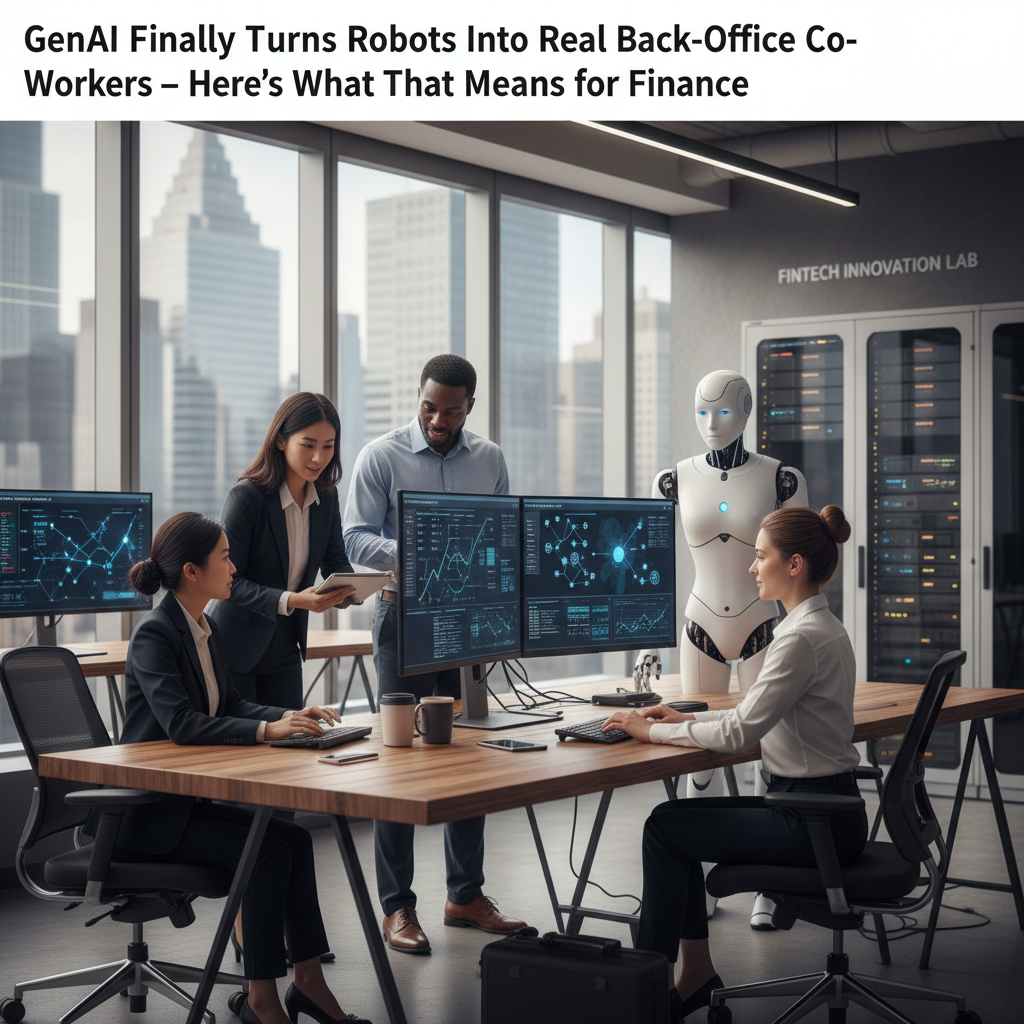
The shift is happening now. For a long time robotic process automation meant brittle scripts clicking through screens. Add generative language models and those scripts suddenly start to reason, summarize and adapt. This is not hypothetical: enterprise RPA vendors and cloud providers are embedding LLMs into workflow engines, and finance teams are the ones pushing hardest.
Why finance is leading
Finance is full of repeatable, document-heavy work — reconciliations, invoice matching, KYC reviews, loan-file checks. High volume, lots of paper (or PDFs), and regulators watching closely. That makes cost savings easier to measure and risk easier to justify. Also, these processes tend to have clear success metrics. So the math works.
- Faster exception handling. Instead of routing a flagged invoice for human triage, a model can extract fields, normalize values and suggest a disposition — reducing back-and-forth.
- Better compliance notes. Generative models can draft summaries of suspicious activity, so investigators spend time on judgment instead of verbatim transcription.
- End-to-end automation. RPA handles orchestration while language models tackle messy inputs: emails, scanned documents, chat logs. It’s the parts that used to require reading.
What’s interesting here is that small gains compound. Shave minutes off many tasks and headcount and SLAs both move.
Who’s building it
UiPath has spoken openly about integrating large models into its stack. Microsoft is folding Copilot-style assistants into Power Automate and the Power Platform, blurring the line between citizen automation and developer workflows. On the infrastructure side, Nvidia GPUs and on-prem inference racks let banks keep sensitive models behind firewalls — a practical necessity for many institutions.
A practical example
Picture a mid-sized bank handling commercial loan renewals. Today a loan officer reads dozens of emails, reconciles documents and writes a renewal memo. With GenAI-powered RPA, the system extracts key dates, flags covenant breaches, drafts the memo and only queues high-risk files for human review. The bank saves time and redeploys officers toward client-facing work. In practice, though, you’ll still want humans on tricky cases — the models help triage, not replace judgment.
The upside — and the snag
The benefits are tangible: cost per transaction drops, SLAs improve, turnaround times shorten. But new fault modes appear.
- Hallucinations matter. A model that invents a contract term can trigger costly manual audits.
- Auditability is essential. Regulators will expect deterministic logs and some form of explainability; many current approaches are still opaque.
- Skills mismatch. Some roles will shrink, others will need model-supervision skills. Expect demand for automation analysts who can translate business rules into guardrails.
Not everything is binary. Some hallucinations are harmless; others are not. The key is knowing which is which.
How firms are managing risk
- Human-in-the-loop thresholds so the model handles routine items and escalates edge cases.
- Hybrid deployments that keep sensitive inference on-prem while using cloud models for less-sensitive tasks.
- Synthetic testing and red-team exercises to surface hallucination patterns before wide rollout.
These measures reduce risk but don’t eliminate it. Expect iterations.
Where investors should look
Watch for real enterprise adoption and sticky partnerships instead of headline-driven hype. Signs to favor:
- Vendors that build governance into the product rather than bolting it on.
- Partnerships with cloud or GPU providers that enable secure, scalable inference.
- Early traction in regulated industries — banks, insurers, healthcare — where the bar for compliance weeds out weak implementations.
Those elements separate durable businesses from one-off integrations.
A practical view
This is more than a productivity feature; it changes how cognitive work is automated. Rollouts will be messy, regulations will push back, and job descriptions will shift. But organizations that invest in governance plumbing now will see meaningfully faster, cheaper and more flexible back-office operations within 18 to 36 months.
Quick checklist for finance leaders
- Start small: pilot reconciliations or billing exceptions.
- Require explainability and audit logs from day one.
- Upskill staff to supervise models and tune automation.
The market will sort builders who bake governance into their stacks from those who slap AI on and hope. For finance, that difference will show up both on the bottom line and in regulator exam rooms.