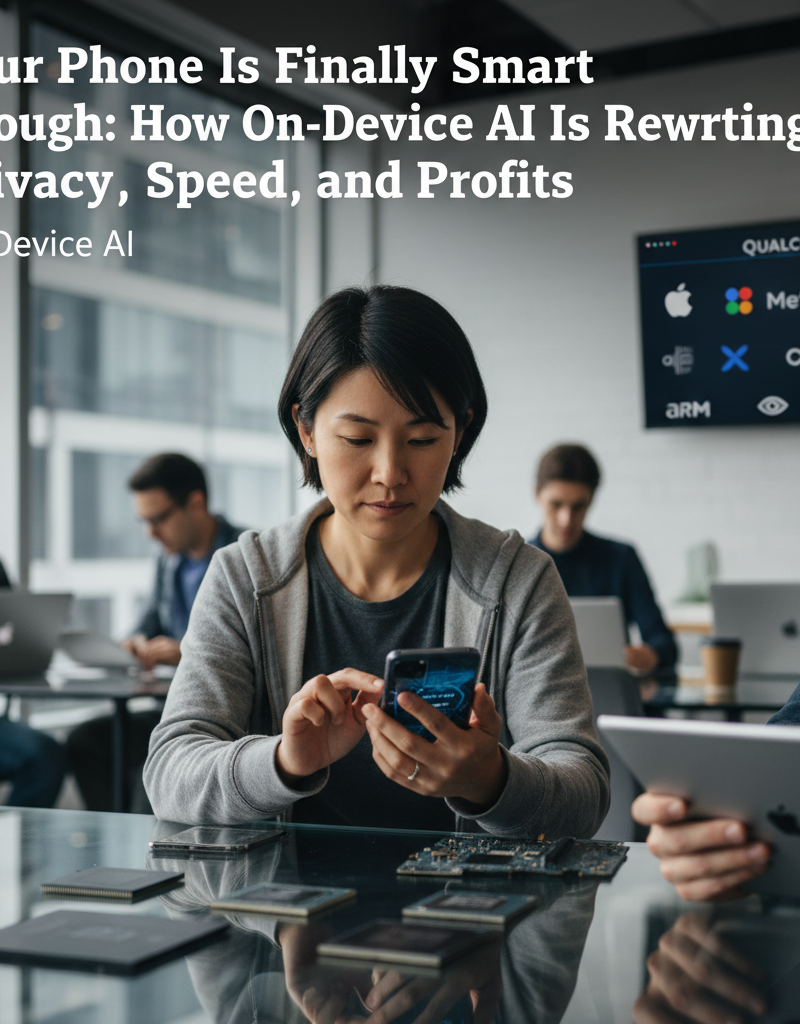
The center of gravity for AI is shifting off the cloud and onto devices. I know that reads like a marketing line, but the tech, the economics and what users want are all nudging the same way. Open models, thinner runtimes and much cheaper inference mean capable LLMs can now live on phones, laptops and edge servers — without needing to phone home every time.
That matters because it unravels three assumptions that dominated the last five years of AI:
- Privacy was a trade-off: you sent sensitive data to a cloud model to get the best results. Local models change that calculus.
- Scale needed datacenters: fine-tuning and inference used to be the hyperscalers’ playground. New toolchains compress models and push inference onto local silicon.
- Monetization leaned on subscriptions and per-token charges: on-device AI opens different paths — one-off purchases, hardware differentiation, and other non-cloud revenue models.
A quick historical aside: moving compute to the edge is not novel. Mobile CPUs and GPUs matured for gaming and on-device imaging. The surprise is how fast those same trends, plus open-source model releases and efficient runtimes, made LLMs viable off-cloud. Think of it as a smartphone moment for generative AI — only the bottlenecks are energy and memory now, not the network.
Examples you can already find in the wild
- Small, open models summarizing long documents, drafting emails or powering search assistants right on a modern laptop.
- Apps that run inference locally and avoid sending personal data to servers — a clear sell for privacy-conscious users and regulated industries.
- Startups shipping bundled local models and curated prompts for niche tasks: contract review, medical note-taking, creative writing helpers.
Why consumers stand to win
- Lower latency. Instant replies without a network round-trip feel different. The UX advantage is real.
- Better privacy. Data stays on-device unless the user chooses otherwise. That matters for health, legal, family stuff.
- Potential cost savings. Fewer API calls can reduce subscription fees or shift how apps and devices are monetized.
Why incumbents will push back — and why some will pivot
- Cloud providers make money from inference. If API calls drop, revenue models need rethinking.
- Chip and hardware makers gain when local compute has value. That gives them an incentive to optimize silicon and toolchains.
- Expect hybrids: most tasks handled locally, with occasional fallbacks to cloud supermodels for the heavy lifting.
Risks and friction
- Model quality versus size. Local models still trail the biggest cloud models on the hardest problems.
- Security and updates. Shipping models on devices raises real questions about patching, provenance and misuse.
- Fragmentation. If every app ships a slightly different model, users get confused and developers pay the cost.
Signals to watch
- OS vendors and handset makers. If a platform ships a polished on-device assistant, mainstream adoption accelerates fast.
- Pricing experiments. Will cloud vendors cut API prices to keep workloads centralized, or will they build orchestration that blurs cloud and edge?
- Chip competition. Look for renewed focus on NPUs, specialized inference cores and libraries that squeeze more ops from silicon.
This is not a straight cloud-versus-device fight. It’s an ecosystem reset where value accrues to whoever makes on-device AI easy, private and genuinely useful. That could be a hardware company, an OS owner, or a nimble startup that packages a great local experience. For users the immediate wins are privacy and speed. For investors, the bets that look promising are on silicon and developer tools for local inference — not necessarily the largest cloud suppliers.
If you want to place bets: watch device makers and chip vendors for commitments to local AI; watch cloud providers for pricing and hybrid product moves; and watch startups for vertical use cases that suddenly make on-device models indispensable.