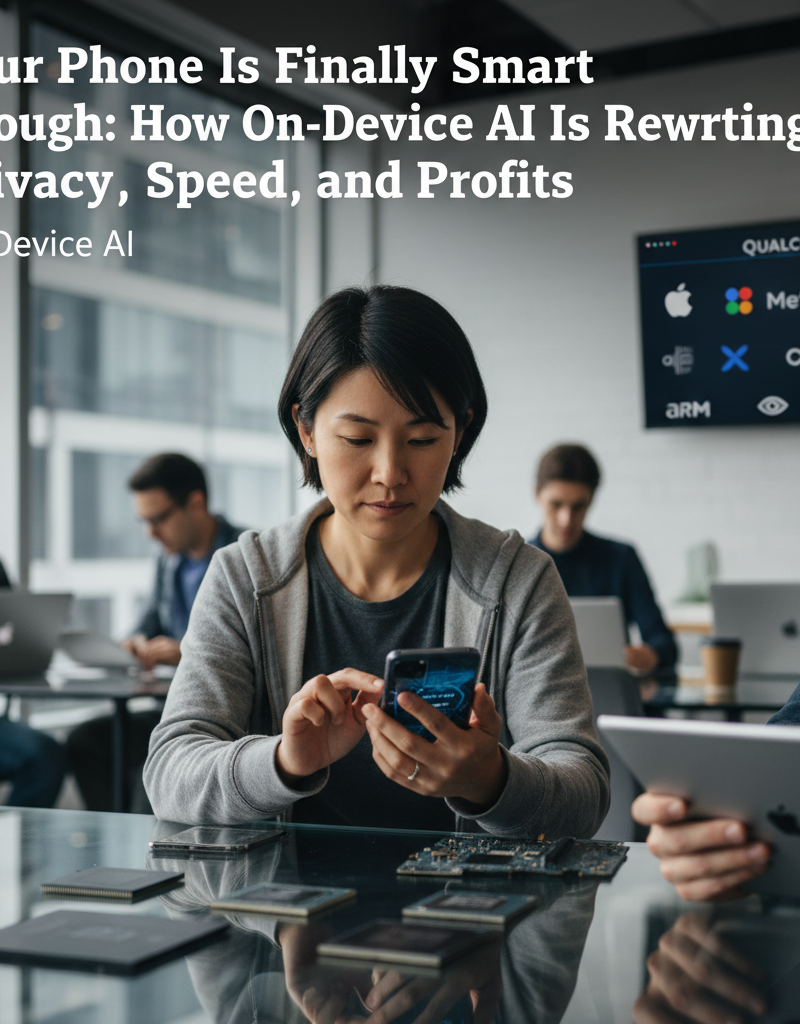
The headline is not merely that AI moved to phones — it's that phones are beginning to run models that actually matter. That small shift opens a fresh front in the fight for user attention, developer economics and investor returns.
For years phones were treated as thin clients: send data up, get answers back. Advances in compression, quantization and on-chip neural engines mean plausible large language models can now run locally. The result is not a simple edge-versus-cloud choice but a hybrid architecture that rearranges incentives in subtle ways.
Why this matters now
- Hardware finally catches up. Modern mobile SoCs and NPUs can execute quantized models that, five years ago, needed racks of GPUs. Latency drops from hundreds of milliseconds to near instant, often removing the need for a network round trip.
- Tooling has matured. Open-source runtimes and quantizers make it cheaper to squeeze useful LLMs onto handsets without destroying coherence.
- Expectations have shifted. People expect speed and better privacy; local inference addresses both, which changes product trade-offs.
Consumer-level effects
- Faster, offline assistants. Composing emails, summarizing long articles or running image-to-text analysis without a network hop feels different than just a marginal speed improvement.
- Better privacy by default. Keeping raw data on the device reduces exposure — valuable in regulated industries and for privacy-minded users. That said, local does not mean perfect: metadata, update mechanisms and telemetry still matter.
- Battery and storage trade-offs. Not every device or price tier will provide the same experience. Running complex models consumes power and space; OEMs will use that to segment offerings.
Who gains and who loses
- Chipmakers with efficient NPUs pick up pricing power. Expect SoC vendors to advertise neural performance as loudly as CPU or GPU specs.
- Platform owners and app stores get another monetization avenue: on-device model marketplaces, in-app model purchases and subscriptions for higher-capability local models.
- Cloud providers do not disappear, but their role shifts toward training, fine-tuning and hosting very large models that phones cannot handle. The steady stream of low-margin inference calls may shrink, while higher-margin training services remain valuable.
Limits and caveats
- Size still matters. Top-tier generative models remain huge. On-device versions are typically compressed or distilled and can diverge on creative or knowledge-updated tasks.
- Update velocity slows. Pushing model updates out to a billion phones raises distribution, privacy and regulatory headaches not present with central models.
- Fingerprinting and leakage persist. Models trained on or fine-tuned with user data can expose sensitive patterns unless engineered carefully.
What investors should watch
- Break the thesis into three bets: silicon (SoCs, NPUs), software (runtimes, quantizers, model marketplaces) and hybrid cloud tooling (training, orchestration, secure updates).
- Expect farther differentiation among smartphone OEMs. Hardware leaders can charge premiums for richer local AI experiences; efficient IP suppliers become strategic partners.
- Near-term winners may include niche vendors solving distribution, secure updates and permissioned on-device fine-tuning.
A short historical lens
This is a rerun of past cycles. When mainframes gave way to client/server, value shifted away from central hosts to devices and the platforms that tied them together. On-device AI repeats that rhythm with different players — chips and models replace servers and middleware — but the economics feel familiar.
Practical takeaways
- Consumers: favor devices that advertise neural performance, not just GHz or camera megapixels. Offline capability matters for smoothness and privacy.
- Product leaders: design for graceful fallbacks — prefer local first, cloud when needed. Plan for smaller, tunable models and a secure update pipeline.
- Investors: monitor SoC margins and the rise of subscription models tied to on-device features.
The move toward on-device AI is incremental but meaningful. It will not erase cloud AI, yet it reshapes where latency-sensitive value is created and who captures it. Think of the orchestra moving from the distant concert hall onto the stage with the soloist — the music is the same, but the economics and audience experience change.
The upshot: on-device AI makes interactions feel more personal — faster, quieter, and privately oriented — and it also creates new battlegrounds for hardware makers, platforms and the supporting software that keeps models honest and current.