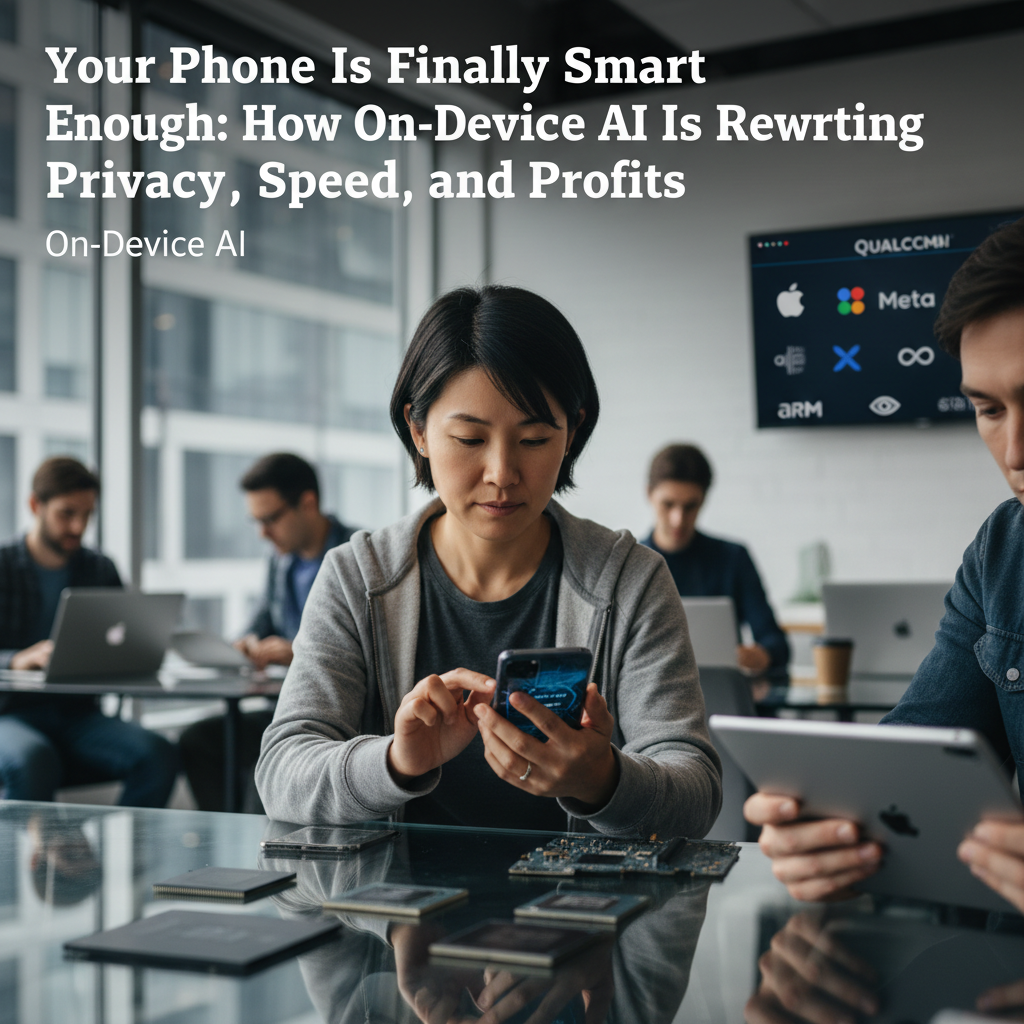
The headline is simple: on-device intelligence is leaving the data center and moving into your pocket.
For years the narrative was straightforward: huge models running on racks of GPUs, phones acting as thin clients. That model is starting to fray. New mobile neural engines, together with compression tricks like quantization and distillation, now make genuinely useful generative models run locally. This feels less like an incremental upgrade and more like a platform reset.
Why this matters now
- Latency and reliability. Local inference cuts round-trip time from hundreds of milliseconds to almost instant responses. And yes — it works offline or on flaky networks.
- Privacy by default. Prompts, documents and audio can be processed without leaving the device. That’s not just a marketing line; it changes the calculus for consumer trust and regulated industries.
- Cost and monetization. Developers can sidestep recurring cloud inference bills. Which is great for margins, but it also undercuts the revenue streams of cloud incumbents.
How it’s happening — the tech, briefly
Smaller, efficient models plus hardware speedups. Teams squeeze models into mobile RAM with 4- to 8-bit quantization and use layer-wise pruning or adapter techniques so the phone only runs what’s needed. At the same time, Apple, Qualcomm and others have pushed on-device matrix throughput and memory bandwidth to make this practical.
Concrete examples
- Offline transcription and on-device summarization that keeps user data local.
- Real-time phone translation and context-aware assistants that don’t ping a server for every turn.
- Toolchains that convert big models into mobile-friendly formats — Core ML, TensorFlow Lite, ONNX — plus runtimes tuned to a handset’s NPU.
Winners and losers
- Winners: chipmakers that ship efficient NPUs and wider memory subsystems; mobile OS vendors that support secure model updates; app makers who can turn cloud-subscription costs into one-time or device-bound features.
- Losers: cloud-inference-as-a-service businesses dependent on lock-in, and companies that monetize by hoarding user data rather than by selling useful functionality.
A caveat — the cloud isn’t going away
Large models will stay in data centers for a while. Training at scale, high-fidelity multimodal synthesis and broad cross-user personalization still demand far more horsepower than a phone can economically provide. Expect a hybrid model: on-device for latency-sensitive, privacy-first tasks; remote servers for heavy lifting.
Regulatory and security angle
Running models on-device reduces some data-exfiltration risks but opens other doors. Model theft, poisoned on-device updates and subtle privacy leaks from embedded models will attract regulators. Security has to cover not just data channels but model distribution and verification too.
A quick history note
This isn’t a throwback to old client-server ideas; it’s an evolution. Compute has swung from mainframes to personal machines to the cloud. Edge intelligence stitches those eras together by placing inference where it’s most effective — close to the user.
What to watch next
- Hardware cadence: which phones ship larger NPUs and smarter memory architectures.
- Model formats: whether standards emerge that ease cross-vendor deployment.
- Business model experiments: pay-once features, privacy premiums, hybrid subscriptions.
Practical takeaway for investors and product teams: on-device intelligence changes the flow of value. Expect intense competition over who controls the runtime and the update channel, and new apps built around privacy, offline capability and micro-latency. This shift won’t erase cloud-hosted models, but it will redraw margins and incentives in mobile ecosystems — and if you think a smarter phone is merely about convenience, you’re missing how it can reshape business models and regulation in one sweep.