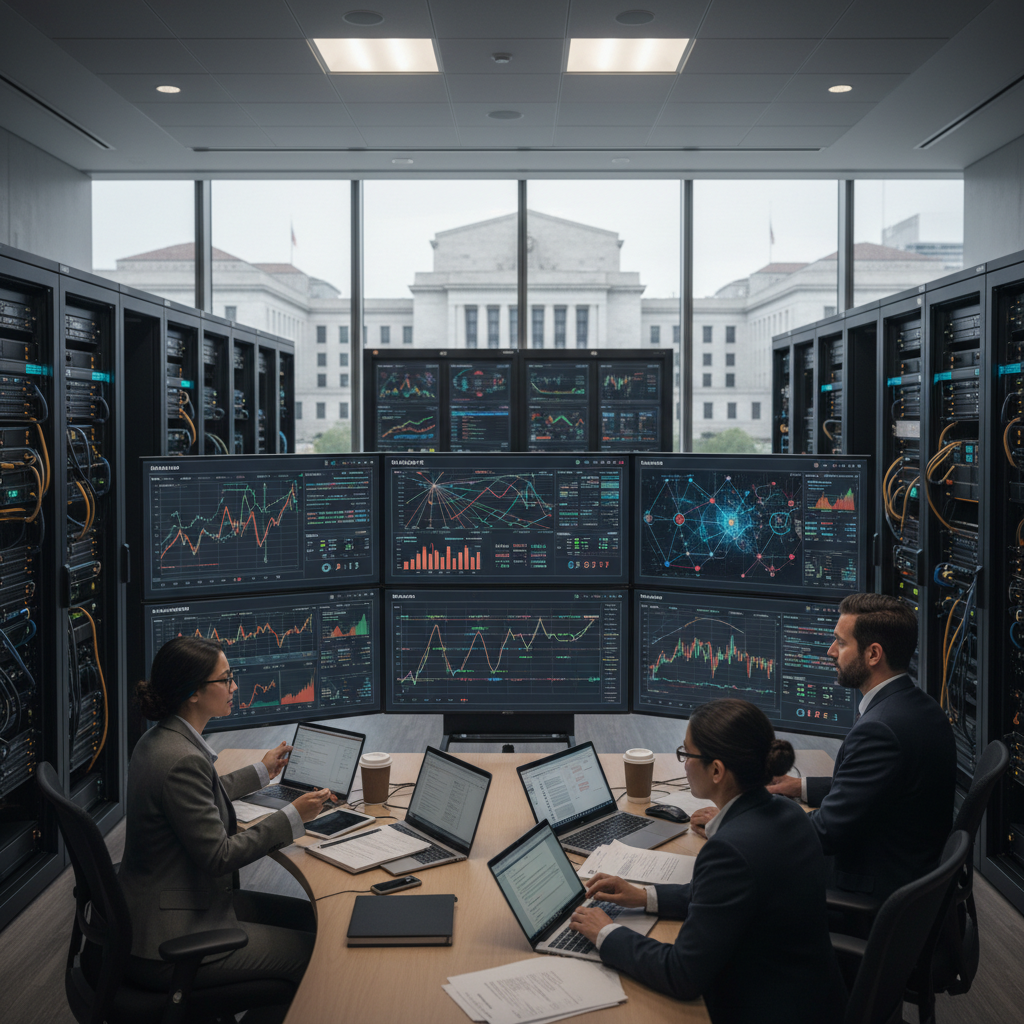
The Federal Reserve is quietly changing how it reads the economy. Part of that change is code-driven. Over the past 18 months, small but meaningful shifts in practice suggest the Fed has widened its data toolkit and started to trust machine learning models to flag inflation and labor trends faster than older statistical methods.
This is not science fiction. Central banks have toyed with high-frequency indicators for years. What’s different now is the specific mix: alternative data, real-time price signals and natural language processing of company filings and job postings are being stitched into nowcasts that land straight in FOMC briefing materials.
Why this matters
- Timing matters more than raw magnitude. These models nudge the Fed on when to act rather than how big a move should be. Spotting disinflation or slack sooner shortens the lag between signal and response.
- Markets react faster. Traders who read the same signals will trade in front of official prints, which can amplify volatility around inflation releases and FOMC minutes.
- Model risk is real — and messy. Many ML approaches are opaque compared with a Taylor rule or a linear Phillips-curve. That opacity raises governance and accountability questions for an institution that sets the price of money.
A bit of historical perspective
It feels like the late 1970s meeting the 2020s. Back then, policymakers struggled with volatile inflation and scarce, noisy data. Today they face abundance and models that can err in new, hard-to-diagnose ways. Modern tools may reduce lag, but they introduce black-box failure modes — a trade-off the Fed has only recently begun to acknowledge publicly.
Concrete implications for markets
- Bonds. If ML-driven nowcasts signal disinflation sooner, long yields could fall quickly, compressing term premia. That would squeeze long-duration tech names unless earnings growth compensates.
- Equities. Cyclicals that benefit from rate relief would likely rally in the short term. But stocks priced for perpetually low rates risk abrupt repricing when machine signals flip.
- Policy instruments. As nowcasts speed up, the case for blunt instruments like prolonged forward guidance weakens. Expect a tilt toward more finely tuned open-market operations.
Small, illustrative examples
- A nowcast that spots a sudden drop in freight costs and weakening regional wage growth might push an ML ensemble to flag early disinflation, and staff briefings could shift toward an earlier cut timetable.
- NLP that detects a spike in hiring-freeze language in SEC filings or job ads can reveal labor slack before headline payrolls show it.
Risks and counterpoints
- Feedback loops. If many market participants use similar signals, apparent patterns can become self-fulfilling.
- Data ownership and privacy. Relying on private data sources raises fairness and transparency questions. Who controls the inputs that influence interest-rate decisions?
- Political risk. The Fed’s credibility is fragile. A policy mistake traced to a mis-specified algorithm would be politically damaging.
Signals to watch next
- Publications from the Fed’s research teams and any concrete steps on model governance. Small transparency moves will tell you a lot about how seriously they’re treating the problem.
- Actions from Treasury and Congress about data access and oversight. Lawmakers are increasingly interested in algorithmic accountability in finance.
- Market reactions to nontraditional data releases: freight indices, online price trackers and job-ad datasets — these are the streams that could move nowcasts before official statistics do.
Net effect
Adopting machine learning for nowcasting is a structural shift, not an immediate shock. Expect faster policy reactions, tighter windows for market positioning and a new political debate over algorithmic accountability in monetary policy. Treat the transition as a regime change: modest repositioning now, with contingency plans for sharper moves when models contradict conventional intuition.
Three practical moves
- Revisit duration exposure with the possibility of quicker rate re-pricing in mind.
- Start watching the alternative data feeds that could nudge central-bank nowcasts.
- Monitor Fed transparency and governance steps; even incremental upgrades will be information-rich.
Pedro Marini