Market context
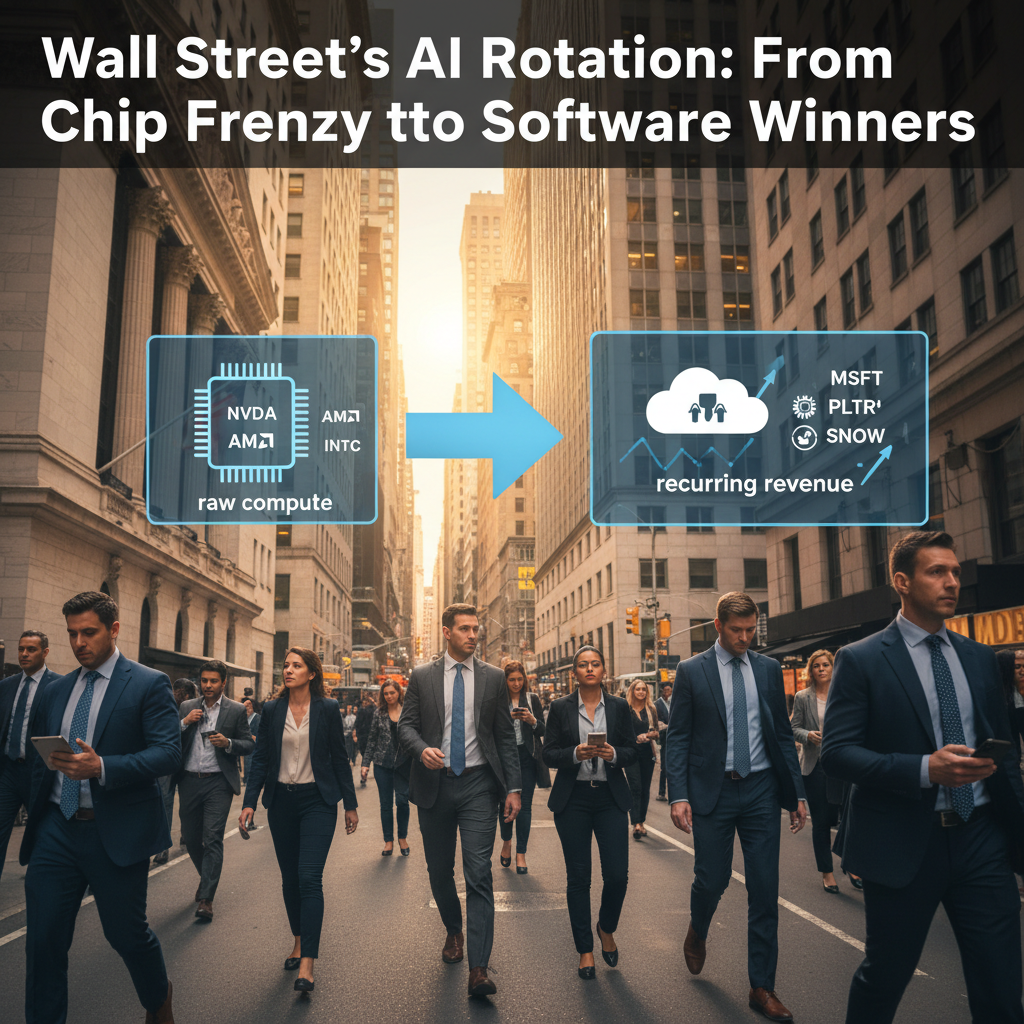
The simple story that’s dominated recent years — GPUs power AI, and Nvidia sits near the center of that — still holds at a high level. But under the surface a quieter rotation is happening. After a hardware-led sprint, investors are starting to prize software and cloud firms for what they offer: higher margins, recurring revenue, and customer stickiness. That changes the risk-return mix in an important way.
Why the rotation makes sense now
- Margins and predictability. Software and cloud companies tend to turn AI interest into subscriptions and services revenue — steadier cash flows than a speculative hardware boom.
- Competition and commoditization. GPUs are becoming crowded and custom silicon is spreading; hardware margins look more exposed. Software scales without the same capex drag.
- Policy and supply noise. Export rules, geopolitical supply chains and lumpy capex cycles make hardware a noisier bet. Software spreads that operational risk across customers and regions.
What’s interesting is how these forces interact. Software isn’t immune to churn or competition; hardware won’t disappear. Still, the relative appeal has shifted.
Names to watch (and why)
- Microsoft (MSFT): A big cloud AI play with deep platform hooks. Enterprises are more likely to adopt AI through hosted services than by standing up their own racks — and Microsoft sits squarely in that path.
- Nvidia (NVDA): Still central to compute demand. But investors need to account for more competition, cyclical capacity, and valuations that already bake in very high growth.
- Palantir (PLTR) and C3.ai (AI): Two different software-first tests. High-margin potential is real, but execution and sales motion will determine whether AI dollars become durable revenue.
- Snowflake (SNOW): Data and models are symbiotic. Firms that control clean, shareable datasets and smooth model deployment can capture disproportionate value.
None of these are slam-dunks. Each has its own execution gap and timing risk.
A counterpoint worth holding
Chips are not going away. Compute demand is compounding; data centers will still need hardware. If you expect multi-year growth in model sizes and compute intensity, owning select hardware names makes sense. The point is not an either-or switch but a rebalancing of weights aligned with timing and risk tolerance.
Tactical signals for investors
- Listen to enterprise AI spend in earnings calls and guidance, not just marketing headlines.
- Watch cloud gross margins and contract lengths; multi-year deals are a stronger signal than pilots.
- Track server bookings and capex commentary for whether hardware demand is genuinely growing or merely lumpy.
- Favor companies that convert pilots into recurring contracts — that’s where economics start to show up.
Takeaway
We’re moving past single-name mania into a more nuanced phase. Think of it a bit like the late 1990s: hardware opened the door, but long-term profits tended to land with the software firms that learned to charge for real usefulness rather than raw horsepower. That does not mean dumping chips — it means calibrating exposure and focusing on durable economic moats.