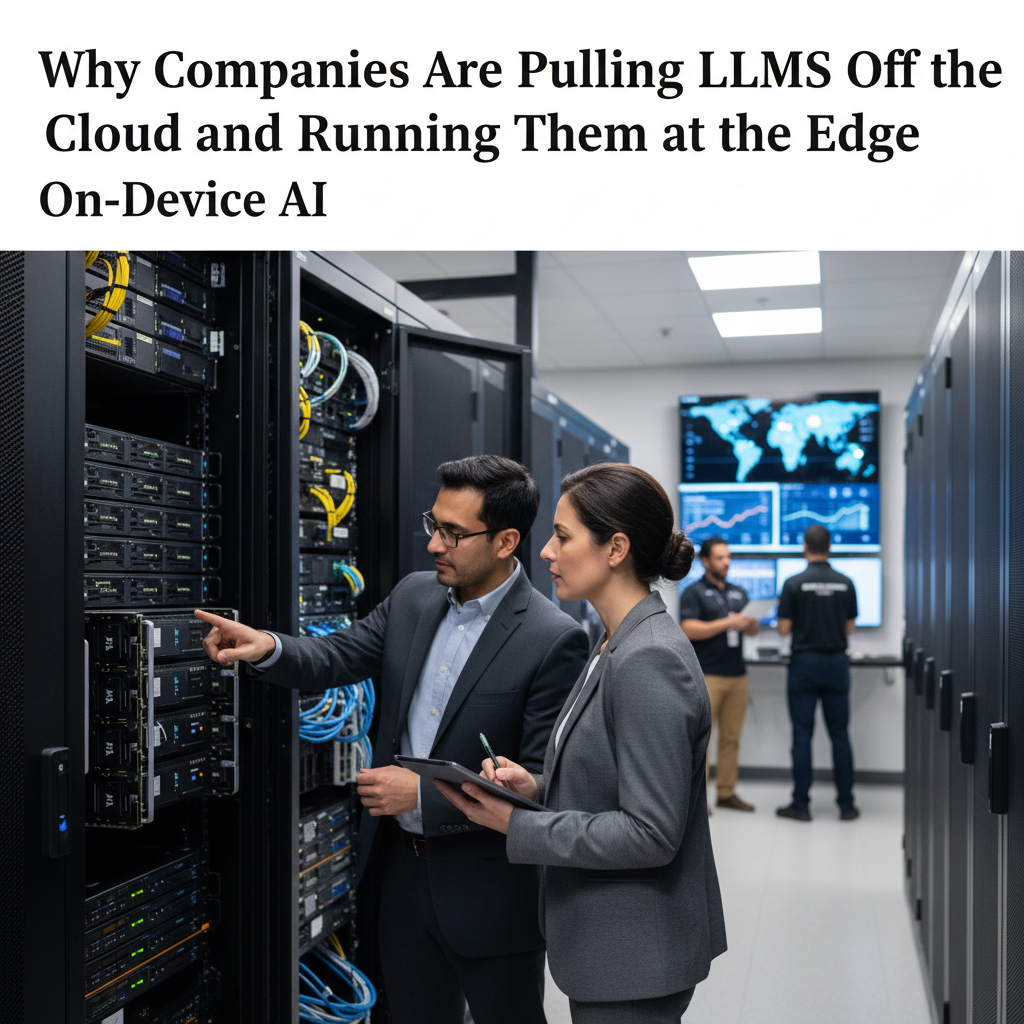
The migration whisper no one named three years ago is suddenly loud. Companies that once shoved every new model into public clouds are increasingly pushing inference back onto on-prem servers and edge devices. This is not nostalgia for old IT. It’s a pragmatic reaction to cost pressure, regulation and real performance needs.
Why now
- Cloud GPU bills changed the math. Teams that spun up pilots on rented H100s and other datacenter GPUs were hit with invoices that outpaced the business value. Running models at scale turned OpEx into a nasty surprise.
- Latency still matters. Customer-facing systems — contact centers, fraud scoring, in-store recommendations — need replies in tens of milliseconds. A hop to a faraway cloud adds jitter and risk.
- Data control is a hard constraint in finance, healthcare and other regulated sectors. Keeping inference on-prem reduces data egress headaches and makes audits simpler.
- The tooling finally caught up. Quantization, distillation and optimized runtimes now let modest servers run useful LLM variants without the old compute bill.
What’s interesting here is how these forces stack. Any one could be managed; together they push a real architectural rethink.
How it looks on the ground
Banks and payments firms are scoring fraud locally so transaction data never has to leave. Retailers put personalization models on in-store edge servers to keep recommendations instant and private. A small set of hospitals are trialing clinical-note summarizers behind their own firewalls so sensitive records stay internal.
Winners and losers
- Nvidia stays central. The architecture it popularized still dominates high-performance inference. But demand is shifting toward inference-optimized GPUs and lower-power accelerators, not only the top-end training cards.
- Cloud providers won’t lose AI business overnight. Training, large-scale experimentation, and aggregated SaaS inference still belong in the cloud. That said, steady inference revenue from vanilla cloud GPUs may slow as firms adopt hybrid patterns.
- Chipmakers and startups focused on inference accelerators and deployment tooling stand to gain. Companies that make quantization and rollout painless become unexpectedly strategic partners.
The trade-offs
On-prem is not a universal win. It takes capital, lifecycle ownership, and security maturity. Staffing, patching, capacity planning — those are real costs. For many organizations, the convenience and elasticity of cloud remain superior. More often than not the answer ends up hybrid: cloud for training and heavy lifting, local inference where latency, cost or compliance demand it.
A bit of history
This feels like the inverse of the 2010s cloud migration. Back then firms happily shed datacenters for agility. Now they’re reclaiming pieces of infrastructure for control and predictable costs. Imagine the tide pulling back and exposing the weak spots in the foundations.
What CIOs and investors should watch
- Measure end-to-end unit economics. Compare true monthly cloud inference costs to amortized on-prem hardware plus staffing and ops.
- Pilot quantized or distilled models to see whether the accuracy trade-offs are acceptable for your use cases.
- Watch deals between system integrators and inference-optimization startups; those partnerships usually reveal where enterprise adoption is actually happening.
The real story isn’t cloud versus on-prem. It’s orchestration. Winners will build a hybrid fabric: training and experimentation in the cloud, efficient local inference where latency, cost or regulation demand it. That split reshuffles advantage and creates a new tier of winners among chip vendors, tools providers and managed services that can smooth what is, frankly, a messy transition.