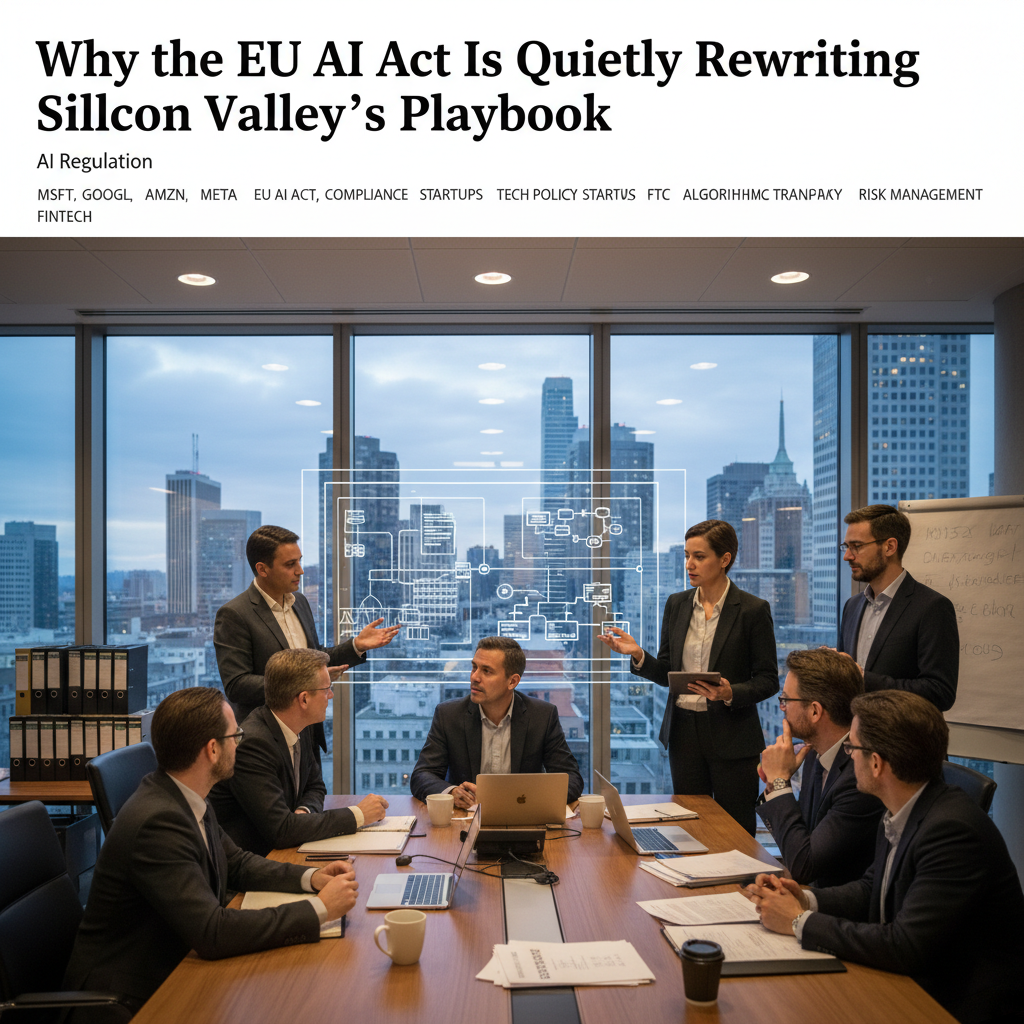
The EU’s regulation is not just a European story anymore. What began as a regional attempt to rein in high-risk systems is now a global playbook. It forces U.S. companies to rethink product design, data strategy and even investor assumptions.
For many American founders this will feel familiar: rules show up after the product is built. The EU AI Act is different. It lands much earlier — classifying systems, demanding documentation, and imposing risk controls before a feature ever ships.
Why it matters to the U.S. market
- Big cloud and platform providers are already carrying the paperwork load, but startups feel the pinch disproportionately. Small teams still face the same legal and engineering bills, with far less runway.
- Investors must treat compliance as a real line item when modeling burn. Expect diligence to probe model inventories, audit trails and governance plans.
- For users, incentives change: companies that can actually show documented, auditable systems will earn trust — and customers — more easily.
A few concrete ripples I’m watching
- Product redesigns. Some firms are re-architecting so that riskier decisions happen server-side, or they simply remove certain features for EU users. That produces operational complexity and product fragmentation.
- Re-export effects. Controls built to satisfy the EU often get applied globally for simplicity. That shifts user experience and privacy postures around the world.
- Competitive consolidation. Compliance becomes a barrier to entry, effectively a moat for incumbents that can absorb the cost, nudging niche AI verticals toward consolidation.
Not all doom and gloom — opportunity exists
- Compliance tooling and assurance look like a small but fast-growing market. Expect more startups selling model registries, logging-as-a-service and automated risk assessments.
- Companies that treat regulatory alignment as genuine product quality can use it as a trust signal. This is not cheap PR — banks, healthcare systems and many enterprise buyers explicitly require it.
Two counterpoints worth pausing on
- Yes, the rules could chill experimentation in some areas. But they may also push innovation into safer, reusable building blocks. In past regulated waves this pattern repeated: heavy rules create an ecosystem of niche specialists.
- Big vendors might get a short-term advantage. Over time, though, the burden of global paperwork could encourage more modular, interoperable solutions — a shift that helps smaller, nimble players who pivot quickly.
A short compliance checklist for U.S. teams
- Map: inventory models, datasets and decision flows. If you cannot explain how a model affects people, you cannot properly govern it.
- Classify: identify systems that could be deemed high-risk and prioritize mitigation.
- Document: automate model cards, versioning and provenance logs.
- Governance: assign a responsible owner and add review gates to your deployment pipeline.
- Market strategy: decide whether to geo-fence features, offer a compliant tier, or harmonize experiences worldwide.
What investors should watch
- Due diligence will move beyond pure technical checks to operational resilience. Look at model registries, incident history and legal opinions.
- Valuations need to reflect time and cost to compliance, especially for startups targeting regulated sectors.
The EU approach does two unexpected things: it turns trust into a commercial asset, and it speeds up the industrialization of compliance tools. The early winners won’t necessarily be the biggest names but those who treat regulation as a product constraint to design around, not as a tax to grumble about.
I’m wary of easy narratives that say regulation only helps incumbents. In telecoms, payments and cloud, rules initially favored large players but eventually spawned whole ecosystems of middleware and specialists. Expect a similar arc here.
My recommendation: treat the EU AI Act as more than a distant legal curiosity. See it as a firm deadline for cleaner engineering and stronger governance. Build for auditability now — it improves product quality and buys optionality later.
Pedro Marini