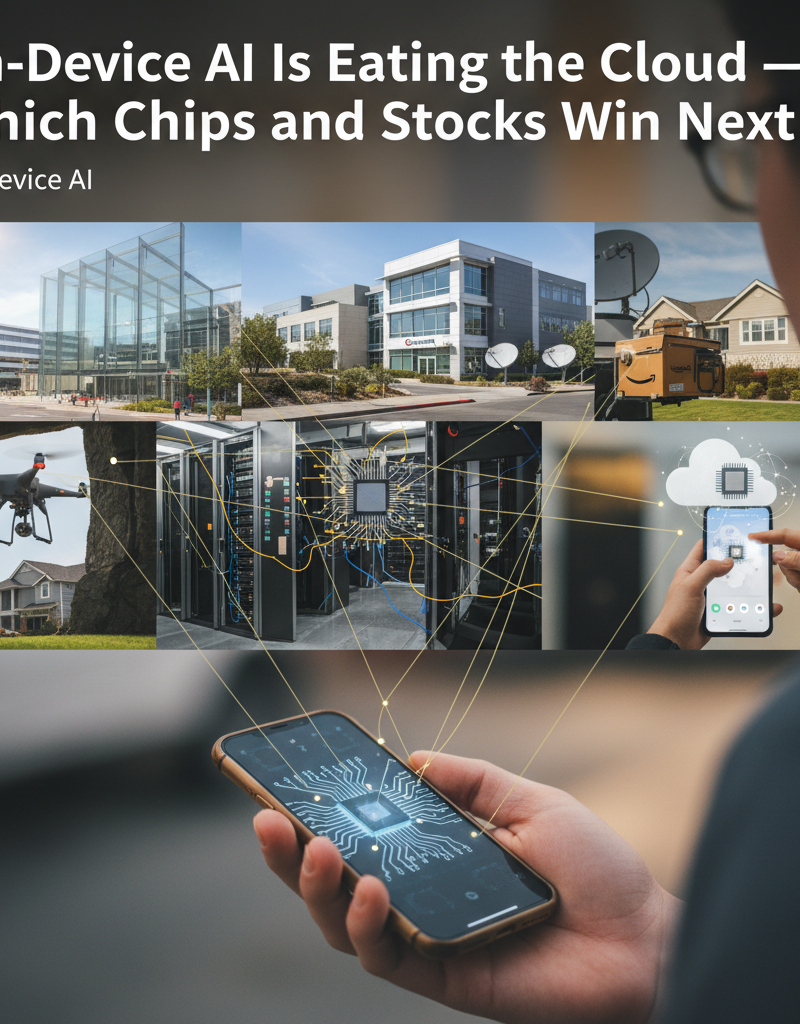
The headline is simple: models are migrating out of data centers and into our phones. If you only follow server-side hype it looks like a small shift. In practice it changes privacy, product design and who wins in the market — and not in subtle ways.
Think back to when smartphone photography stopped being just about lenses and became about chips. Image signal processors quietly turned so-so optics into shots people actually shared. On-device AI did most of the heavy lifting. On-device large language models feel like the same inflection point — not because they instantly match cloud supercomputers, but because they change how features are built, sold and trusted.
How this actually happens
- Model compression and quantization squeeze multi‑billion-parameter behavior into far fewer bits. You lose some nuance, yes, but you gain much lower latency and stronger privacy guarantees.
- Mobile neural accelerators — Apple’s Neural Engine, Google’s Tensor moves and Qualcomm’s AI cores — are now tuned for these smaller, dense models.
- Open weights and permissive licenses for some models make realistic local deployments possible for production apps, not just demos.
Real-world examples you probably already use, soon offline
- Note summarizers and meeting recaps that never leave the device, so sensitive conversations stay local.
- Photo captioning and on-device search that respect privacy and respond instantly.
- Enterprise apps that ship a vetted model inside a secure container to avoid cloud compliance headaches.
Why companies care — and why investors should pay attention
Running intelligence on-device cuts recurring cloud bills, slashes round-trip latency and enables features you simply can’t offer as cloud-only because of regulation or customer expectations. That’s why chipmakers and handset vendors are racing: faster matrix math on silicon translates into new margin opportunities for OEMs and software vendors who can bundle smarts into the OS.
Still, this isn’t a flip-the-switch moment. A few important frictions:
- Performance ceiling: local models will trail the biggest cloud LLMs on complex reasoning and on having the very latest facts.
- Freshness and updates: shipping static models to devices creates staleness. Expect hybrid patterns — periodic model updates or networked retrieval for current knowledge.
- Power and thermal limits: running inference chews battery and generates heat. Optimizations matter, a lot.
Policy, licensing and weird competitive dynamics
App-store rules, enterprise security policies and model licenses will shape winners more than pure engineering in many cases. Open-source models unlocked experimentation, but commercial deployments need clear licensing, traceability and auditability. Don’t be surprised if app stores tighten rules around child safety, health claims and data handling for locally running generative models.
A quick look at the market map
- Chip designers win if they can do more matrix ops per watt. Qualcomm and Apple are fighting that battleground.
- Cloud incumbents still own the high-end inference stack and enterprise deals, so expect a lot of hybrid cloud–edge offerings.
- Startups that nail quantization, pruning and runtime compilers will be attractive acquisition targets.
What users should watch for
- Offline assistants that actually respect privacy, not just the marketing line.
- Apps that feel snappier because they avoid constant round trips to servers.
- New subscription mixes: paying for local intelligence as a distinct value, not just cloud compute.
This won’t be a zero-sum move away from cloud. Think of it as an ecosystem reshuffle. The next decade will be messy and creative: vendors and developers will experiment with hybrids, and the device in your pocket will increasingly be where personal intelligence lives, not just a dumb terminal to the cloud.
Pedro Marini